


Estrogens and progestins enhance spatial learning of intact and ovariectomized rats in the object placement task
- PMID: 17507257
- PMCID: PMC2077328
- DOI: 10.1016/j.nlm.2007.04.003
Estrogens and progestins enhance spatial learning of intact and ovariectomized rats in the object placement task
Abstract
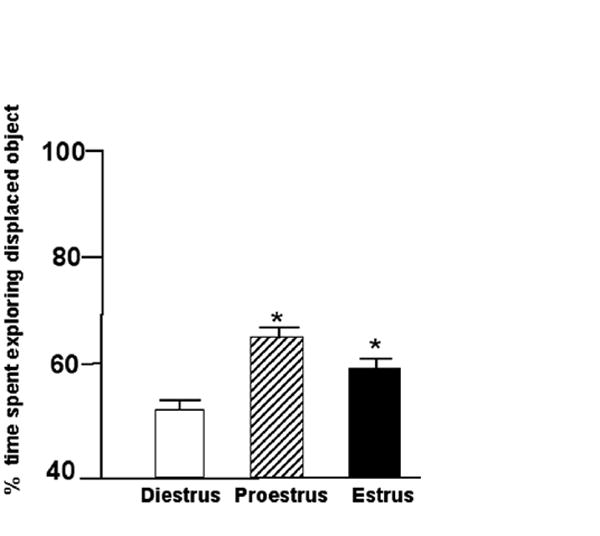
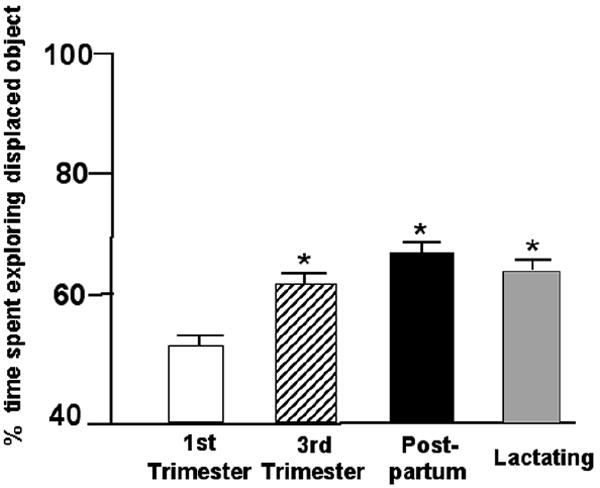
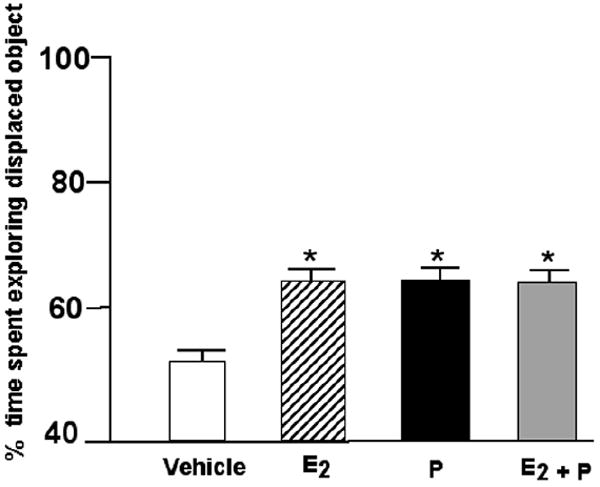
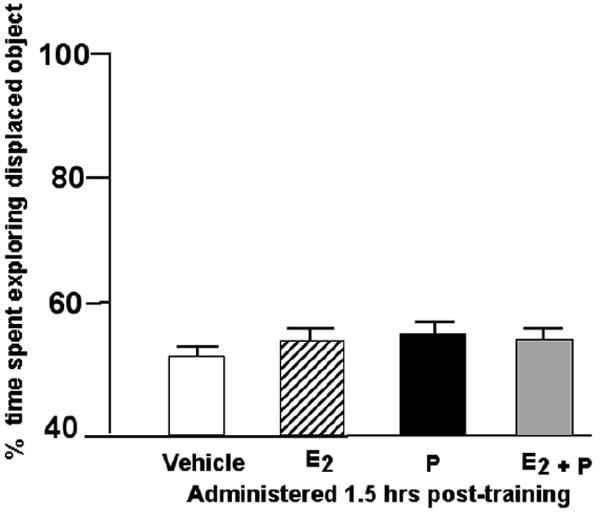
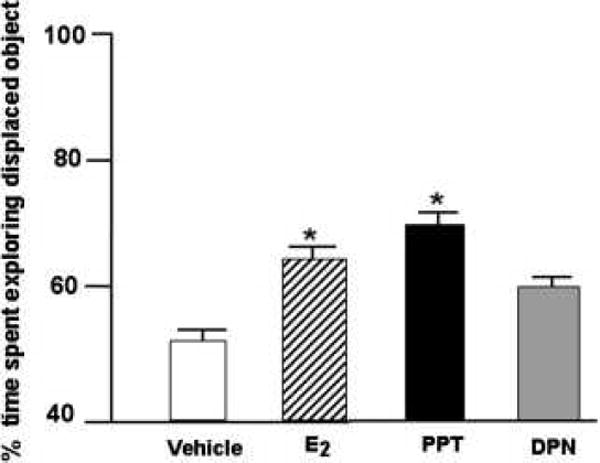
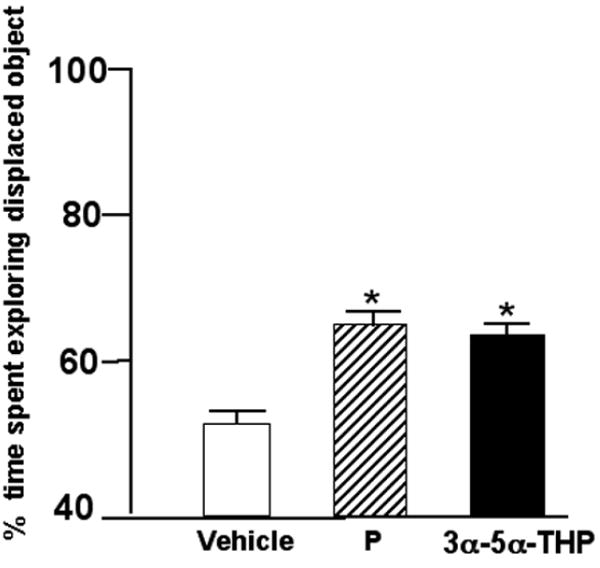
Steroid modulation of cognitive function has focused on estrogen (E(2)), but progestins naturally co-vary with E(2) and may also influence cognitive performance. Spatial performance in the object placement task over endogenous hormonal states in which E(2) and progestins vary, and when E(2) and/or progestins were administered, was examined. Experiment 1: Rats in proestrus or estrus had significantly better performance in the object placement task than did diestrus rats. Experiment 2: Rats in the third trimester, post-partum, or lactation exhibited significantly better performance in the object placement task than did rats in the first trimester. Experiment 3: Ovariectomized (ovx) rats administered 17beta-estradiol (0.9 mg/kg), subcutaneously (sc), progesterone (P; 4 mg/kg, sc), or E(2) and P, immediately after training in the object placement task, performed significantly better when tested 4h later, than did control rats administered vehicle (sesame oil 0.2 cc). Experiment 4: ovx rats administered E(2) or P with a 1.5h delay after training in the object placement task, did not perform differently than vehicle-administered controls. Experiment 5: ovx rats administered post-training E(2), which has a high affinity for both E(2) receptor (ER)alpha and beta isoforms, or propyl pyrazole triol (PPT; 0.9 mg/kg, sc), which is more selective for ERalpha than ERbeta, had significantly better performance in the object placement task than did rats administered vehicle or diarylpropionitrile (DPN; 0.9 mg/kg, sc), an ERbeta selective ligand. Experiment 6: ovx rats administered P, or its metabolite, 5alpha-pregnan-3alpha-ol-20-one (3alpha,5alpha-THP; 4 mg/kg, sc), immediately post-training performed significantly better in the object placement task than did vehicle control rats. Thus, performance in the object placement task is better when E(2) and/or P are naturally elevated or when E(2), the ERalpha selective ER modulator PPT, P, or its metabolite, 3alpha,5alpha-THP, are administered post-training.
Figures
References
-
- Aggleton JP, Hunt PR, Rawlins JN. The effects of hippocampal lesions upon spatial and non-spatial tests of working memory. Behavioural Brain Research. 1986;19:133–46. - PubMed
-
- Bimonte HA, Denenberg VH. Estradiol facilitates performance as working memory load increases. Psychoneuroendocrinology. 1999;24:161–73. - PubMed
-
- Bitran D, Dugan M, Renda P, Ellis R, Foley M. Anxiolytic effects of the neuroactive steroid pregnanolone (3α-OH-5β-pregnan-20-one) after microinjection in the dorsal hippocampus and lateral septum. Brain Research. 1999;850:217–24. - PubMed
-
- Bitran D, Hilvers RJ, Kellogg CK. Anxiolytic effects of 3α-hydroxy-5α-pregnan-20-one-endogenous metabolites of progesterone that are active at the GABAA receptor. Brain Research. 1991;561:157–161. - PubMed
Publication types
MeSH terms
Substances
Grants and funding
LinkOut - more resources
Full Text Sources
Medical
