


Targeting MEK induces myeloma-cell cytotoxicity and inhibits osteoclastogenesis
- PMID: 17510321
- PMCID: PMC1975848
- DOI: 10.1182/blood-2007-03-081240
Targeting MEK induces myeloma-cell cytotoxicity and inhibits osteoclastogenesis
Retraction in
-
Tai Y-T, Fulciniti M, Hideshima T, Song W, Leiba M, Li X-F, Rumizen M, Burger P, Morrison A, Podar K, Chauhan D, Tassone P, Richardson P, Munshi NC, Ghobrial IM, Anderson KC. Targeting MEK induces myeloma-cell cytotoxicity and inhibits osteoclastogenesis. Blood. 2007;110(5):1656-1663.Blood. 2024 Oct 10;144(15):1648. doi: 10.1182/blood.2024026818. Blood. 2024. PMID: 39231434 Free PMC article.
Abstract
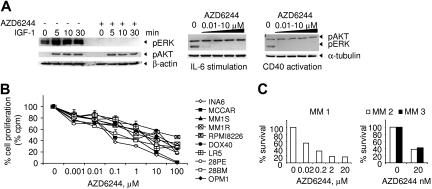
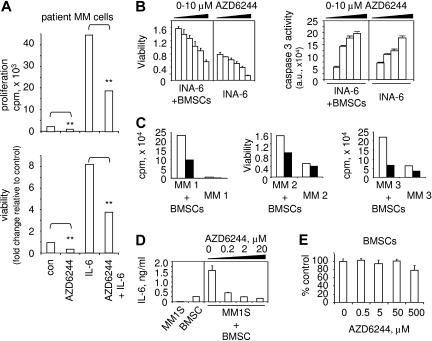
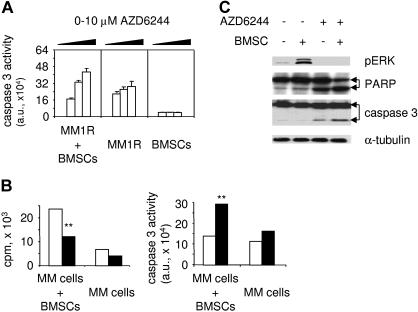
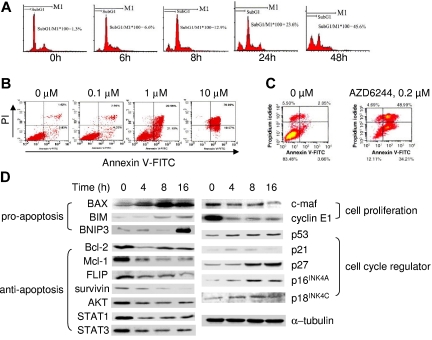
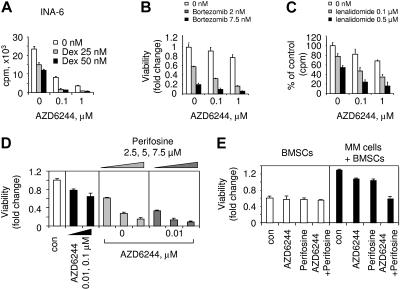
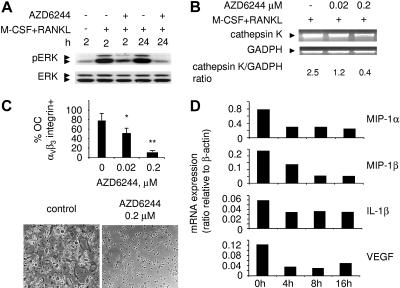
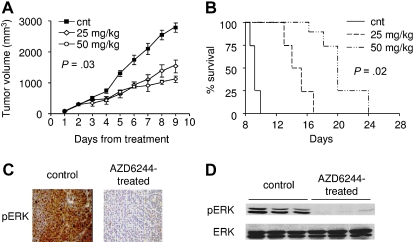
Activation of the extracellular signal-regulated kinase1/2 (ERK1/2) signaling cascade mediates human multiple myeloma (MM) growth and survival triggered by cytokines and adhesion to bone marrow stromal cells (BMSCs). Here, we examined the effect of AZD6244 (ARRY-142886), a novel and specific MEK1/2 inhibitor, on human MM cell growth in the bone marrow (BM) milieu. AZD6244 blocks constitutive and cytokine-stimulated ERK1/2 phosphorylation and inhibits proliferation and survival of human MM cell lines and patient MM cells, regardless of sensitivity to conventional chemotherapy. Importantly, AZD6244 (200 nM) induces apoptosis in patient MM cells, even in the presence of exogenous interleukin-6 or BMSCs associated with triggering of caspase 3 activity. AZD6244 sensitizes MM cells to both conventional (dexamethasone) and novel (perifosine, lenalidomide, and bortezomib) therapies. AZD6244 down-regulates the expression/secretion of osteoclast (OC)-activating factors from MM cells and inhibits in vitro differentiation of MM patient PBMCs to OCs induced by ligand for receptor activator of NF-kappaB (RANKL) and macrophage-colony stimulating factor (M-CSF). Finally, AZD6244 inhibits tumor growth and prolongs survival in vivo in a human plasmacytoma xenograft model. Taken together, these results show that AZD6244 targets both MM cells and OCs in the BM microenvironment, providing the preclinical framework for clinical trials to improve patient outcome in MM.
Figures
References
-
- Hideshima T, Bergsagel PL, Kuehl WM, Anderson KC. Advances in biology of multiple myeloma: clinical applications. Blood. 2004;104:607–618. - PubMed
-
- van de Donk NW, Kroger N, Hegenbart U, et al. Remarkable activity of novel agents bortezomib and thalidomide in patients not responding to donor lymphocyte infusions following nonmyeloablative allogeneic stem cell transplantation in multiple myeloma. Blood. 2006;107:3415–3416. - PubMed
-
- Barlogie B, Kyle RA, Anderson KC, et al. Standard chemotherapy compared with high-dose chemoradiotherapy for multiple myeloma: final results of phase III US Intergroup Trial S9321. J Clin Oncol. 2006;24:929–936. - PubMed
-
- Richardson P, Anderson K. Thalidomide and dexamethasone: a new standard of care for initial therapy in multiple myeloma. J Clin Oncol. 2006;24:334–336. - PubMed
Publication types
MeSH terms
Substances
Grants and funding
LinkOut - more resources
Full Text Sources
Other Literature Sources
Medical
Research Materials
Miscellaneous
