


Outcome of influenza vaccination in combat-related post-traumatic stress disorder (PTSD) patients
- PMID: 17511777
- PMCID: PMC1941948
- DOI: 10.1111/j.1365-2249.2007.03410.x
Outcome of influenza vaccination in combat-related post-traumatic stress disorder (PTSD) patients
Abstract
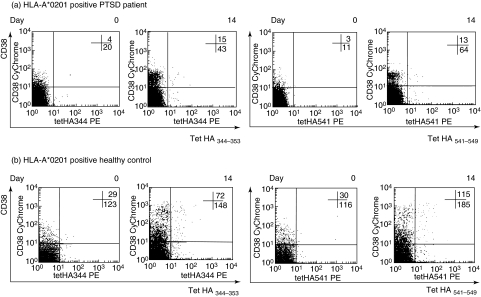
Post-traumatic stress disorder (PTSD) is an anxiety disorder that can occur after exposure to extreme traumatic experience such as war trauma, and is accompanied by fear, helplessness or horror. Exposure to trauma can result in immune dysregulation and influence susceptibility to infectious disease as well as vaccine efficacy. The aim of the study was to determine the relation of psychological stress and the immune response to influenza vaccination in combat-related PTSD patients (n = 28). Detection of anti-viral antibody titre was performed by inhibition of haemagglutination assay. Ex vivo tetramer staining of CD8(+) T lymphocytes was used to monitor T cells specific for human leucocyte antigen (HLA)-A*0201-restricted influenza A haemagglutinin antigens before and after vaccination. Twenty patients showed a fourfold antibody titre increase to one or both influenza A viral strains, and 18 of them showed the same response for both influenza B viral strains. Ten of 15 healthy controls showed a fourfold rise in antibody titre to both influenza A viral strains and eight of them showed the same response for both influenza B viral strains. HLA-A*0201(+) PTSD patients (n = 10) showed a significant increase of influenza-specific CD8 T cells after vaccination. Although those PTSD patients had a lower number of influenza-specific CD8(+) T cells before vaccination compared to HLA-A*0201(+) healthy controls (n = 6), there was no difference in influenza A antibody titre between PTSD patients and control subjects before vaccination. The generated humoral and cellular immune response in PTSD patients argues against the hypothesis that combat-related PTSD in war veterans might affect protection following influenza vaccination.
Figures

References
-
- Cohen S, Frank E, Doyle WJ, Skoner DP, Rabin BS, Gwaltney JM., Jr Types of stressors that increase susceptibility to the common cold in healthy adults. Health Psychol. 1998;17:214–23. - PubMed
-
- Cohen S, Tyrrell DA, Smith AP. Psychological stress and susceptibility to the common cold. N Engl J Med. 1991;325:606–12. - PubMed
-
- Vedhara K, Cox NK, Wilcock GK, et al. Chronic stress in elderly carers of dementia patients and antibody response to influenza vaccination. Lancet. 1999;353:627–31. - PubMed
-
- Burns VE, Carroll D, Drayson M, Whitham M, Ring C. Life events, perceived stress and antibody response to influenza vaccination in young, healthy adults. J Psychosom Res. 2003;55:569–72. - PubMed
Publication types
MeSH terms
Substances
LinkOut - more resources
Full Text Sources
Medical
Research Materials
