. 2007 Aug 15;313(14):3005-15.
doi: 10.1016/j.yexcr.2007.04.021. Epub 2007 Apr 24.

Cellular responses to disruption of the permeability barrier in a three-dimensional organotypic epidermal model

Affiliations

Cellular responses to disruption of the permeability barrier in a three-dimensional organotypic epidermal model

Gati Ajani et al. Exp Cell Res. .

Abstract

Repeated injury to the stratum corneum of mammalian skin (caused by friction, soaps, or organic solvents) elicits hyperkeratosis and epidermal thickening. Functionally, these changes serve to restore the cutaneous barrier and protect the organism. To better understand the molecular and cellular basis of this response, we have engineered an in vitro model of acetone-induced injury using organotypic epidermal cultures. Rat epidermal keratinocytes (REKs), grown on a collagen raft in the absence of any feeder fibroblasts, developed all the hallmarks of a true epidermis including a well-formed cornified layer. To induce barrier injury, REK cultures were treated with intermittent 30-s exposures to acetone then were fixed and paraffin-sectioned. After two exposures, increased proliferation (Ki67 and BrdU staining) was observed in basal and suprabasal layers. After three exposures, proliferation became confined to localized buds in the basal layer and increased terminal differentiation was observed (compact hyperkeratosis of the stratum corneum, elevated levels of K10 and filaggrin, and heightened transglutaminase activity). Thus, barrier disruption causes epidermal hyperplasia and/or enhances differentiation, depending upon the extent and duration of injury. Given that no fibroblasts are present in the model, the ability to mount a hyperplastic response to barrier injury is an inherent property of keratinocytes.


Figures

Figure 1
Figure 1. A three dimensional organotypic model of the epidermis using rat epidermal keratinocytes grown on a collagen matrix
Production of the model epithelium involves a two-step process. First, MDCK cells are grown on a polymerized collagen gel (no dermal cells/components) in a Transwell insert for 3 weeks and are then lysed, leaving behind a fully-functional basement membrane (BM, dotted line). Second, immortalized rat epidermal keratinocytes (REKs) are cultured on the BM and allowed to stratify to produce a stratified epidermis including the stratum corneum (see Materials and Methods).
Figure 2
Figure 2. Epidermal hyperplasia in response to acetone varies significantly along the length of the specimen
Representative Hematoxylin and eosin stained sections from an untreated REK culture on the left (A, C, E, and G), and an acetone treated culture (3-treatment, cumulative exposure 90 seconds) on the right (B, D, F, and H). The vertical arrows with horizontal bars denote the stratum corneum (s.c.). Note the thicker stratum corneum as well as the epidermal thickness in the acetone treated sample as opposed to control (A and B). The sections are from the center of the specimen (A and B), transitional zone at ~10% of the culture diameter (C and D), midway between the edge and transition zone (E and F), and from the edge (G and H). Ki67 stain (as described in Materials and Methods) are from a REK culture without treatment (I) and following treatment with acetone (J). Dotted lines, dermal-epidermal junction. Scale bar, 50 μm. (K), Analysis of acetone induced injury and cell death in REK organotypic cultures. REK cultures were treated with successive exposures to acetone as a form of graded injury over time. Paraffin sections were stained with hematoxylin and eosin, and in equally-spaced random fields from each specimen, dead cells were counted (per criteria in Materials and Methods) and reported relative to epidermal BM length (one length = 500 μm). Each bar represents the mean +/− SD of eight microscopic fields (magnification, 200x). (L), Analysis of viable cell numbers in acetone-treated REK organotypic cultures. REK cultures were treated with successive exposures to acetone as a form of graded injury and stained with anti-Ki67 antibody. Ki67-positive cell counts were counted and normalized to the BM length (one length = 500 μm). Each bar represents the mean +/− SD of eight microscopic fields.
Figure 3
Figure 3. Hyperplastic response of 3-D organotypic raft cultures to acetone injury
(AE) Appearance of the model tissue in the absence of acetone (A), or in response to 1, 2, 3, and 4-treatments (BE, respectively) (Scale bar, 50 μm). Samples were fixed in paraffin and the sections were cut and stained with the routine H&E stains. The stratum corneum became markedly thickened in response to acetone injury, as observed especially in panel D. (F) Quantitative analysis of viable cell counts. Paraffin sections were stained with hematoxylin and eosin, microscopic images photographed, and the number of viable cells (see Materials and Methods for criteria) was reported per epidermal BM length (one length = 400 μm). Bars represent mean ± SD from 30 fields, pooled from three different experiments on REK lift cultures. Asterisks, difference with respect to control, significant by Student’s t-test, P<0.05 (**) and P<0.025 (*). (G) Quantitative analysis of stratum corneum thickness. Hematoxylin and eosin-stained sections were photographed, the thickness of the stratum corneum (in arbitrary pixel units) was evaluated via image processing, and expressed per BM length (one length = 400 μm). Bars represent mean ± SD of 18 fields, pooled from three different experiments. Asterisk, difference with respect to control is significant by Student’s t-test, P<0.025 (*).
Figure 4
Figure 4. Enhanced cellular proliferation, as revealed by increased Ki67 and BrdU stains in REK organotypic cultures following treatment with acetone
Acetone-treated samples were sectioned and stained with Ki67 stain (AC) and BrdU (DE): (performed as described in Materials and Methods). Representative Images from the center of each culture are shown. (A), No acetone treatment. Scale bar, 50 μm (B), REK cultures that received two-acetone treatments, or (C), three acetone treatments. (D), REK cultures given three-acetone treatments and stained with BrdU. (E), High power view (magnified) to illustrate BrdU-stained cell clusters as described in Results. Dotted lines, dermal-epidermal junction. Crosses, stratum corneum, Scale bar, 25 μm. (F), Analysis of cells stained with Ki67 following treatment with acetone. Ki67 antibody-stained paraffin sections were digitally photographed, positive cell counts using the image processing technique described in Materials and Methods, and counts expressed per epidermal BM length (one length = 400 μm). Each bar is the mean ± SD of 8 images pooled from three different experiments. Asterisks, an increase in proliferation in the two-acetone treated samples is significant at P < 0.01 (**) by Student’s t test. (G), Analysis of cells stained with BrdU following treatment with acetone. Following 2 h of BrdU uptake, cultures were paraffin-fixed, stained, and images captured as described in Materials and Methods. Data are expressed as BrdU-positive cells per epidermal BM length (one length = 500 μm). Bars represent the mean ± SD of ten images pooled from three different experiments. Asterisk, an increase in proliferation in the two-acetone treated samples is significant at P < 0.025 (*) by Student’s t test.
Figure 5
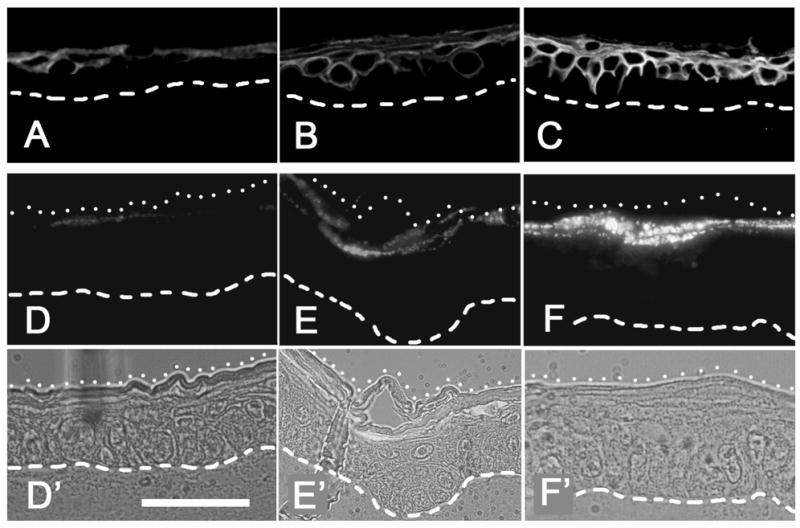
Figure 5. Expression of epidermal differentiation markers is significantly increased in REK lift cultures treated with acetone
Representative sections immunostained for K10 (AC), Filaggrin (DF), or visualized by phase contrast (D′–F′). Panels show REK cultures given (A), no acetone treatment. (B), two-acetone treatments, or (C), three-acetone treatments. Filaggrin stained samples (second row) are paired with corresponding phase images (third row). Dashed lines, dermal-epidermal junction. Dotted lines, top of stratum corneum. Scale bar, 50 μm
Figure 6
Figure 6. Increases in the differentiation markers K10 and filaggrin are confirmed by western blots in acetone-treated REK lift cultures
Western analysis performed on untreated and acetone-treated samples as described in Materials and Methods. (A), Coomassie stain for the control (None), two (2x), and three (3x) acetone treated REK cultures. (B), Expression of K10, an early marker of differentiation, (C), Filaggrin, a late marker of differentiation, expressed in untreated and acetone treated REK cultures. MW, molecular weight of protein standards in kilodaltons. Numbers beneath protein bands, relative induction (-fold) over untreated controls, determined by densitometry. Each experiment was repeated twice with similar results.
Figure 7
Figure 7. Acetone-treated REK cultures show heightened transglutaminase activity
Representative immunostained sections for fluorescein-cadaverine, a substrate of transglutaminase that becomes incorporated into the stratum corneum. (A), Control. (B), two-acetone, and (C) three-acetone treated REK cultures. Lift cultures treated with fluorescein alone were negative for incorporation (data not shown). Dashed lines, dermal-epidermal junction. The experiment was performed twice with similar results.

References

    1. Lampe MA, Williams ML, Elias PM. Human epidermal lipids: characterization and modulations during differentiation. J Lipid Res. 1983;24:131–140. - PubMed
    1. Elias PM, Wood LC, Feingold KR. Epidermal pathogenesis of inflammatory dermatoses. Am J Contact Dermat. 1999;10:119–126. - PubMed
    1. Proksch E, Holleran WM, Menon GK, Elias PM, Feingold KR. Barrier function regulates epidermal lipid and DNA synthesis. Br J Dermatol. 1993;128:473–482. - PubMed
    1. Denda M, Tsuchiya T, Elias PM, Feingold KR. Stress alters cutaneous permeability barrier homeostasis. Am J Physiol Regul Integr Comp Physiol. 2000;278:R367–372. - PubMed
    1. Elias PM, Feingold KR. Does the tail wag the dog? Role of the barrier in the pathogenesis of inflammatory dermatoses and therapeutic implications. Arch Dermatol. 2001;137:1079–1081. - PubMed

Publication types