


Tuning ion coordination architectures to enable selective partitioning
- PMID: 17513348
- PMCID: PMC1929028
- DOI: 10.1529/biophysj.107.107482
Tuning ion coordination architectures to enable selective partitioning
Abstract
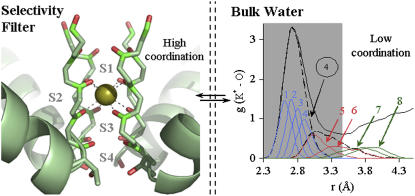
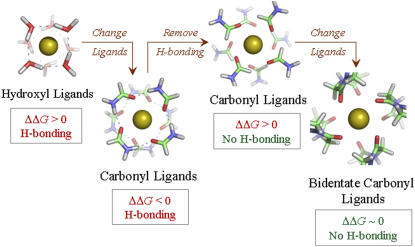
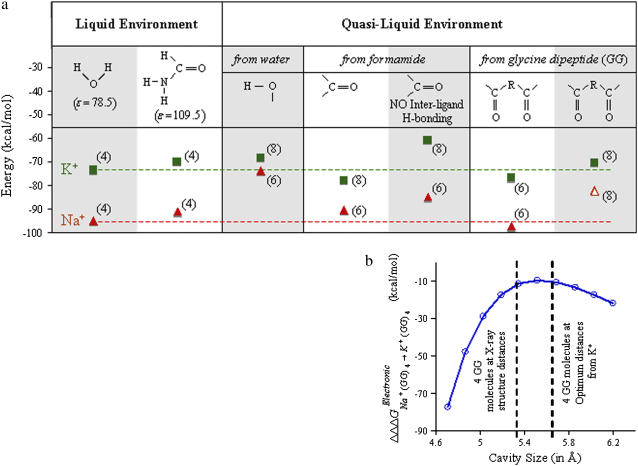
K+ ions seemingly permeate K-channels rapidly because channel binding sites mimic coordination of K+ ions in water. Highly selective ion discrimination should occur when binding sites form rigid cavities that match K+, but not the smaller Na+, ion size or when binding sites are composed of specific chemical groups. Although conceptually attractive, these views cannot account for critical observations: 1), K+ hydration structures differ markedly from channel binding sites; 2), channel thermal fluctuations can obscure sub-Angström differences in ion sizes; and 3), chemically identical binding sites can exhibit diverse ion selectivities. Our quantum mechanical studies lead to a novel paradigm that reconciles these observations. We find that K-channels utilize a "phase-activated" mechanism where the local environment around the binding sites is tuned to sustain high coordination numbers (>6) around K+ ions, which otherwise are rarely observed in liquid water. When combined with the field strength of carbonyl ligands, such high coordinations create the electrical scenario necessary for rapid and selective K+ partitioning. Specific perturbations to the local binding site environment with respect to strongly selective K-channels result in altered K+/Na+ selectivities.
Figures
Comment on
-
Tuning a potassium channel--the caress of the surroundings.Biophys J. 2007 Aug 15;93(4):1091-2. doi: 10.1529/biophysj.107.110205. Epub 2007 May 18. Biophys J. 2007. PMID: 17513347 Free PMC article. No abstract available.
References
-
- Hille, B. 2001. Ionic Channels of Excitable Membranes. Sinauer Associates, Sunderland, MA.
-
- Zhou, Y., J. H. Morais-Cabral, A. Kaufman, and R. MacKinnon. 2001. Chemistry of ion coordination and hydration revealed by a K+ channel-Fab complex at 2.0 Å resolution. Nature. 414:43–48. - PubMed
-
- Jiang, Y., A. Lee, J. Chen, M. Cadene, B. T. Chait, and R. MacKinnon. 2002. Crystal structure and mechanism of a calcium-gated potassium channel. Nature. 417:515–522. - PubMed
-
- Jiang, Y., A. Lee, J. Chen, V. Ruta, M. Cadene, B. T. Chait, and R. MacKinnon. 2003. X-ray structure of a voltage-dependent K+ channel. Nature. 423:33–41. - PubMed
-
- Kuo, A., J. M. Gulbis, J. F. Antcliff, T. Rahman, E. D. Lowe, J. Zimmer, J. Cuthbertson, F. M. Ashcroft, T. Ezaki, and D. A. Doyle. 2003. Crystal structure of the potassium channel KirBac1.1 in the closed state. Science. 300:1922–1926. - PubMed
Publication types
MeSH terms
Substances
Grants and funding
LinkOut - more resources
Full Text Sources
Medical
