Comparative Study
. 2007 Aug;189(15):5728-37.
doi: 10.1128/JB.00161-07. Epub 2007 May 18.

Genetic interactions of DNA repair pathways in the pathogen Neisseria meningitidis

Affiliations
Comparative Study

Genetic interactions of DNA repair pathways in the pathogen Neisseria meningitidis

Tonje Davidsen et al. J Bacteriol. 2007 Aug.

Abstract

The current increase in the incidence and severity of infectious diseases mandates improved understanding of the basic biology and DNA repair profiles of virulent microbes. In our studies of the major pathogen and model organism Neisseria meningitidis, we constructed a panel of mutants inactivating genes involved in base excision repair, mismatch repair, nucleotide excision repair (NER), translesion synthesis, and recombinational repair pathways. The highest spontaneous mutation frequency among the N. meningitidis single mutants was found in the MutY-deficient strain as opposed to mutS mutants in Escherichia coli, indicating a role for meningococcal MutY in antibiotic resistance development. Recombinational repair was recognized as a major pathway counteracting methyl methanesulfonate-induced alkylation damage in the N. meningitidis. In contrast to what has been shown in other species, meningococcal NER did not contribute significantly to repair of alkylation-induced DNA damage, and meningococcal recombinational repair may thus be one of the main pathways for removal of abasic (apurinic/apyrimidinic) sites and strand breaks in DNA. Conversely, NER was identified as the main meningococcal defense pathway against UV-induced DNA damage. N. meningitidis RecA single mutants exhibited only a moderate decrease in survival after UV exposure as opposed to E. coli recA strains, which are extremely UV sensitive, possibly reflecting the lack of a meningococcal SOS response. In conclusion, distinct differences between N. meningitidis and established DNA repair characteristics in E. coli and other species were identified.


Figures
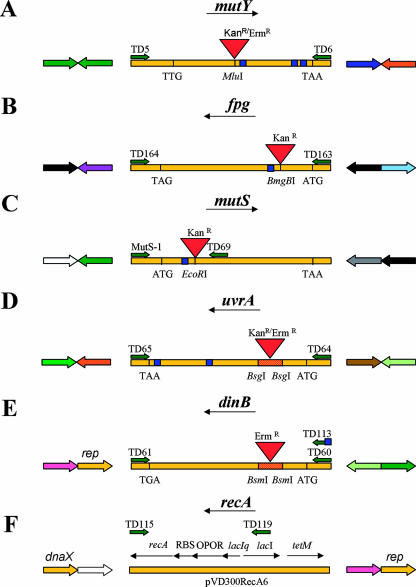
FIG. 1.
FIG. 1.
Cloning of N. meningitidis DNA repair genes and construction of the MC H44/76 mutant strains (A to E). Experimental details are outlined in Materials and Methods. The primers used for PCR amplification of open reading frames are denoted TD. The restriction sites used for insertion of antibiotic resistance markers are depicted together with the DNA uptake sequences (blue squares) required for MC transformation of exogenous DNA. The two adjacent genes upstream and downstream of mutY, fpg, mutS, uvrA, dinB, and recA are illustrated according to the following color scheme: yellow, genes involved in DNA metabolism (rep, ATP-dependent DNA helicase; dnaX, DNA polymerase III, gamma and tau subunits); orange, mobile and extrachromosomal element function; dark green, energy metabolism; light green, transport and binding proteins; white, conserved hypothetical proteins; black, hypothetical proteins; dark blue, cellular processes and detoxification; light blue, cell envelope; purple, fatty acid and phospholipids biosynthesis; gray, central intermediary metabolism; pink, amino acid biosynthesis; brown, unknown function.
FIG. 2.
FIG. 2.
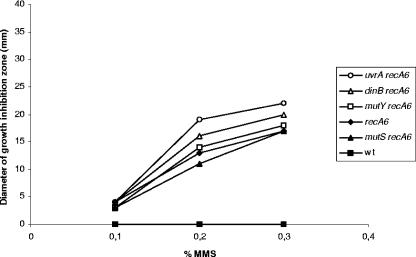
Survival of the MC DNA repair-deficient strains to alkylating stress as measured by growth inhibition zones (mm) surrounding paper diffusion disks after exposure to different concentrations of MMS. Repeated experiments (three to five repetitions) demonstrated that the diameter of the growth inhibition zone of each strain fluctuated; however, the strains always displayed the same MMS sensitivity relative to each other. One representative experiment is shown. The strains are as indicated on the figure; the remaining DNA repair-deficient strains listed in Table 1 showed MMS sensitivity comparable to the wild-type (wt) strain.
FIG. 3.
FIG. 3.
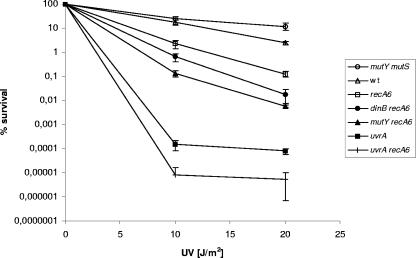
Survival of the MC DNA repair-deficient strains after exposure to different doses of UV light. The results are given as the averages of three experiments, with error bars showing the standard deviations. The 19 MC strains tested split statistically into seven groups, represented in the figure by one strain each. Group 1 is represented by mutY mutS; mutY fpg, mutS dinB, and mutY dinB mutants showed similar phenotypes. Group 2 is represented by the wild type (wt); fpg, mutY, mutS, and dinB mutants showed similar phenotypes. Group 3 is represented by recA6, and group 4 is represented by dinB recA6. Group 5 is represented by mutY recA6; the mutS recA6 mutant showed a similar phenotype. Group 6 is represented by uvrA; mutS uvrA, fpg uvrA, dinB uvrA, and mutY uvrA mutants showed similar phenotypes. Group 7 is represented by uvrA recA6.
FIG. 4.
FIG. 4.
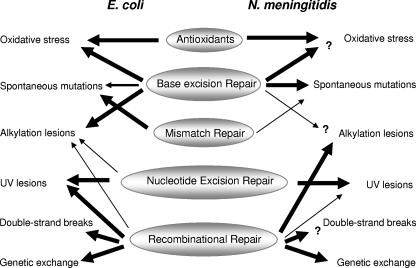
Differences in the contribution of DNA repair pathways in E. coli versus N. meningitidis. Major features discriminating MC repair from E. coli under the conditions tested in this study are (i) the involvement of the MC MutY of the base excision repair pathway in the repair of spontaneous mutations; (ii) the significant contribution of MC recombinational repair and seemingly absent MC nucleotide excision repair for the prevention of alkylation damage; and (iii) the lesser influence of MC recombinational repair in the defense against UV-induced DNA damage. Arrows indicate the relative contribution of each repair pathway in the repair of specific DNA damages. The MC data are based on analysis of single and double DNA repair mutants conducted in this study (Table 1). Interesting questions remaining to be answered concern the involvement of MC BER in the defense against externally induced oxidative stress since at least five MC antioxidants probably mask their contribution (53), the putative participation of the MC Tag in the defense against alkylation damage, and the contribution of Nth and/or Xth in the removal of AP sites. MC RecA is involved in genetic exchange, but it remains to be elucidated whether recombinational repair is the only pathway for the repair of double-strand breaks.

References

    1. Alseth, I., F. Osman, H. Korvald, I. Tsaneva, M. C. Whitby, E. Seeberg, and M. Bjoras. 2005. Biochemical characterization and DNA repair pathway interactions of Mag1-mediated base excision repair in Schizosaccharomyces pombe. Nucleic Acids Res. 33:1123-1131. - PMC - PubMed
    1. Ban, C., M. Junop, and W. Yang. 1999. Transformation of MutL by ATP binding and hydrolysis: a switch in DNA mismatch repair. Cell 97:85-97. - PubMed
    1. Ban, C., and W. Yang. 1998. Structural basis for MutH activation in E. coli mismatch repair and relationship of MutH to restriction endonucleases. EMBO J. 17:1526-1534. - PMC - PubMed
    1. Black, C. G., J. A. Fyfe, and J. K. Davies. 1997. Cloning, nucleotide sequence and transcriptional analysis of the uvrA gene from Neisseria gonorrhoeae. Mol. Gen. Genet. 254:479-485. - PubMed
    1. Black, C. G., J. A. Fyfe, and J. K. Davies. 1998. Absence of an SOS-like system in Neisseria gonorrhoeae. Gene. 208:61-66. - PubMed

Publication types

MeSH terms

LinkOut - more resources