. 2007 Aug;27(15):5403-13.
doi: 10.1128/MCB.00346-07. Epub 2007 May 21.

A novel splicing factor, Yju2, is associated with NTC and acts after Prp2 in promoting the first catalytic reaction of pre-mRNA splicing

Affiliations

A novel splicing factor, Yju2, is associated with NTC and acts after Prp2 in promoting the first catalytic reaction of pre-mRNA splicing

Yen-Chi Liu et al. Mol Cell Biol. 2007 Aug.

Abstract

The Prp19-associated complex (NTC) is essential for pre-mRNA splicing and is associated with the spliceosome during spliceosome activation. NTC is required for specifying interactions of U5 and U6 with pre-mRNA to stabilize their association with the spliceosome after dissociation of U4. Here, we show that a novel splicing factor, Yju2, is associated with components of NTC, and that it is required for pre-mRNA splicing both in vivo and in vitro. During spliceosome assembly, Yju2 is associated with the spliceosome at nearly the same time as NTC but is destabilized after the first catalytic reaction, whereas other NTC components remain associated until the reaction is complete. Extracts depleted of Yju2 could be complemented by recombinant Yju2, suggesting that Yju2 and NTC are not entirely in association with each other. Yju2 is not required for the binding of NTC to the spliceosome or for NTC-mediated spliceosome activation. Complementation analysis of the affinity-isolated spliceosome formed in Yju2-depleted extracts demonstrated that Yju2 acts in concert with an unidentified heat-resistant factor(s) in an ATP-independent manner to promote the first catalytic reaction of pre-mRNA splicing after Prp2-mediated structural rearrangement of the spliceosome.


Figures
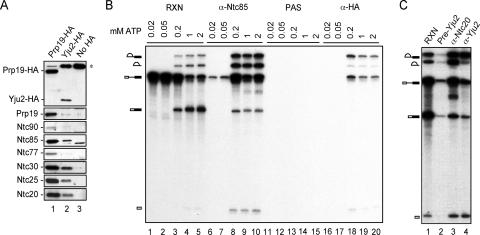
FIG. 1.
FIG. 1.
Yju2 is associated with components of NTC and is associated with the spliceosome at nearly the same time as NTC. (A) Extracts prepared from Prp19-HA (lane 1), Yju2-HA (lane 2), and untagged (No HA; lane 3) strains were immunoprecipitated with the anti-HA antibody, followed by Western blotting using antibodies against the HA epitope and components of NTC. The asterisk indicates a nonspecific protein recognized by the anti-HA antibody. (B) Splicing reactions were carried out in Yju2-HA extracts at 2 mM (lanes 5, 10, 15, and 20), 1 mM (lanes 4, 9, 14, and 19), 0.2 mM (lanes 3, 8, 13, and 18), 0.05 mM (lanes 2, 7, 12, and 17), and 0.02 mM (lanes 1, 6, 11, and 16) of ATP, and reaction mixtures were subjected to immunoprecipitation in the absence of antibodies (lanes 11 to 15) or with anti-Ntc85 (lanes 6 to 10) and anti-HA (lanes 16 to 20) antibodies. Lanes 1 to 5 represent 1 μl of the reaction mixture. Lanes 6 to 20 represent precipitates from 10 μl of reaction mixtures. (C) Splicing reactions were carried out at 2 mM of ATP, and reaction mixtures were subjected to immunoprecipitation with preimmune (lane 2), anti-Ntc20 (lane 3), or anti-Yju2 (lane 4) antibody. Lane 1 represents 0.5 μl of the reaction mixture. Lane 3 represents the precipitate from 5 μl of reaction mixtures, and lanes 2 and 4 represent precipitate from 20 μl of reaction mixtures. RXN, reaction mixture; PAS, protein A-Sepharose; Pre-Yju2, preimmune serum of Yju2.
FIG. 2.
FIG. 2.
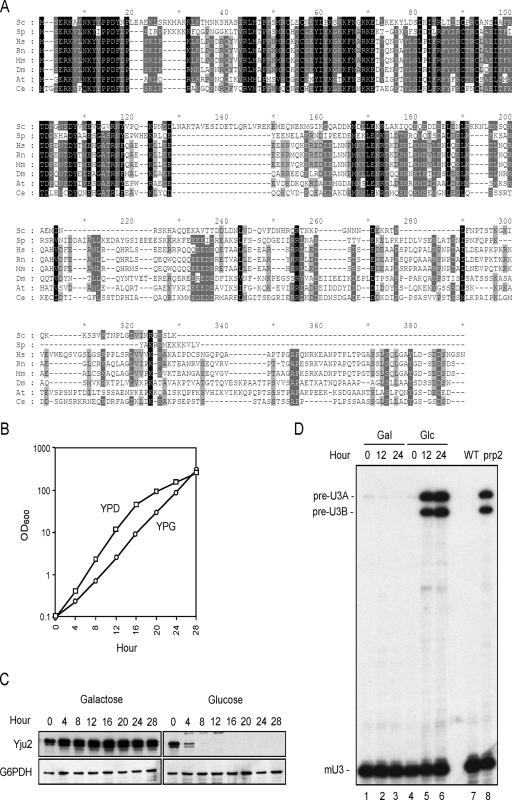
Yju2 is required for pre-mRNA splicing in vivo. (A) Protein sequence alignment of Yju2 orthologs using MAFFT and GeneDoc. Putative Yju2 orthologs were identified by using published KEGG (Kyoto Encyclopedia of Genes and Genomes) databases (24). Conserved residues are shaded black for 100% conservation, gray for 80% conservation, and light gray for 60% conservation. Abbreviations, protein accession numbers (from NCBI), and percentages of identity with Yju2 are the following: Sc, Saccharomyces cerevisiae, NP_012828, 100%; Sp, Schizosaccharomyces pombe, NP_001018234, 40%; Hs, Homo sapiens, NP_060544, 36.32%; Rn, Rattus norvegicus, XP_576700, 36.32%; Mm, Mus musculus, NP_082657, 36.32%; Dm, Drosophila melano-gaster, NP_611092, 35.38%; At, Arabidopsis thaliana, NP_173156, 33.99%; and Ce, Caenorhabditis elegans, NP_498576, 33.33%. (B) Growth curves of GAL-YJU2 cells in glucose medium (YPD) and galactose medium (YPG). Cells were grown in galactose medium to mid-log phase and then either continuously maintained in YPG or shifted to YPD. Cells were collected at 0, 4, 8, 12, 16, 20, 24, and 28 h after the shift for measurements of the optical density at 600 nm (OD600). (C) Protein extracted from collected cells was analyzed by probing Western blots with the anti-Yju2 antibody. Anti-G6PDH antibody was used as an internal control. (D) Total RNA extracted from collected cells was analyzed by primer extension using R13 as the primer. The prp2 mutant was grown at 37°C for 2 h before harvest. YPD, yeast extract-peptone-dextrose; YPG, yeast extract-peptone-galactose; Gal, galactose; Glc, glucose.
FIG. 3.
FIG. 3.
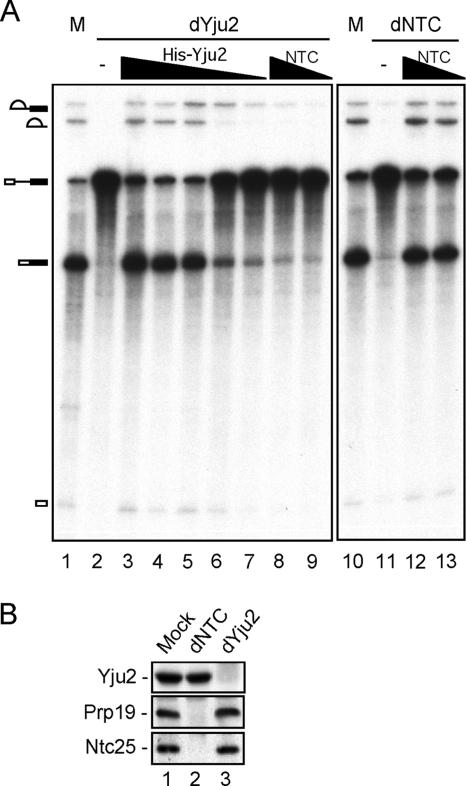
Complementation of Yju2-depleted extracts by recombinant Yju2. (A) Splicing reactions were carried out in mock-depleted (lanes 1 and 10), Yju2-depleted (lanes 2 to 9), or NTC-depleted (lanes 11 to 13) extract with the addition of recombinant His-Yju2 (lane 3, 150 ng; lane 4, 50 ng; lane 5, 15 ng; lane 6, 5 ng; and lane 7, 2 ng) or affinity-purified NTC (lanes 8 and 12, 2 μl; lanes 9 and 13, 1 μl). (B) Western blot of mock-depleted (lane 1), NTC-depleted (lane 2), or Yju2-depleted (lane 3) extract probed with anti-Yju2, anti-HA, or anti-Ntc25 antibody. M, mock depleted; dYju2, Yju2 depleted; dNTC, NTC depleted.
FIG. 4.
FIG. 4.
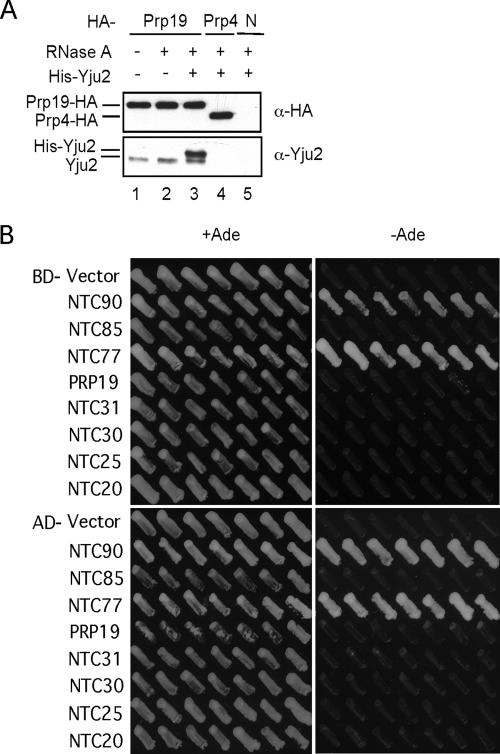
Interactions of Yju2 with NTC and NTC components. (A) His-Yju2 (50 ng) was added to Prp19-HA (lanes 1 to 3), Prp4-HA (lane 4), or untagged extract (lane 5) and immunoprecipitated with the anti-HA antibody, followed by probing Western blots with anti-HA and anti-Yju2 antibodies. Extracts were pretreated with RNase A prior to precipitation (lanes 2 to 5). N, untagged extracts. (B) Yju2 and NTC components were fused to the GAL4-DNA binding domain (BD) and the GAL4 activation domain (AD), and interactions were assayed for activation of ADE2 under the control of the GAL2 promoter on plates with or without adenine.
FIG. 5.
FIG. 5.
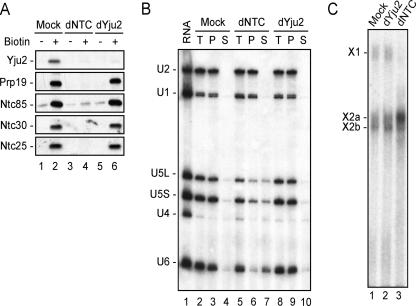
Yju2 was not required for spliceosome activation. (A) Splicing reactions were carried out in mock-depleted (lanes 1 and 2), NTC-depleted (lanes 3 and 4), or Yju2-depleted (lanes 5 and 6) extract using biotinylated (lanes 2, 4, and 6) or nonbiotinylated (lanes 1, 3, and 5) ACAC pre-mRNA. The spliceosome was isolated by precipitation with streptavidin-Sepharose, followed by Western blotting using antibody against Yju2, Prp19, Ntc85, Ntc30, or Ntc25. (B) Splicing reactions were carried out in mock-depleted (lanes 2 to 4), NTC-depleted (lanes 5 to 7), or Yju2-depleted (lanes 8 to 10) extract using biotinylated ACAC pre-mRNA as the substrate, and the spliceosome was precipitated with streptavidin-Sepharose. After the unbound materials were washed off, the pellet was separated into two fractions: one was the total precipitate (T; lanes 2, 5, and 8), and the other was added to the splicing buffer and incubated at room temperature for 20 min. After separating the supernatant (S; lanes 4, 7, and 10) and pellet fractions (P; lanes 3, 6, and 9), RNA was extracted and analyzed by Northern blotting. Lane 1 is total RNA from 2 μl of extracts. (C) Splicing reactions were carried out in mock-depleted (lane 1), Yju2-depleted (lane 2), or NTC-depleted extract (lane 3) using Ac/Cla pre-mRNA as the substrate. The reaction mixtures were precipitated with the anti-Smd1 antibody, followed by UV irradiation. RNA was then isolated and selected with 5′-end-biotinylated oligonucleotide U6-Abio through precipitation with streptavidin-Sepharose and was then further analyzed. The cross-linked products X1, X2a, and X2b are as described by Chan and Cheng (5). dYju2, Yju2-depleted; dNTC, NTC-depleted.
FIG. 6.
FIG. 6.
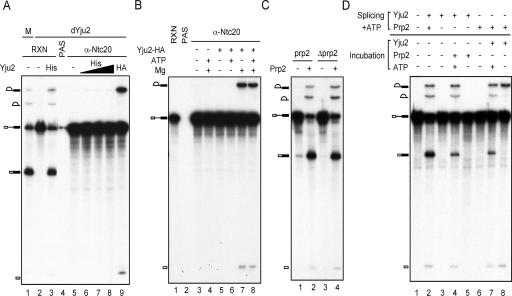
Yju2 is required for the first catalytic reaction after the Prp2 step. (A) Splicing was carried out in Yju2-depleted extracts and reaction mixtures (lane 2) precipitated with the anti-Ntc20 antibody (lanes 5 to 9). After the unbound materials were washed off, the pellet was incubated in the presence of ATP and Mg2+ at 25°C for 20 min alone (lane 5) or with the addition of recombinant His-Yju2 (lane 6, 50 ng; lane 7, 250 ng; lane 8, 750 ng) or affinity-purified Yju2-HA from 150 μl yeast extracts (lane 9). His, His-Yju2; HA, affinity-purified Yju2-HA from yeast; RXN, reaction; PAS, protein A-Sepharose. (B) Splicing was carried out in Yju2-depleted extracts and reaction mixtures (lane 1) precipitated with the anti-Ntc20 antibody (lanes 3 to 8). The precipitates were incubated alone (lanes 3 and 4) or with the addition of affinity-purified Yju2-HA (lanes 5 to 8) alone or in the presence of ATP or Mg2+. (C) Splicing in untreated (lanes 1 and 2) or heat-treated prp2-1 mutant extracts (lanes 3 and 4) alone (lanes 1 and 3) or with (lanes 2 and 4) the addition of 100 ng of recombinant Prp2 protein (lanes 2 and 4). (D) Splicing was carried out in Yju2-depleted prp2-1 extracts with the addition of recombinant Yju2 (lanes 2 to 5) or Prp2 (lanes 2 and 6 to 8) protein. Glucose was then added to a final concentration of 5 mM, and the mixture was incubated for 5 min to deplete ATP. Recombinant Yju2, Prp2, and/or 10 mM ATP was then added and further incubated at 25°C for 10 min.
FIG. 7.
FIG. 7.
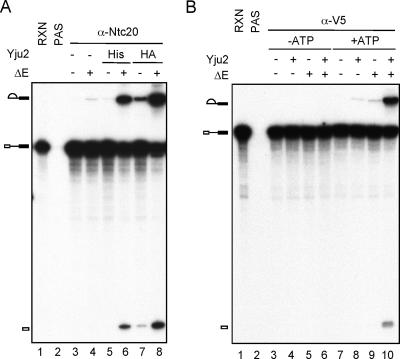
Yju2 and a heat-resistant factor(s) are required for the first catalytic reaction after the Prp2 step. (A) Splicing was carried out in Yju2-depleted extracts and reaction mixtures (lane 1) precipitated with the anti-Ntc20 antibody (lanes 3 to 8). Precipitates were incubated in the presence of Mg2+ at 25°C for 20 min alone (lane 3) or with the addition of recombinant His-Yju2 (lanes 5 and 6, 50 ng) or affinity-purified Yju2-HA (lanes 7 and 8) from 150 μl yeast extracts and either in combination with 4 μl heat-treated extracts prepared from Yju2-depleted extracts (lanes 4, 6, and 8) or alone (lanes 3, 5, and 7). (B) Splicing was carried out in Yju2-depleted heat-inactivated prp2-1 extracts, followed by addition of glucose (final concentration, 5 mM) to deplete ATP. Affinity-purified V5-tagged Prp2 was then added and incubated for 10 min, and the Prp2-bound spliceosome was precipitated with the anti-V5 antibody. Affinity-purified Yju2-HA and/or heat-treated extracts were then added to precipitates for incubation in the presence (lanes 7 to 10) or absence (lanes 3 to 6) of 2 mM ATP at 25°C for 20 min. ΔE, heat-treated extracts; RXN, reaction; PAS, protein A-Sepharose.
FIG. 8.
FIG. 8.
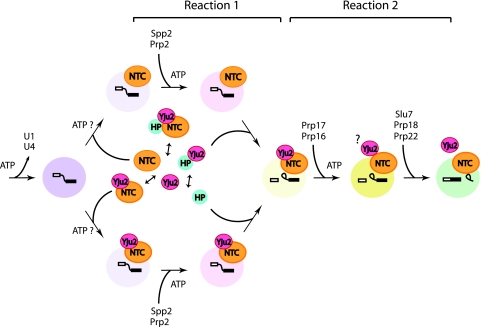
Diagram illustrating the interaction of Yju2 with NTC, with HP, and with the spliceosome; the diagram also illustrates the function of Yju2 in the splicing reaction. Yju2 interacts with NTC and with HP in dynamic manners. Double arrowheads indicate equilibrium between the association and dissociation forms. After U1 and U4 are dissociated from the spliceosome, NTC, either in association with Yju2 or with no association, binds to activate the spliceosome. The first catalytic reaction involves an ATP-dependent step, which requires Prp2 and Spp2, and an ATP-independent step, which requires HP and Yju2. The second catalytic reaction also involves an ATP-dependent step, which requires Prp17 and Prp16, and an ATP-independent step, which requires Slu7, Prp18, and Prp22. The requirement for ATP in each step is indicated. Yju2 is destabilized from the spliceosome after the reaction is complete, but its association with the spliceosome after the Prp16 step remains undetermined and is indicated by a question mark. A change in the color of the spliceosome represents a structural change of the spliceosome during each transition.

References

    1. Ansari, A., and B. Schwer. 1995. SLU7 and a novel activity, SSF1, act during the PRP16-dependent step of yeast pre-mRNA splicing. EMBO J. 14:4001-4009. - PMC - PubMed
    1. Brow, D. A. 2002. Allosteric cascade of spliceosome activation. Annu. Rev. Genet. 36:333-360. - PubMed
    1. Brys, A., and B. Schwer. 1996. Requirement for SLU7 in yeast pre-mRNA splicing is dictated by the distance between the branchpoint and the 3′ splice site. RNA 2:707-717. - PMC - PubMed
    1. Burge, C. B., T. H. Tuschl, and P. A. Sharp. 1999. Splicing of precursors to mRNAs by the spliceosome, p. 525-560. In R. F. Gesteland, T. R. Cech, and J. F. Atkins (ed.), RNA world II. Cold Spring Harbor Laboratory Press, Cold Spring Harbor, NY.
    1. Chan, S.-P., and S.-C. Cheng. 2005. The Prp19-associated complex is required for specifying interactions of U5 and U6 with pre-mRNA during spliceosome activation. J. Biol. Chem. 280:31190-31199. - PubMed

Publication types

MeSH terms