


Design, synthesis, and biological evaluation of novel bifunctional C-terminal-modified peptides for delta/mu opioid receptor agonists and neurokinin-1 receptor antagonists
- PMID: 17516639
- PMCID: PMC2365895
- DOI: 10.1021/jm061369n
Design, synthesis, and biological evaluation of novel bifunctional C-terminal-modified peptides for delta/mu opioid receptor agonists and neurokinin-1 receptor antagonists
Abstract
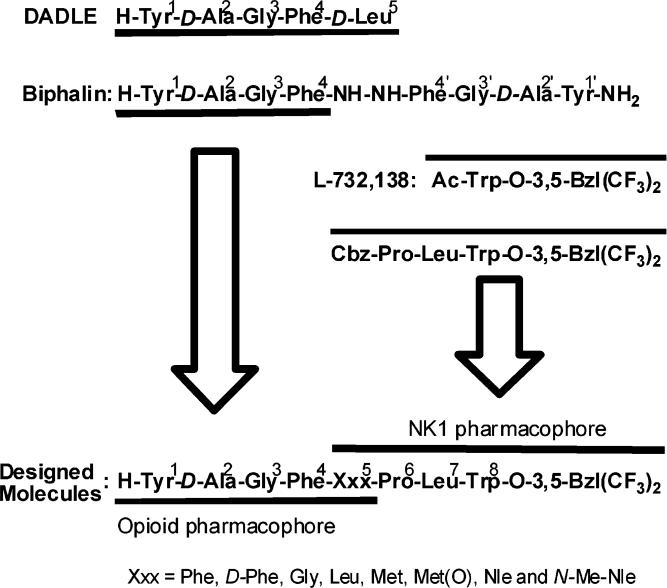
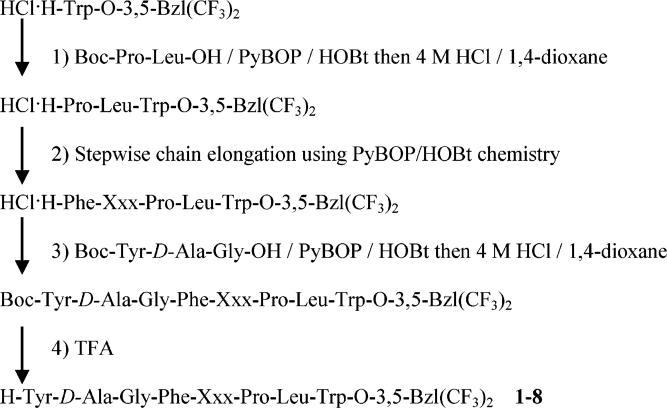
A series of bifunctional peptides that act as agonists for delta and mu opioid receptors with delta selectivity and as antagonist for neurokinin-1 (NK1) receptors were designed and synthesized for potential application as analgesics in various pain states. The peptides were characterized using radioligand binding assays and functional assays using cell membrane and animal tissue. Optimization was performed on the fifth residue which serves as an address moiety for both receptor recognitions. It had critical effects on both activities at delta/mu opioid receptors and NK1 receptors. Among the synthesized peptides, H-Tyr-D-Ala-Gly-Phe-Met-Pro-Leu-Trp-O-3,5-Bzl(CF3) 2 (5) and H-Tyr-D-Ala-Gly-Phe-Nle-Pro-Leu-Trp-O-3,5-Bzl(CF3)2 (7) had excellent agonist activity for both delta opioid and mu opioid receptors and excellent antagonist activity for NK1 receptors. These results indicate that the rational design of multifunctional ligands with opioid agonist and neurokinin-1 antagonist activities can be accomplished and may provide a new tool for treatment of chronic and several pain states.
Figures
References
-
- Yaksh TL. Spinal opiate analgesia: characteristics and principles of action. Pain. 1981;11:293–346. - PubMed
-
- Hill R. NK1 (substance P) receptor antagonists – why are they not analgesic in humans? Trends Pharmacol. Sci. 2000;21:244–246. - PubMed
-
- Kalso E. Improving opioid effectiveness: from ideas to evidence. Eur. J. Pain. 2005;9:131–135. - PubMed
Publication types
MeSH terms
Substances
Grants and funding
LinkOut - more resources
Full Text Sources
Chemical Information
Research Materials
Miscellaneous
