Review
. 2007 Aug;37(10):1097-106.
doi: 10.1016/j.ijpara.2007.04.003. Epub 2007 Apr 18.

Transmission of Leishmania metacyclic promastigotes by phlebotomine sand flies

Affiliations
Review

Transmission of Leishmania metacyclic promastigotes by phlebotomine sand flies

Paul A Bates. Int J Parasitol. 2007 Aug.

Abstract

A thorough understanding of the transmission mechanism of any infectious agent is crucial to implementing an effective intervention strategy. Here, our current understanding of the mechanisms that Leishmania parasites use to ensure their transmission from sand fly vectors by bite is reviewed. The most important mechanism is the creation of a "blocked fly" resulting from the secretion of promastigote secretory gel (PSG) by the parasites in the anterior midgut. This forces the sand fly to regurgitate PSG before it can bloodfeed, thereby depositing both PSG and infective metacyclic promastigotes in the skin of a mammalian host. Other possible factors in transmission are considered: damage to the stomodeal valve; occurrence of parasites in the salivary glands; and excretion of parasites from the anus of infected sand flies. Differences in the transmission mechanisms employed by parasites in the three subgenera, Leishmania, Viannia and Sauroleishmania are also addressed.


Figures
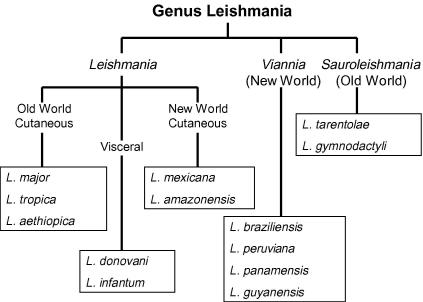
Fig. 1
Fig. 1
Outline classification of Leishmania illustrating the three subgenera. The list of named species is not comprehensive; over 30 species have been named in the genus including many that are non-pathogenic or of minor medical importance (of limited range or small numbers of recorded cases). The species named above include some of the better known species that are the focus of biomedical research. Parasites in the subgenera Leishmania and Viannia infect mammals, whereas the Sauroleishmania infect reptiles as their vertebrate hosts.
Fig. 2
Fig. 2
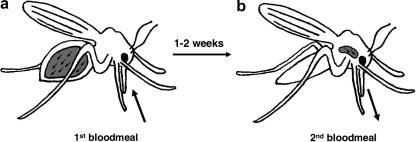
Bloodfeeding and transmission of Leishmania. (a) Sand flies become infected when amastigotes are ingested along with a bloodmeal and transform into promastigotes. During the “bloodmeal phase” the parasites are located at the posterior end of the midgut, and such infections are immature and non-transmissible. (b) Development in the gut continues for 1–2 weeks resulting in a mature transmissible infection with metacyclic promastigotes located in the anterior of the gut. Depending on parasite and vector species there may be additional bloodmeals during the maturation period, but most parasites can complete their development within the timeframe of a single digestive cycle. During maturation the flies supplement their nutrition by feeding on sugars from plants, so this is sometimes known as the “sugarmeal phase” of parasite development. Infective metacyclic promastigotes are egested when the fly takes a subsequent bloodmeal.
Fig. 3
Fig. 3
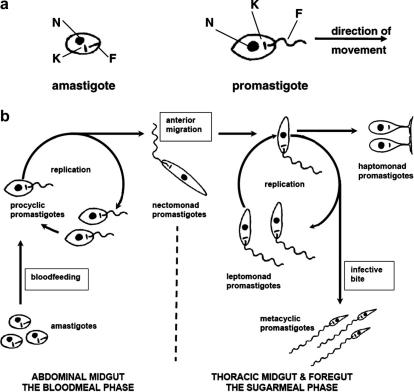
Development of Leishmania (Leishmania) species in the sand fly vector. (a) The morphology of amastigotes and promastigotes. Each form has a nucleus (N), kinetoplast (K) and flagellum (F). The kinetoplast is the mitochondrial genome. The flagellum in amastigotes is internal and non-functional; in promastigotes the flagellum extends from the cell body, beats and pulls the organism in the direction shown, emerging from the anterior end of the cell. (b) The developmental sequence of the five major promastigote forms: procyclic promastigotes, nectomonad promastigotes, leptomonad promastigotes, haptomonad promastigotes and metacyclic promastigotes. The exact position of haptomonad promastigotes in the developmental sequence is uncertain.
Fig. 4
Fig. 4
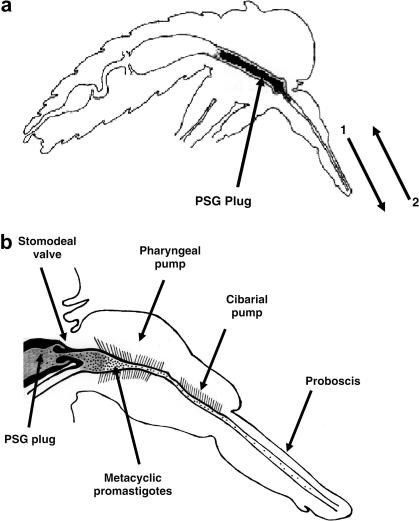
(a) Sagittal section through a Leishmania-infected female sand fly showing the position of the promastigote secretory gel (PSG) plug within the anterior midgut and foregut. The plug must be partially egested (1) before blood feeding can occur (2), thereby injecting both metacyclic promastigotes and PSG into the skin of the mammalian host. (b) Detail of the anterior midgut and foregut. The PSG plug (shaded) forces the stomodeal valve open and extends into the pharynx region. Metacyclic promastigotes (stippling) are concentrated at the anterior pole of the plug but are found along the foregut in both the cibarium and proboscis.

References

    1. Bacot A.W., Martin C.J. Observations on the mechanism of the transmission of plague by fleas. J. Hyg. Plague. 1914;(Suppl. III):423–439. - PMC - PubMed
    1. Bates P.A., Ashford R.W. Old World leishmaniasis. In: Cox F.E.G., Wakelin D., Gillespie S.H., Despommier D.D., editors. Topley & Wilson’s Microbiology & Microbial Infections. tenth ed. Parasitology, Hodder Arnold; London: 2006. pp. 283–312.
    1. Bates P.A., Rogers M.E. New insights into the developmental biology and transmission mechanisms of Leishmania. Curr. Mol. Med. 2004;4:601–609. - PubMed
    1. Beach R., Kiilu G., Hendricks L., Oster C., Leeuwenberg J. Cutaneous leishmaniasis in Kenya: transmission of Leishmania major to man by the bite of a naturally infected Phlebotomus duboscqi. Trans. Roy. Soc. Trop. Med. Hyg. 1984;78:747–751. - PubMed
    1. Beach R., Kiilu G., Leeuwenburg J. Modification of sand fly biting behaviour by Leishmania leads to increased parasite transmission. Am. J. Trop. Med. Hyg. 1985;34:278–282. - PubMed

MeSH terms