. 2007 May 29;104(22):9511-6.
doi: 10.1073/pnas.0701055104. Epub 2007 May 21.

Roles of heat-shock protein 90 in maintaining and facilitating the neurodegenerative phenotype in tauopathies

Affiliations

Roles of heat-shock protein 90 in maintaining and facilitating the neurodegenerative phenotype in tauopathies

Wenjie Luo et al. Proc Natl Acad Sci U S A. .

Abstract

Neurodegeneration, a result of multiple dysregulatory events, is a lengthy multistep process manifested by accrual of mutant variants and abnormal expression, posttranslational modification, and processing of certain proteins. Accumulation of these dysregulated processes requires a mechanism that maintains their functional stability and allows the evolution of the neurodegenerative phenotype. In malignant cells, the capacity to buffer transformation has been attributed to heat-shock protein 90 (Hsp90). Although normal proteins seem to require limited assistance from the chaperone, their aberrant counterparts seem to be highly dependent on Hsp90. Whereas enhanced Hsp90 affinity for mutated or functionally deregulated client proteins has been observed for several oncoproteins, it is unknown whether Hsp90 plays a similar role for neuronal proteins and thus maintains and facilitates the transformed phenotype in neurodegenerative diseases. Tauopathies are neurodegenerative diseases characterized by aberrant phosphorylation and/or expression of Tau protein, leading to a time-dependent accumulation of Tau aggregates and subsequent neuronal death. Here, we show that the stability of p35, a neuronal protein that activates cyclin-dependent protein kinase 5 through complex formation leading to aberrant Tau phosphorylation, and that of mutant but not WT Tau protein is maintained in tauopathies by Hsp90. Inhibition of Hsp90 in cellular and mouse models of tauopathies leads to a reduction of the pathogenic activity of these proteins and results in elimination of aggregated Tau. The results identify important roles played by Hsp90 in maintaining and facilitating the degenerative phenotype in these diseases and provide a common principle governing cancer and neurodegenerative diseases.


Conflict of interest statement

The authors declare no conflict of interest.

Figures
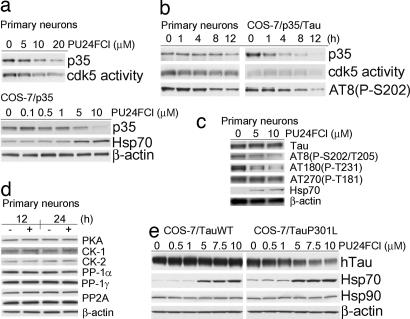
Fig. 1.
Fig. 1.
Inhibition of Hsp90 specifically decreases both p35 and mTau expression and reduces cdk5 activity in a time- and dose-dependent manner. (a) Western blot analysis of primary embryonic cortical neurons (Upper) and COS-7/p35 cells (Lower) treated with the indicated doses of PU24FCl for 24 h. (b) Western blot analysis of primary embryonic cortical neurons (Left) and COS-7/p35/Tau (Right) treated with PU24FCl (10 μM) for the indicated times. (c and d) Western blot analysis of primary embryonic cortical neurons treated with the indicated doses of PU24FCl for 24 h (c) or with PU24FCl (10 μM) (+) and vehicle (−) for the indicated times (d). (e) Western blot analysis of COS-7/Tau (Left) or COS-7/TauP301L (Right) cells treated with the indicated doses of PU24FCl for 24 h. β-Actin and Hsp90 were used as a protein quantification control. Each experiment was conducted in triplicate, and gels presented here are representative runs. DMSO was used as a vehicle.
Fig. 2.
Fig. 2.
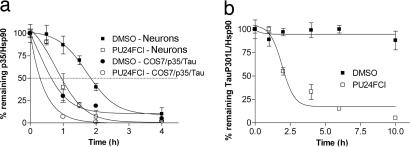
Hsp90 regulates the stability of p35 and mTau. (a) The half-life of p35 was analyzed in primary embryonic cortical neurons or COS-7/p35/Tau cells treated with cycloheximide (100 μg/ml) in the presence of vehicle or PU24FCl (10 μM) for the indicated times. (b) The half-life of mutant Tau was analyzed in COS-7/TauP301L cells treated with 100 μg/ml cycloheximide in the presence of vehicle or 10 μM PU24FCl for the indicated times. Levels of p35 and TauP301L in the presence and absence of the Hsp90 inhibitor were normalized to Hsp90 expression and results plotted against inhibitor treatment time. DMSO was used as a vehicle.
Fig. 3.
Fig. 3.
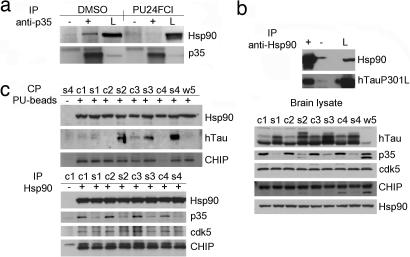
mTau and p35 exist in a complex with Hsp90. (a) Immunoprecipitation (IP) of p35-containing protein complexes from COS-7 cells transfected with cDNAs corresponding to myc-His-tagged p35 with a control IgG (−) or a specific anti-p35 antibody (+) in the presence of vehicle or PU24FCl (10 μM). Lysate (L) was added as a control. (b) Immunoprecipitation of Hsp90-containing protein complexes from COS-7 cells transfected with cDNAs corresponding to TauP301L with a control IgG (−) or a specific anti-Hsp90 antibody (+). Lysate was added as a control. (c) Hsp90-containing protein complexes isolated through chemical precipitation (CP) with a solid support immobilized-PU (+) or control beads (−) (Upper Left) and through immunoprecipitation with a specific anti-Hsp90 antibody (+) or a control IgG (−) (Lower Left) from JNPL3 mouse brains. c1–c4 and s1–s4, cortical and subcortical brain homogenates, respectively, extracted from four 10-month-old female mice. w5 is whole-brain homogenate from a nontransgenic control mouse. (Right) Western blot analysis of brain lysate protein content. Hsp90 was used as protein quantification control. DMSO was used as a vehicle. CHIP, C terminus of heat-shock cognate 70-interacting protein.
Fig. 4.
Fig. 4.
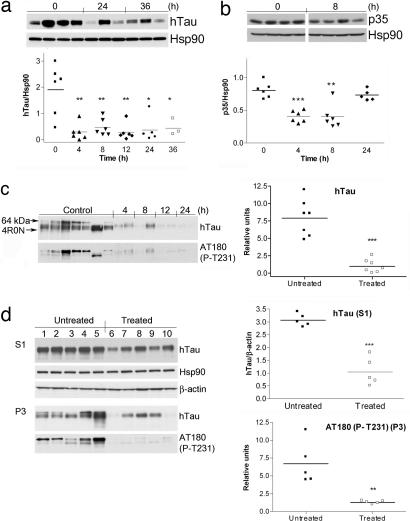
In vivo degradation of aberrant neuronal Hsp90 clients leads to a reduction in aggregated and hyperphosphorylated Tau. Western blot analysis of brain soluble fractions (S1) extracted from JNPL3 female mice treated for the indicated times with 75 mg/kg PU-DZ8. (a) Subcortical brain region of 2.5- to 4-month-old mice is presented. Human Tau levels were normalized to those of Hsp90. (b) Subcortical brain region of 2.5- to 4-month-old mice is presented. P35 levels were normalized to those of Hsp90. Representative data are displayed. (c) (Left) Western blot analysis of the insoluble Tau (P3) fractions extracted from the subcortical brain region of 6-month-old mice treated with 75 mg/kg PU-DZ8 for the indicated times. The location of 64-kDa Tau (arrowhead) and recombinant Tau containing four-repeat Tau isoforms without the N-terminal inserts (4R0N) is indicated. (Right) Relative hTau protein expression and Tau phosphorylation at T231 in the untreated versus the treated mouse group is presented. (d) Western blot analysis of soluble (S1) and insoluble (P3) subcortical brain fractions extracted from JNPL3 female mice treated for 30 days with Hsp90 inhibitors. β-Actin and Hsp90 were used as protein quantification control.
Fig. 5.
Fig. 5.
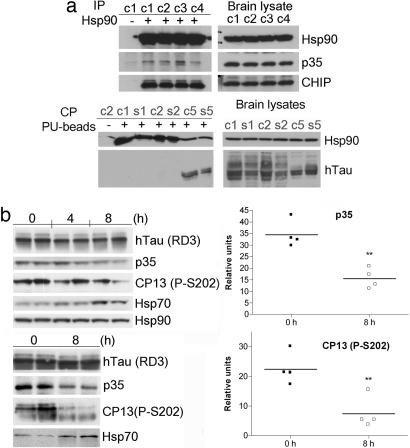
Hsp90 regulates p35 but not WT Tau in vivo in a WT Tau environment. (a) (Upper Left) Immunoprecipitation of Hsp90-containing protein complexes from hTau mouse brains with a specific anti-Hsp90 antibody (+) or a control IgG (−). (Lower Left) Immunoprecipitation of Hsp90-containing protein complexes isolated through chemical precipitation with a solid support immobilized-PU (+) or control beads (−) from hTau (c1, s1, c2, and s2) and JNPL3 (c5 and s5) mouse brains. c1–c5 and s1–s5, cortical and subcortical brain homogenates, respectively, extracted from 10-month-old female mice. (Right) Western blot analyses of brain lysate protein content. (b) (Left) Western blot analysis of soluble (S1) fractions extracted from the cortical brain region of 4-month-old (Upper) and 8- to 10-month-old (Lower) hTau female mice treated for the indicated times with 75 mg/kg PU-DZ8. Representative data are displayed. Hsp90 was used as protein quantification control. (Right) Relative p35 protein expression and Tau phosphorylation at S202 (CP13) in the untreated versus the 8-h-treated mouse group is presented. Specific human Tau isoforms in hTau mice were assessed by immunoblotting with an antibody specific for three-repeat domain Tau (RD3).

References

    1. Neckers L. Handb Exp Pharmacol. 2006;172:259–277. - PubMed
    1. McDonald E, Workman P, Jones K. Curr Top Med Chem. 2006;6:1091–1107. - PubMed
    1. Chiosis G. Expert Opin Ther Targets. 2006;10:37–50. - PubMed
    1. Young JC, Hartl FU. EMBO J. 2000;19:5930–5940. - PMC - PubMed
    1. Murray B, Lynch T, Farrell M. Biochem Soc Trans. 2005;33:595–599. - PubMed

Publication types