


Evolutionary and geographical history of the Leishmania donovani complex with a revision of current taxonomy
- PMID: 17517634
- PMCID: PMC1890502
- DOI: 10.1073/pnas.0703678104
Evolutionary and geographical history of the Leishmania donovani complex with a revision of current taxonomy
Abstract
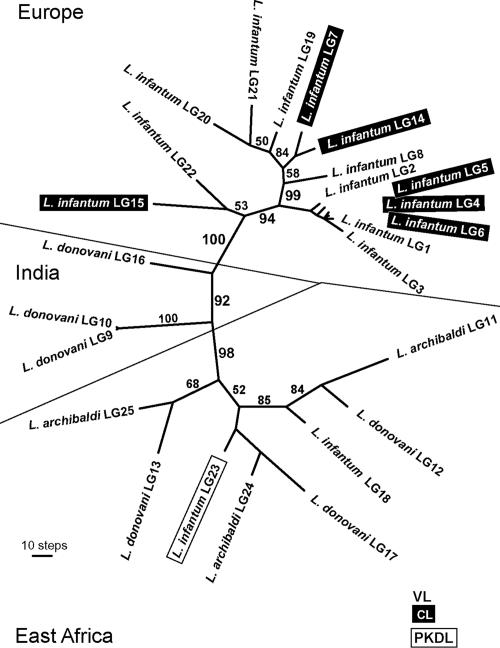
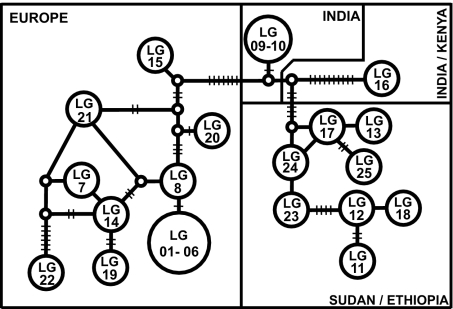
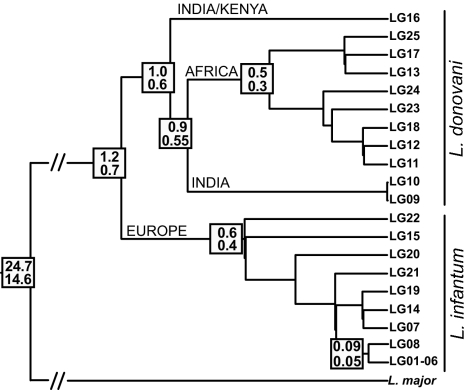
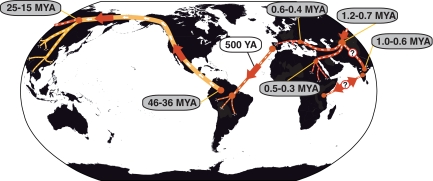
Leishmaniasis is a geographically widespread severe disease, with an increasing incidence of two million cases per year and 350 million people from 88 countries at risk. The causative agents are species of Leishmania, a protozoan flagellate. Visceral leishmaniasis, the most severe form of the disease, lethal if untreated, is caused by species of the Leishmania donovani complex. These species are morphologically indistinguishable but have been identified by molecular methods, predominantly multilocus enzyme electrophoresis. We have conducted a multifactorial genetic analysis that includes DNA sequences of protein-coding genes as well as noncoding segments, microsatellites, restriction-fragment length polymorphisms, and randomly amplified polymorphic DNAs, for a total of approximately 18,000 characters for each of 25 geographically representative strains. Genotype is strongly correlated with geographical (continental) origin, but not with current taxonomy or clinical outcome. We propose a new taxonomy, in which Leishmania infantum and L. donovani are the only recognized species of the L. donovani complex, and we present an evolutionary hypothesis for the origin and dispersal of the species. The genus Leishmania may have originated in South America, but diversified after migration into Asia. L. donovani and L. infantum diverged approximately 1 Mya, with further divergence of infraspecific genetic groups between 0.4 and 0.8 Mya. The prevailing mode of reproduction is clonal, but there is evidence of genetic exchange between strains, particularly in Africa.
Conflict of interest statement
The authors declare no conflict of interest.
Figures
References
-
- Desjeux P. Trans R Soc Trop Med Hyg. 2001;95:239–243. - PubMed
-
- Dujardin JC. Trends Parasitol. 2006;22:4–6. - PubMed
-
- Lainson R, Shaw JJ. In: The Leishmaniases in Biology and Medicine. Peters W, Killick-Kendrick R, editors. London: Academic; 1987. pp. 1–120.
-
- Rioux J-A, Lanotte G, Serres E, Pratlong F, Bastien P, Perieres J. Ann Parasitol Hum Comp. 1990;65:111–125. - PubMed
-
- Pratlong F, Dereure J, Bucheton B, El-Safi S, Dessein A, Lanotte G, Dedet JP. Parasitology. 2001;122:599–605. - PubMed
Publication types
MeSH terms
Substances
LinkOut - more resources
Full Text Sources
Other Literature Sources
