. 2007 May 29;104(22):9505-10.
doi: 10.1073/pnas.0703509104. Epub 2007 May 21.

Combination brain and systemic injections of AAV provide maximal functional and survival benefits in the Niemann-Pick mouse

Affiliations

Combination brain and systemic injections of AAV provide maximal functional and survival benefits in the Niemann-Pick mouse

Marco A Passini et al. Proc Natl Acad Sci U S A. .

Abstract

Niemann-Pick disease (NPD) is caused by the loss of acid sphingomyelinase (ASM) activity, which results in widespread accumulation of undegraded lipids in cells of the viscera and CNS. In this study, we tested the effect of combination brain and systemic injections of recombinant adeno-associated viral vectors encoding human ASM (hASM) in a mouse model of NPD. Animals treated by combination therapy exhibited high levels of hASM in the viscera and brain, which resulted in near-complete correction of storage throughout the body. This global reversal of pathology translated to normal weight gain and superior recovery of motor and cognitive functions compared to animals treated by either brain or systemic injection alone. Furthermore, animals in the combination group did not generate antibodies to hASM, demonstrating the first application of systemic-mediated tolerization to improve the efficacy of brain injections. All of the animals treated by combination therapy survived in good health to an investigator-selected 54 weeks, whereas the median lifespans of the systemic-alone, brain-alone, or untreated ASM knockout groups were 47, 48, and 34 weeks, respectively. These data demonstrate that combination therapy is a promising therapeutic modality for treating NPD and suggest a potential strategy for treating disease indications that cause both visceral and CNS pathologies.


Conflict of interest statement

The authors declare no conflict of interest.

Figures

Fig. 1.
Fig. 1.
Levels of hASM and anti-hASM antibodies in the viscera. ELISAs were performed on serum from periodic eye bleeds to determine the levels of hASM (A) and anti-hASM (B) antibodies in circulation. Shown are the significant P values that compare the individual groups to untreated ASMKO mice. ∗, P < 0.05; ∗∗, P < 0.01; ∗∗∗, P < 0.001. Filled square, untreated ASMKO mice; open square, combination group; open circle, AAV8 systemic-alone group; filled circle, AAV2 brain-alone group.
Fig. 2.
Fig. 2.
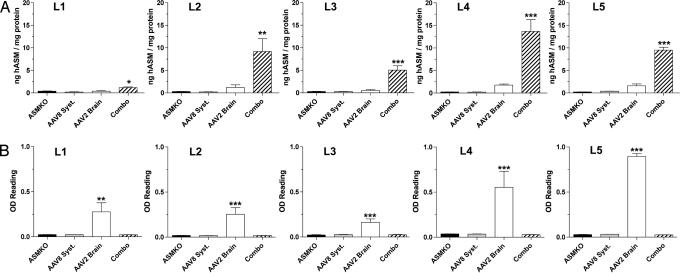
Levels of hASM and anti-hASM antibodies in brain homogenates. The combination group contained significantly higher levels of hASM compared to the AAV2 brain-alone group throughout the entire brain (A). The same homogenates were used to measure anti-hASM antibody levels in the brain (B). See Fig. 3B for the relative positions of L1–L5 along the neuraxis. ∗, P < 0.05; ∗∗, P < 0.01; ∗∗∗, P < 0.001. ASMKO, untreated ASMKO mice; combo, combination group; AAV8 syst, AAV8 systemic-alone group; AAV2 brain, AAV2 brain-alone group; WT, untreated wild-type mice.
Fig. 3.
Fig. 3.
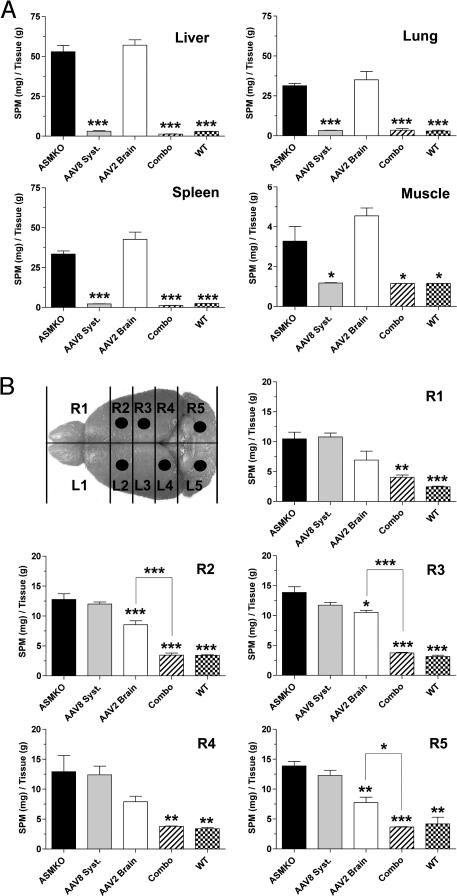
Sphingomyelin levels in the viscera and brain. Shown are levels of SPM storage in the liver, lung, spleen, and skeletal muscle (A), and in the brain (B). The illustration shows the relative positions of the five brain slabs along the neuraxis, and the dots correspond to the brain slabs that contained an injection site. ∗, P < 0.05; ∗∗, P < 0.01; ∗∗∗, P < 0.001. ASMKO, untreated ASMKO mice; combo, combination group; AAV8 syst, AAV8 systemic-alone group; AAV2 brain, AAV2 brain-alone group; WT, untreated wild-type mice.
Fig. 4.
Fig. 4.
Correlation of hASM expression and reversal of pathology in the brain. Shown are sagittal tissue sections of the striatum from the AAV2 brain-alone (A, C, and E), combination (B, D, and F), and untreated ASMKO (G) and wild-type (H) groups. Brain sections were processed by in situ hybridization to determine the site of transduction (A and B), by immunohistochemistry to detect hASM (C and D), and by lysenin to detect SPM (E–H). The hASM human mRNA and protein patterns in the AAV2 brain-alone group roughly overlapped with the area of SPM clearance (arrow). In contrast, animals from the combination group showed clearance of SPM (arrow) that extended beyond the transduction site. On closer examination, a faint and diffuse hASM pattern that may correspond to cross-correction was observed in the combination group (asterisk). This diffuse hASM pattern was not observed in the AAV2 brain-alone group (asterisk), indicating that cross-correction may have been compromised in this group. All photographs were exposure-matched for accurate comparisons. (Scale bar: 0.25 mm.)
Fig. 5.
Fig. 5.
Restoration of motor and cognitive function in ASMKO mice. Analysis of motor function by accelerating (A) and rocking (B) rotarods, and cognitive function by the Barnes maze (C). The combination group performed significantly better than untreated ASMKO and AAV2 brain- and AAV8 systemic-alone groups on both rotarod tests throughout the entire time course (P < 0.001). However, the combination group was not completely asymptomatic when compared to untreated wild-type controls (A and B). In the Barnes maze, the combination group performed at wild-type levels throughout the time course of the study, which did not occur in the singly treated groups (C). ∗, P < 0.05; ∗∗, P < 0.01; ∗∗∗, P < 0.001. In addition, comparisons between the AAV2 brain-alone group and the combination group, and between the combination group and untreated wild-type mice, are shown in brackets. Open square, combination group; open circle, AAV8 systemic-alone group; filled square, AAV2 brain-alone group; filled circle, untreated ASMKO mice; filled triangle, untreated wild type.
Fig. 6.
Fig. 6.
Comparison of fitness and survival benefits. Animals in the combination group gained weight over time, similar to wild-type controls (A). In contrast, the AAV2 brain- and AAV8 systemic-alone groups lost weight during the late stages of survival. The Kaplan–Meier curve shows that all mice in the AAV2 brain- and AAV8 systemic-alone groups became moribund (B). In contrast, 100% of the ASMKO mice receiving combination therapy survived to 54 weeks of age. ∗, P < 0.05; ∗∗, P < 0.01; ∗∗∗, P < 0.001. In addition, comparison between the AAV2 brain-alone group and the combination group is shown in brackets. Open square, combination group; open circle, AAV8 systemic-alone group; filled square, AAV2 brain-alone group; filled circle, untreated ASMKO mice; filled triangle, untreated wild type.

References

    1. Skorupa AF, Fisher KJ, Wilson JM, Parente MK, Wolfe JH. Exp Neurol. 1999;160:17–27. - PubMed
    1. Bosch A, Perret E, Desmaris N, Heard JM. Mol Ther. 2000;1:63–70. - PubMed
    1. Sferra TJ, Qu G, McNeely D, Rennard R, Clark KR, Lo WD, Johnson PR. Hum Gene Ther. 2000;11:507–519. - PubMed
    1. Frisella WA, O'Connor LH, Vogler CA, Roberts M, Walkley S, Levy B, Daly TM, Sands MS. Mol Ther. 2001;3:351–358. - PubMed
    1. Fu H, Samulski RJ, McCown TJ, Picornell YJ, Fletcher D, Muenzer J. Mol Ther. 2002;5:42–49. - PubMed

MeSH terms

Substances

LinkOut - more resources