


Comment
doi: 10.1073/pnas.0702844104.
Epub 2007 May 16.
When the usual insulin is just not enough
Affiliations
- PMID: 17517662
- PMCID: PMC1885561
- DOI: 10.1073/pnas.0702844104
Item in Clipboard
Comment
When the usual insulin is just not enough
Proc Natl Acad Sci U S A.
.
No abstract available
Conflict of interest statement
The authors declare no conflict of interest.
Figures
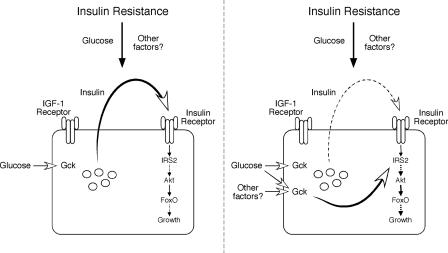
Insulin resistance provokes expansion of the adult beta cell mass, probably by stimulating proliferation of mature beta cells. In their report, Okada et al. (4) show that such compensatory hyperplasia requires the presence of insulin receptors but not insulin-like growth factor 1 (IGF-1) receptors. They describe two models to explain this process. In the first (Left), insulin resistance leads to an increase in circulating glucose, which, through the carbohydrate sensor glucokinase (Gck), augments insulin secretion from the beta cell. The insulin then acts in an autocrine/paracrine manner to activate a well described signaling cascade through IRS2 and Akt to initiate cell growth. This process is independent of the IGF-1 receptor. In an alternative mechanism (Right), insulin resistance also leads to an increase in glucose as well as other unknown factors that act on the beta cell. The critical difference in this model, however, is that insulin is not the primary initiating signal for growth but provides a permissive input to allow response to glucose or other factors by another mechanism, possibly also dependent on Gck. Note that in both cases, the hyperplastic response is absolutely dependent on cellular insulin but not IGF-1 receptors, as clearly shown by Okada et al.
Comment on
-
Insulin receptors in beta-cells are critical for islet compensatory growth response to insulin resistance.Proc Natl Acad Sci U S A. 2007 May 22;104(21):8977-82. doi: 10.1073/pnas.0608703104. Epub 2007 Apr 6. Proc Natl Acad Sci U S A. 2007. PMID: 17416680 Free PMC article.
References
Publication types
MeSH terms
Substances
LinkOut - more resources
Full Text Sources
Medical
