


doi: 10.1128/AAC.01513-06.
Epub 2007 May 21.
Experimental phage therapy against Staphylococcus aureus in mice
Affiliations
- PMID: 17517843
- PMCID: PMC1932491
- DOI: 10.1128/AAC.01513-06
Item in Clipboard
Experimental phage therapy against Staphylococcus aureus in mice
Antimicrob Agents Chemother.
2007 Aug.
Abstract
The present study describes a bacteriophage (M(Sa)) active against Staphylococcus aureus, including methicillin-resistant staphylococcal strains. When inoculated into mice simultaneously with S. aureus A170 (10(8) CFU/mouse), phage (10(9) PFU) rescued 97% of the mice; when applied to nonlethal (5 x 10(6) CFU/mouse) 10-day infections, the phage also fully cleared the bacteria. The phage M(Sa), delivered inside macrophages by S. aureus, kills the intracellular staphylococci in vivo and in vitro. The phage can also prevent abscess formation and reduce the bacterial load and weight of abscesses. These results suggest a potential use of the phage for the control of both local and systemic human S. aureus infections.
Figures
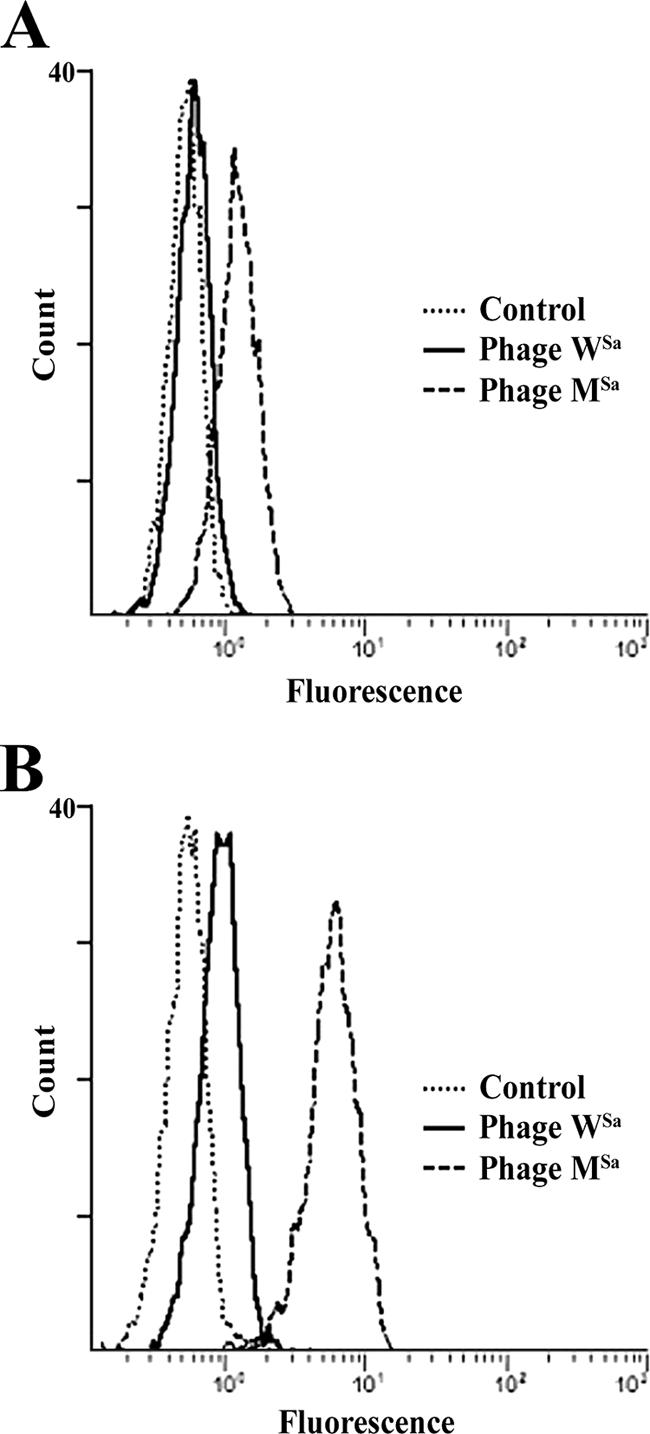
Phages WSa and MSa are serologically distinct. (A) MαMSa antibodies react with the mutant phage MSa but not with the wild phage WSa. The peak of phage WSa coincides with the peak of the negative control. (B) RαWSa antibodies react with the heterologous antigen (phage MSa) more strongly than with the homologous one (phage WSa).
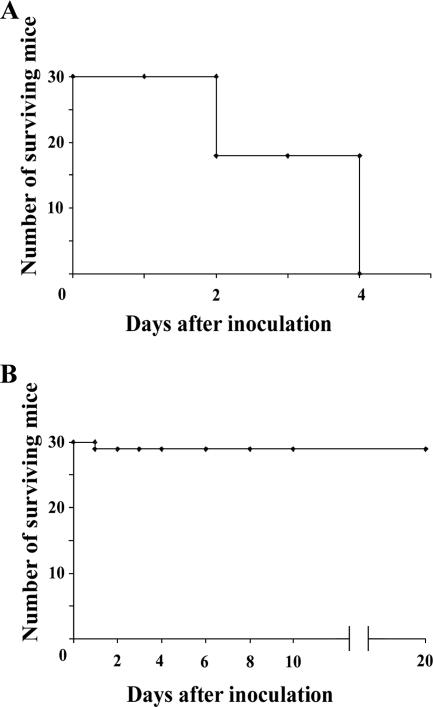
Phage MSa given concurrently with S. aureus A170 rescues 93% (29/30 mice) of mice artificially infected with a lethal dose of the pathogen. (A) Mice infected with S. aureus A170 (108 CFU/mouse). (B) Mice infected with S. aureus (108 CFU/mouse) and treated immediately after with phage MSa (109 PFU/mouse).
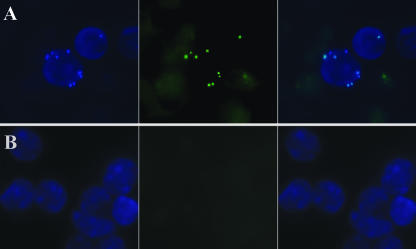
In vivo bactericidal activity of phage MSa. (A) Fluorescence microscopy pictures of kidney cells recovered from mice 4 days after intravenous infection with 108 CFU of GFP-expressing S. aureus. (B) Kidney cells from mice infected concurrently with 108 CFU of GFP-expressing S. aureus and 109 PFU of phage MSa. Cells were counterstained with 4′,6′-diamino-2-phenylindole (DAPI). (Left) Cells analyzed with a 340- to 380-nm filter (DAPI). (Center) Cells analyzed with a 450- to 490-nm filter (GFP). (Right) Overlay. Magnification, ×1,000 (oil immersion).
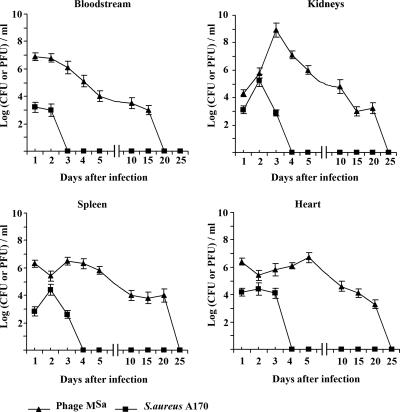
In vivo phage replication occurs when the bacterial density reaches a threshold of approximately 104 CFU/ml. Mice were treated concurrently with 108 CFU S. aureus A170 and 109 PFU phage MSa. The organs were dissected in saline, diluted in distilled water, and plated. In the bloodstream, bacteria did not reach the threshold for phage replication. The bacterial density thresholds were approximately the same for the various organs.
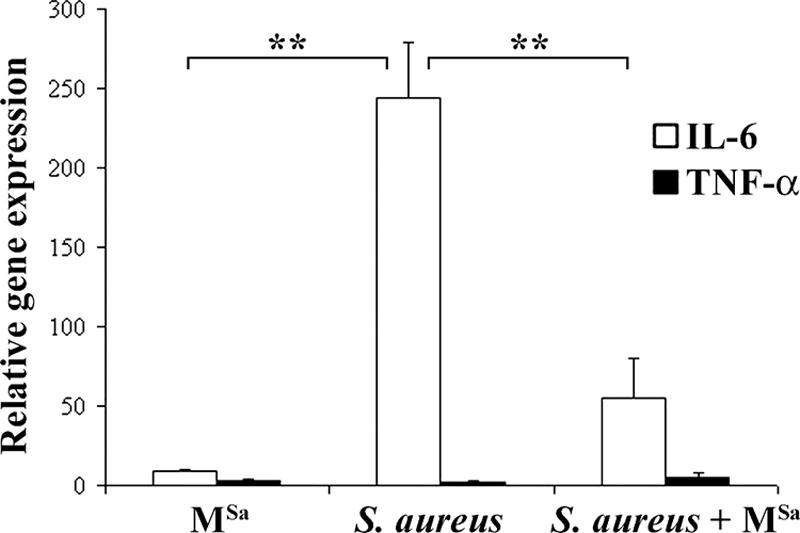
Expression levels of IL-6 and TNF-α genes in the kidneys of mice treated with phage MSa alone, S. aureus alone, or both. Expression levels were measured by real-time RT-PCR 24 h after treatment. Expression levels of the IL-6 and TNF-α genes are given relative to the average levels measured in three control mice. Results refer to three independent experiments, with each one carried out in triplicate. Significant results (at a P value of <0.001) are marked with asterisks.
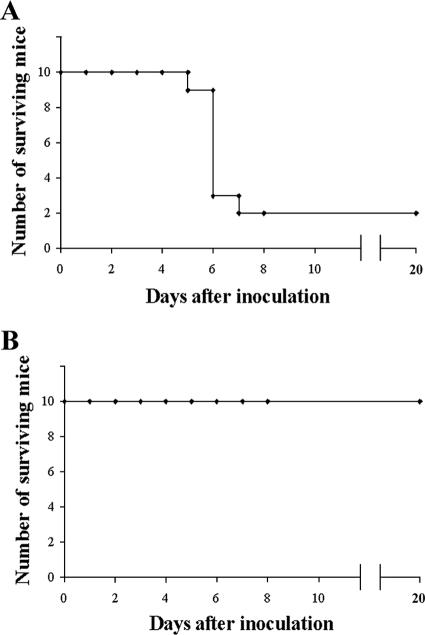
Phage MSa is active against the methicillin-resistant strain S. aureus A352. (A) Mice infected with S. aureus A352 (108 CFU/mouse). (B) Mice infected with S. aureus A352 (108 CFU/mouse) and treated immediately after with phage MSa (109 PFU/mouse).
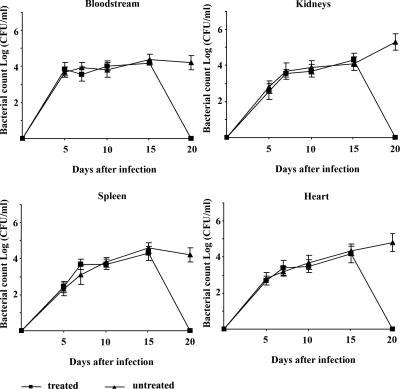
Using mouse sterilization as a criterion for measuring phage activity, MSa was shown to be active when administered 10 days after infection. Mice received 5 × 10⁶ CFU S. aureus A170 and, 10 days later, 109 PFU phage MSa. The experiment included 20 phage-treated and 20 untreated animals.
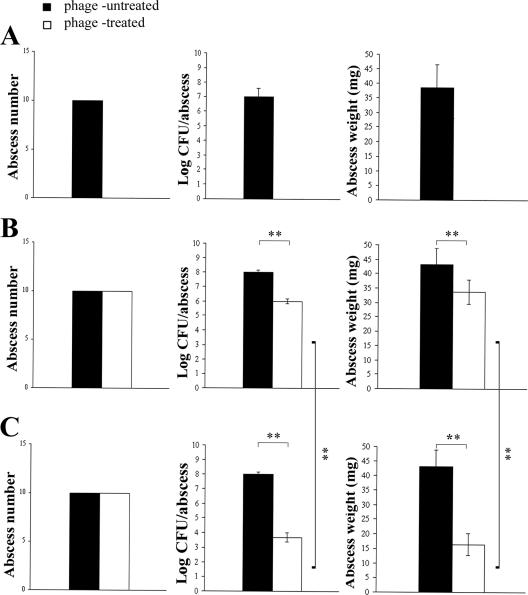
Effect of phage MSa on abscess formation. (A) One single dose of phage MSa, given concurrently with S. aureus, inhibits abscess formation. (B) One single dose of phage MSa, given 4 days after S. aureus, cannot prevent abscess formation but significantly reduces the bacterial load and the weight of abscesses. (C) Multiple doses of phage MSa, given 4 days after S. aureus, are more effective than a single dose in reducing the bacterial load and the weight of abscesses. Significant results (at a P value of <0.001) are marked with asterisks.
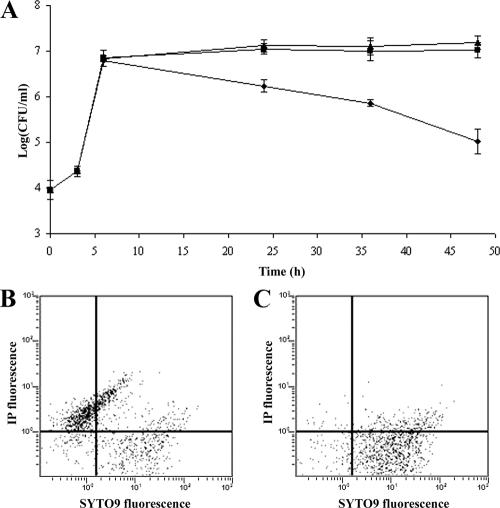
MSa kills intracellular S. aureus A170. (A) Numbers of live bacteria recovered in the 0- to 48-h time interval from mouse peritoneal macrophages (105/well) infected with S. aureus A170 (104 CFU/well) and subsequently treated with phage MSa alone (▪), infected with S. aureus A170 preincubated with phage MSa (⧫), or left untreated (▴). (B) Flow cytometric analysis of dead and live intracellular staphylococci recovered from mouse peritoneal macrophages infected with S. aureus A170 and subsequently treated for 48 h with S. aureus A170 preincubated with phage MSa. (C) Flow cytometric analysis of dead and live intracellular staphylococci recovered from mouse peritoneal macrophages infected with S. aureus A170 and subsequently treated for 48 h with phage MSa. When used concurrently, propidium iodide stains dead bacteria and SYTO9 stains the bacteria which are alive.
References
-
- Adams, M. H. 1959. Methods of study of bacterial viruses, p. 447-448. In Bacteriophages. Interscience Publishers, London, United Kingdom.
-
- Becker, K., R. Roth, and G. Peters. 1998. Rapid and specific detection of toxigenic Staphylococcus aureus: use of two multiplex PCR enzyme immunoassays for amplification and hybridization of staphylococcal enterotoxin genes, exfoliative toxin genes, and toxic shock syndrome toxin 1 gene. J. Clin. Microbiol. 36:2548-2553. - PMC - PubMed
-
- Broxmeyer, L., D. Sosnowska, E. Miltner, O. Chacon, D. Wagner, J. McGarvey, R. G. Barletta, and L. E. Bermudez. 2002. Killing of Mycobacterium avium and Mycobacterium tuberculosis by a mycobacteriophage delivered by a nonvirulent mycobacterium: a model for phage therapy of intracellular bacterial pathogens. J. Infect. Dis. 186:1155-1160. - PubMed
MeSH terms
LinkOut - more resources
Full Text Sources
Other Literature Sources
Medical
