


doi: 10.1128/IAI.00159-07.
Epub 2007 May 21.
Heterogeneity of a Campylobacter jejuni protein that is secreted through the flagellar filament
Affiliations
- PMID: 17517862
- PMCID: PMC1951984
- DOI: 10.1128/IAI.00159-07
Item in Clipboard
Heterogeneity of a Campylobacter jejuni protein that is secreted through the flagellar filament
Infect Immun.
2007 Aug.
Abstract
Cj0859c, or FspA, is a small, acidic protein of Campylobacter jejuni that is expressed by a sigma(28) promoter. Analysis of the fspA gene in 41 isolates of C. jejuni revealed two overall variants of the predicted protein, FspA1 and FspA2. Secretion of FspA occurs in broth-grown bacteria and requires a minimum flagellar structure. The addition of recombinant FspA2, but not FspA1, to INT407 cells in vitro resulted in a rapid induction of apoptosis. These data define a novel C. jejuni virulence factor, and the observed heterogeneity among fspA alleles suggests alternate virulence potential among different strains.
Figures
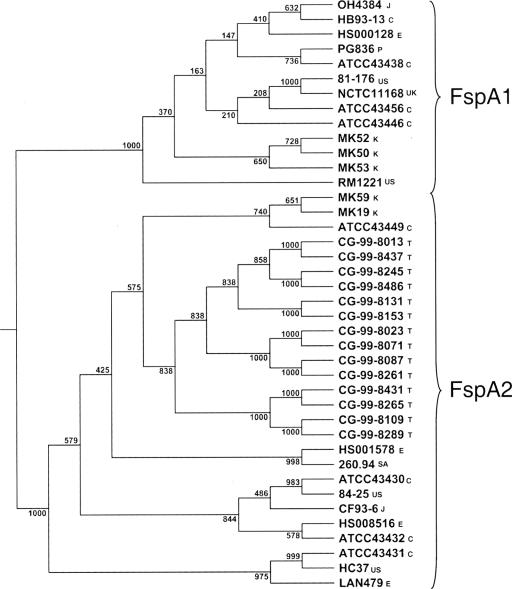
Phylogenetic tree based on protein sequences encoded by alleles of the fspA gene. The tree is based on 1,000 bootstraps; scores are shown for all nodes. The tree clearly separates the two versions of Cj0859c, FspA1 and FspA2. The letters following the strain name refer to the country of isolation. C, Canada; CH, China; E, Egypt; J, Japan; K, Kuwait; PR, Puerto Rico; SA, South Africa; T, Thailand; UK, United Kingdom; US, United States. All the strains, with the exception of C. jejuni RM1221, which was isolated from a chicken carcass (30), were clinical isolates.
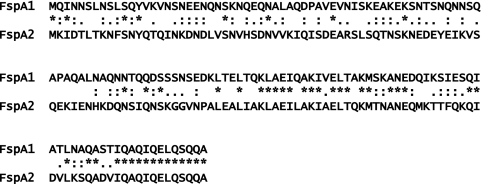
ClustalW alignment (45) of FspA81-176 (FspA1) and FspA8486 (FspA2). *, identical amino acids; :, high-similarity amino acids; ., low-similarity amino acids.
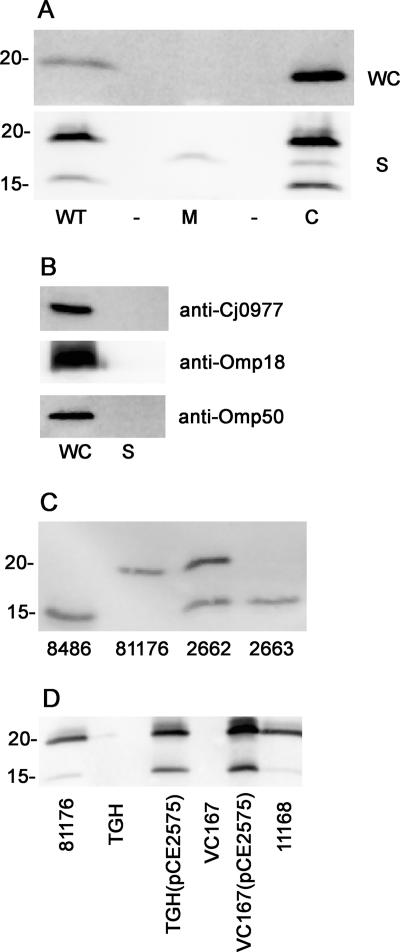
Secretion of FspA. (A) Detection of FspA81-176 in whole cells or supernatants. WT, wild-type 81-176; M, 81-176 fspA81-176::cat (strain PG2572); C, 81-176 fspA81-176::cat (pCPE2575) (strain PG2573); WC, whole cells; S, supernatants. (B) Controls for bacterial cell leakage. Whole cells and supernatants of wild-type 81-176 were detected with antibodies against recombinant forms of Cj0977, Omp18, and Omp50 (4, 5, 13). WC, whole cells; S, supernatants. (C) Detection of FspA8486 in wild-type CG8486 and strain PG2662 (wild-type 81-176 containing FspA8486 inserted into astA) and PG2663 (81-176 fspA81-176::cat containing FspA8486 inserted into astA). (D) Secretion of FspA81-176 campylobacter strains with and without plasmid pCPE2575 carrying fspA81-176. TGH, C. jejuni strain TGH9011.
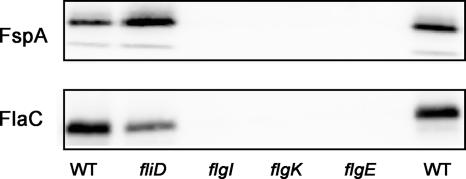
Secretion of FspA81-176 requires a minimum flagellar structure. FspA81-176 or FlaC was detected in supernatants from 81-176 and mutants. Gels were immunodetected with anti-FspA81-176 antibody. WT, wild type.
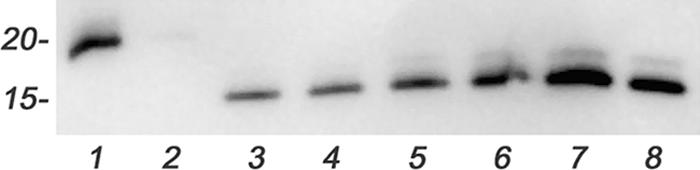
Interactions of FspA proteins with INT407 cells. Hexahistidine-tagged recombinant FspA81-176 and FspA8486 proteins were added to a monolayer of INT407 cells, and the cells were incubated for 4 h at 37°C. The monolayer was washed five times and lysed as described in Materials and Methods, and an aliquot (10 μl, or about 750 ng protein) of each lysate was electrophoresed on a 12.5% SDS-PAGE gel, transferred onto a nitrocellulose membrane, and probed with anti-histidine-tagged mouse monoclonal antibody (Novagen). Lane 1, recombinant FspA81-176 (40 ng); lane 2, INT407 cells plus 50 μg of FspA81-176; lane 3, INT407 cells plus 5 μg FspA8486; lane 4, INT407 cells plus 10 μg FspA8486; lane 5, INT407 cells plus 25 μg FspA8486; lane 6 INT407 cells plus 50 μg FspA8486; lane 7, recombinant FspA8486 (80 ng); lane 8, recombinant FspA8486 (40 ng).
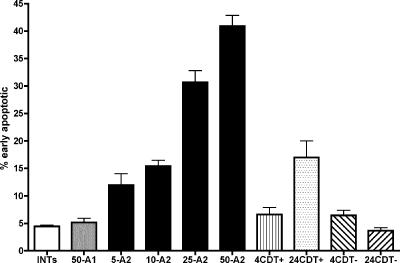
Induction of apoptosis. Monolayers of INT407 cells were treated with 5 μg to 50 μg of recombinant FspA8486 or 50 μg recombinant FspA81-176 for 4 h and stained with a Guava Nexin kit, and the percentage of cells in early stages of apoptosis (annexin V positive and 7-AAD negative) was determined using a Guava Technologies personal cytometer. Bars are labeled as follows: INTs, untreated INT407 cells; 50-A1, 50 μg FspA81-176; 5-A2, 5 μg FspA8486; 10-A2, 10 μg FspA8486; 25-A2, 25 μg FspA8486; 50-A2, 50 μg FspA8486. Additional controls included 10 μg of total protein from wild-type 81-176, which has been shown to contain CDT (21, 22), and 10 μg of total protein from a cdtA mutant of 81-176. These membrane preparations were incubated for both 4 h (4 CDT+ and 4 CDT−) and 24 h (24 CDT+ and 24 CDT−). The data represent the means and standard deviations of four to seven individual experiments done in duplicate. The P value for 5 μg of FspA8486 compared to INT407 cells alone was <0.05; the P values for 10, 25, and 50 μg of FspA8486 compared to INT407 cells alone were <0.001; the P value for the CDT-positive membranes of 81-176 compared to INT407 cells at 24 h of incubation (not shown) was <0.05.
References
-
- Alm, R. A., L.-S. L. Ling, D. Moir, B. L. King, E. D. Brown, P. Doig, D. R. Smith, B. Noonan, B. C. Guild, B. L. de Jonge, G. Carmel, P. J. Tummino, A. Caruso, M. Uria-Nickelsen, D. M. Mills, C. Ives, R. Gibson, D. Merberg, S. D. Mills, Q. Jian, D. E. Taylor, G. F. Vovis, and T. J. Trust. 1999. Genomic sequence comparison of two unrelated isolates of the human gastric pathogen Helicobacter pylori. Nature 397:160-189. - PubMed
-
- Bacon, D. J., C. M. Szymanski, D. H. Burr, R. P. Silver, R. A. Alm, and P. Guerry. 2001. A phase variable capsule is involved in virulence of Campylobacter jejuni 81-176. Mol. Microbiol. 40:769-777. - PubMed
-
- Black, R. E., M. M. Levine, M. L. Clements, T. P. Hughes, and M. J. Blaser. 1988. Experimental Campylobacter jejuni infection in humans. J. Infect. Dis. 157:472-479. - PubMed
Publication types
MeSH terms
Substances
Grants and funding
LinkOut - more resources
Full Text Sources
Other Literature Sources
Molecular Biology Databases
