. 2007 Aug;75(8):3747-57.
doi: 10.1128/IAI.00082-07. Epub 2007 May 21.

Helicobacter pylori chemotaxis modulates inflammation and bacterium-gastric epithelium interactions in infected mice

Affiliations

Helicobacter pylori chemotaxis modulates inflammation and bacterium-gastric epithelium interactions in infected mice

Susan M Williams et al. Infect Immun. 2007 Aug.

Abstract

The ulcer-causing pathogen Helicobacter pylori uses directed motility, or chemotaxis, to both colonize the stomach and promote disease development. Previous work showed that mutants lacking the TlpB chemoreceptor, one of the receptors predicted to drive chemotaxis, led to less inflammation in the gerbil stomach than did the wild type. Here we expanded these findings and examined the effects on inflammation of completely nonchemotactic mutants and mutants lacking each chemoreceptor. Of note, all mutants colonized mice to the same levels as did wild-type H. pylori. Infection by completely nonchemotactic mutants (cheW or cheY) resulted in significantly less inflammation after both 3 and 6 months of infection. Mutants lacking either the TlpA or TlpB H. pylori chemotaxis receptors also had alterations in inflammation severity, while mutants lacking either of the other two chemoreceptors (TlpC and HylB) behaved like the wild type. Fully nonchemotactic and chemoreceptor mutants adhered to cultured gastric epithelial cells and caused cellular release of the chemokine interleukin-8 in vitro similar to the release caused by the wild type. The situation appeared to be different in the stomach. Using silver-stained histological sections, we found that nonchemotactic cheY or cheW mutants were less likely than the wild type to be intimately associated with the cells of the gastric mucosa, although there was not a strict correlation between intimate association and inflammation. Because others have shown that in vivo adherence promotes inflammation, we propose a model in which H. pylori uses chemotaxis to guide it to a productive interaction with the stomach epithelium.


Figures
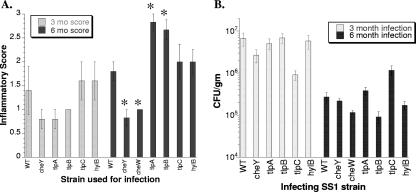
FIG. 1.
FIG. 1.
(A) Inflammatory scores of mouse stomachs infected with H. pylori SS1 or its isogenic chemotaxis mutants. Mouse stomach sections were stained with hematoxylin and eosin and graded for the amount of lymphocyte infiltration as described in Materials and Methods. Mice were infected for 3 months or 6 months with the strains indicated below the bars. In all experiments C57BL/6 mice were used. Five mice were used for each group for the 3-month infections. For the 6-month infections, six mice were used for all groups except the wild-type and ΔtlpB::cat groups (five mice). Uninfected mice for both time points gave inflammatory scores of zero. The error bars indicate the standard errors of the means. An asterisk indicates that there is a statistically significant difference between the inflammatory score for a strain and the score for mice infected with the wild type for the same length of time. The data are also shown in Tables 2 and 3. WT, wild type. (B) CFU per gram of mouse stomach. The numbers of viable bacteria were determined after 3 or 6 months of infection, using samples described above. At each time point, there is no difference between the number of wild-type bacterial cells and the number of cells of any of the mutants. The error bars indicate the standard errors of the means.
FIG. 2.
FIG. 2.
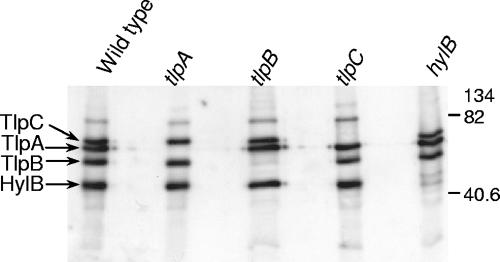
Western analysis of H. pylori SS1 and its isogenic chemoreceptor mutants, showing that each mutant lacks one chemoreceptor. Total bacterial proteins were collected from 2-day CHBA cultures. Proteins were separated on a 10% sodium dodecyl sulfate-polyacrylamide gel electrophoresis gel and transferred to polyvinylidene difluoride membranes. Transferred proteins were incubated with 1:5,000 anti-GST-TlpA22, which reacts to the conserved domain that is shared between all chemoreceptors. The strains are indicated above the lanes, and SS1 ΔtlpB::cat was used for this analysis. The position of each chemoreceptor is shown on the left, and the molecular masses (in kilodaltons) are given at the right. TlpC is predicted to be a 75.2-kDa protein, TlpA is predicted to be a 74.5-kDa protein, TlpB is predicted to be a 62.8-kDa protein, and HylB is predicted to be a 48.4-kDa protein; the sizes determined in this study agree well with these predictions.
FIG. 3.
FIG. 3.
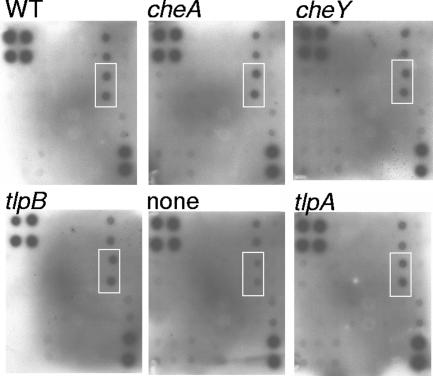
Cytokine/chemokine release from AGS cells. AGS cells were incubated with H. pylori wild-type strain SS1 and its isogenic mutants as indicated above the panels. Culture supernatant was collected and assayed using a cytokine array. The six panels show representative arrays from H. pylori SS1 strains. The white box on each array encompasses the IL-8 spots; the two spots above these spots, positive in every sample, are Gro. The group of four spots at the top left and the group of two spots at the bottom right are positive controls. The assays were repeated three or four times for each H. pylori strain; the results of one representative assay are shown.
FIG. 4.
FIG. 4.
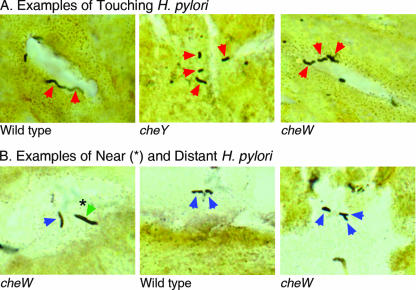
Examples of H. pylori-gastric epithelium interactions observed in infected mouse stomach sections. Stomach samples from C57BL/6 mice infected for 6 months (same mice as those described in Fig. 1 and Tables 3 and 6) were stained with Warthin-Starry stain and visualized using light microscopy with a ×100 oil immersion objective. Bacteria stain dark brown, the epithelium stains gold, and the mucus stains light yellow-clear. A grader who was blinded to the identity of the infecting strain scored every visible bacterium with morphology appropriate for H. pylori as either touching, near, or distant, as described in the text. (A) Examples of bacteria scored as touching (indicated by arrowheads) for each bacterial strain (H. pylori wild-type strain SS1, SS1 cheY, or SS1 cheW). (B) Examples of bacteria scored as near and bacteria scored as distant (indicated by green and blue arrowheads, respectively).

References

    1. Akanuma, M., S. Maeda, K. Ogura, Y. Mitsuno, Y. Hirata, T. Ikenoue, M. Otsuka, T. Watanabe, Y. Yamaji, H. Yoshida, T. Kawabe, Y. Shiratori, and M. Omata. 2002. The evaluation of putative virulence factors of Helicobacter pylori for gastroduodenal disease by use of a short-term Mongolian gerbil infection model. J. Infect. Dis. 185:341-347. - PubMed
    1. Alm, R. A., L.-S. L. Ling, D. T. Moir, B. L. King, E. D. Brown, P. C. Doig, D. R. Smith, B. Noonan, B. C. Guild, B. L. Dejonge, G. Carmel, P. J. Tummino, A. Caruso, M. Uria-Nickelsen, D. M. Mills, C. Ives, R. Gibson, D. Merber, S. D. Mills, Q. Jiang, D. E. Taylor, G. F. Vovis, and T. J. Trust. 1999. Genomic-sequence comparison of two unrelated isolates of the human gastric pathogen Helicobacter pylori. Nature 397:176-180. - PubMed
    1. Andermann, T. M., Y.-T. Chen, and K. M. Ottemann. 2002. Two predicted chemoreceptors promote Helicobacter pylori infection. Infect. Immun. 70:5877-5881. - PMC - PubMed
    1. Armitage, J. P. 1999. Bacterial tactic responses. Adv. Microb. Physiol. 41:229-289. - PubMed
    1. Asahi, M., T. Azuma, S. Ito, Y. Ito, H. Suto, Y. Nagai, M. Tsubokawa, Y. Tohyama, S. Maeda, M. Omata, T. Suzuki, and C. Sasakawa. 2000. Helicobacter pylori CagA protein can be tyrosine phosphorylated in gastric epithelial cells. J. Exp. Med. 191:593-602. - PMC - PubMed

Publication types

MeSH terms