


Bladder cancer associated glycoprotein signatures revealed by urinary proteomic profiling
- PMID: 17518487
- PMCID: PMC2668245
- DOI: 10.1021/pr0700807
Bladder cancer associated glycoprotein signatures revealed by urinary proteomic profiling
Abstract
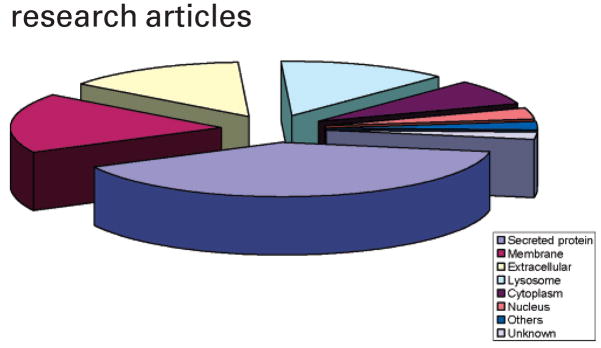
Current methods in the noninvasive detection and surveillance of bladder cancer via urine analysis include voided urine cytology (VUC) and some diagnostic urinary protein biomarkers; however, due to the poor sensitivity of VUC and high false-positive rates of currently available protein assays, detection of bladder cancer via urinalysis remains a challenge. In the study presented here, a rapid, high-sensitivity technique was developed to profile the N-linked glycoprotein component in naturally micturated human urine specimens. Concanavalin A (Con A) affinity chromatography coupled to nanoflow liquid chromatography was utilized to separate the complex peptide mixture prior to a linear ion trap MS analysis. Of 186 proteins identified with high confidence by multiple analyses, 40% were secreted proteins, 18% membrane proteins, and 14% extracellular proteins. In this study, the presence of several proteins appeared to be associated with the presence of bladder cancer, including alpha-1B-glycoprotein that was detected in all tumor-bearing patient samples but in none of the samples obtained from non-tumor-bearing individuals. The combination of Con A affinity chromatography and nano-LC/MS/MS provides an initial investigation of N-glycoproteins in complex biological samples and facilitates the identification of potential biomarkers of bladder cancer in noninvasively obtained human urine.
Figures
References
-
- Pisani P, Parkin DM, Bray F, Ferlay J. Estimates of the worldwide mortality from 25 cancers in 1990. Int J Cancer. 1999;83(1):18–29. - PubMed
-
- Aben KK, Kiemeney LA. Epidemiology of bladder cancer. Eur Urol. 1999;36(6):660–72. - PubMed
-
- Millan-Rodriguez F, Chechile-Toniolo G, Salvador-Bayarri J, Palou J, Algaba F, Vicente-Rodriguez J. Primary superficial bladder cancer risk groups according to progression, mortality and recurrence. J Urol. 2000;164(3 Part 1):680–4. - PubMed
-
- Cajulis RS, Haines GK, 3rd, Frias-Hidvegi D, McVary K, Bacus JW. Cytology, flow cytometry, image analysis, and interphase cytogenetics by fluorescence in situ hybridization in the diagnosis of transitional cell carcinoma in bladder washes: a comparative study. Diagn Cytopathol. 1995;13(3):214–23. discussion 224. - PubMed
-
- Hautmann S, Toma M, Lorenzo Gomez MF, Friedrich MG, Jaekel T, Michl U, Schroeder GL, Huland H, Juenemann KP, Lokeshwar VB. Immunocyt and the HA-HAase urine tests for the detection of bladder cancer: a side-by-side comparison. Eur Urol. 2004;46(4):466–71. - PubMed
Publication types
MeSH terms
Substances
Grants and funding
LinkOut - more resources
Full Text Sources
Other Literature Sources
Medical
Miscellaneous
