Comparative Study
. 2007 Jun 5;104(23):9834-9.
doi: 10.1073/pnas.0703388104. Epub 2007 May 22.

Sildenafil accelerates reentrainment of circadian rhythms after advancing light schedules

Affiliations
Comparative Study

Sildenafil accelerates reentrainment of circadian rhythms after advancing light schedules

Patricia V Agostino et al. Proc Natl Acad Sci U S A. .

Abstract

Mammalian circadian rhythms are generated by a master clock located in the suprachiasmatic nuclei and entrained by light-activated signaling pathways. In hamsters, the mechanism responsible for light-induced phase advances involves the activation of guanylyl cyclase, cGMP and its related kinase (PKG). It is not completely known whether interference with this pathway affects entrainment of the clock, including adaptation to changing light schedules. Here we report that cGMP-specific phosphodiesterase 5 is present in the hamster suprachiasmatic nuclei, and administration of the inhibitor sildenafil (3.5 mg/kg, i.p.) enhances circadian responses to light and decreases the amount of time necessary for reentrainment after phase advances of the light-dark cycle. These results suggest that sildenafil may be useful for treatment of circadian adaptation to environmental changes, including transmeridian eastbound flight schedules.


Conflict of interest statement

The authors declare no conflict of interest.

Figures
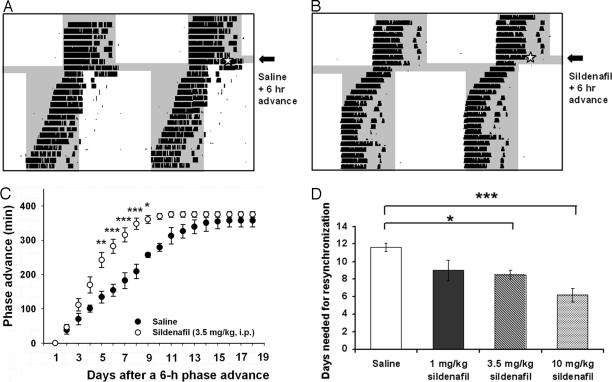
Fig. 1.
Fig. 1.
Effects of sildenafil on circadian reentrainment. Double-plotted actograms of hamster wheel-running activity showing reentrainment to a 6-h advance of the LD cycle after the injection of vehicle (A) and sildenafil (B) (3.5 mg/kg, i.p.) at ZT 18 on the day of the cycle change. Periods of darkness are shaded in gray. (C) Summary of phase advances (minutes) on each day after the change in the LD cycle (n = 6 animals per group, means ± SEM). Open and filled circles indicate sildenafil and saline, respectively. ∗∗∗, P < 0.001; ∗∗, P < 0.01; ∗, P < 0.05 (Student's t test). (D) Dose–response curve for sildenafil effects (mean ± SEM, n = 6). ∗∗∗, P < 0.001; ∗, P < 0.05 (ANOVA followed by Tukey's test).
Fig. 2.
Fig. 2.
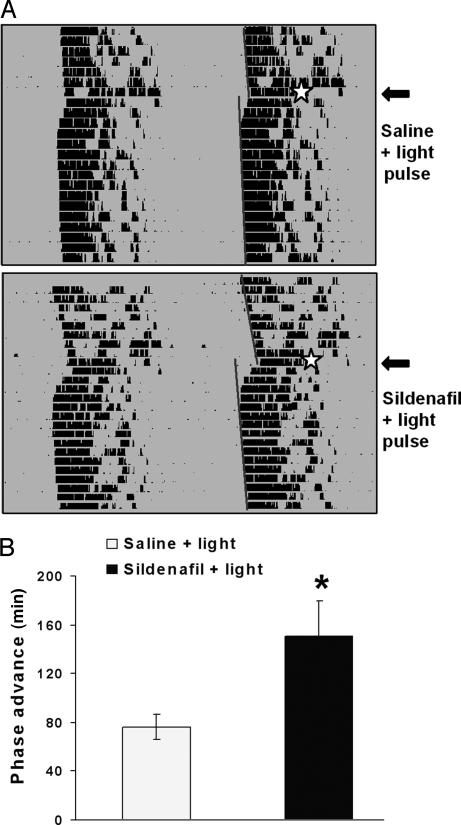
Effects of sildenafil on light-induced phase advances. (A) Double-plotted actograms of hamster wheel-running activity showing vehicle or sildenafil (3.5 mg/kg, i.p.) injection 45 min before a light pulse at CT 18. Light stimulation is indicated by a star. Activity onsets are indicated by straight lines drawn over the actograms. (B) Quantification of phase advances (mean ± SEM, n = 5). ∗, P < 0.05 (Student's t test).
Fig. 3.
Fig. 3.
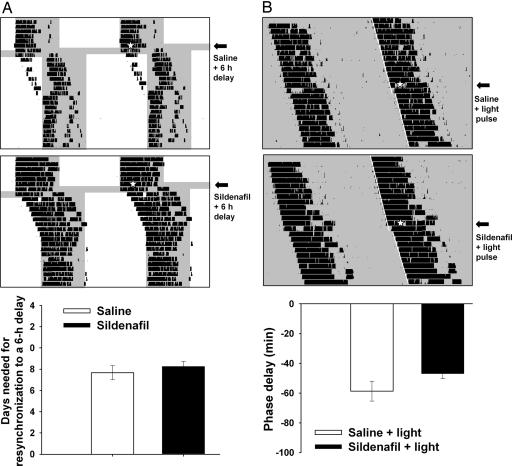
Effects of sildenafil on phase delays. (A) Effect on reentrainment of wheel-running activity rhythm following a 6-h phase delay of the LD cycle. Double-plotted actograms of hamster wheel-running activity showing reentrainment to a 6-h delay of the LD cycle after the injection of vehicle (Top) and sildenafil (3.5 mg/kg, i.p.; Middle). Injections of either saline or sildenafil were given at ZT 14 on the day of the cycle change (white star). (Bottom) Mean ± SEM (n = 4 animals per group) of days needed for reentrainment. (B) Effect of sildenafil on light-induced phase delays after light pulses at CT 14. Representative actograms show vehicle (Top) or sildenafil (Middle) injections. (Bottom) Mean ± SEM (n = 4 animals per group).
Fig. 4.
Fig. 4.
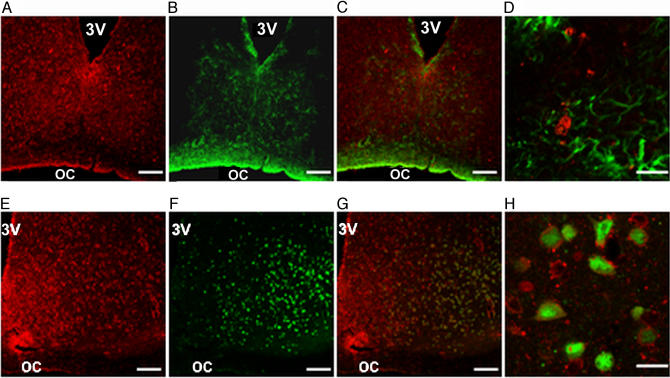
Neuronal localization of cGMP in the SCN. Combination of single confocal images for cGMP (red fluorescence) and NeuN or GFAP (green fluorescence) staining. (A) cGMP. (B) GFAP. (C) Double-labeling of cGMP-GFAP. (D) Higher magnification of C shows no colocalization between cGMP and GFAP. (E) cGMP. (F) Neuron-specific nuclear protein, NeuN. (G) Double-labeling of cGMP-NeuN. (H) Higher magnification of G shows cells with both cGMP (cytoplasmic) and NeuN (nuclear), suggesting neuronal expression of cGMP in the SCN. (Scale bars: 100 μm in A–C and E–G and 20 μm in D and H.)

References

    1. Pittendrigh CS, Daan A. J Comp Physiol. 1976;106:291–331.
    1. Klein DC, Moore RY, Reppert SM. Suprachiasmatic Nucleus: The Mind's Clock. New York: Oxford Univ Press; 1991.
    1. Ebling FJ. Prog Neurobiol. 1996;50:109–132. - PubMed
    1. Hannibal J. Cell Tissue Res. 2002;309:73–88. - PubMed
    1. Dziema H, Obrietan K. J Neurophysiol. 2002;88:1374–1386. - PubMed

Publication types

MeSH terms