


The potential therapeutic role of lymph node resection in epithelial ovarian cancer: a study of 13918 patients
- PMID: 17519907
- PMCID: PMC2359970
- DOI: 10.1038/sj.bjc.6603803
The potential therapeutic role of lymph node resection in epithelial ovarian cancer: a study of 13918 patients
Abstract
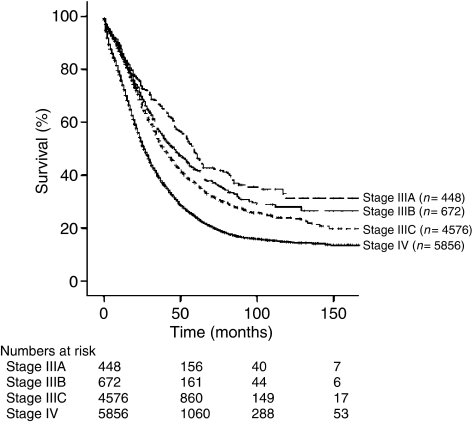
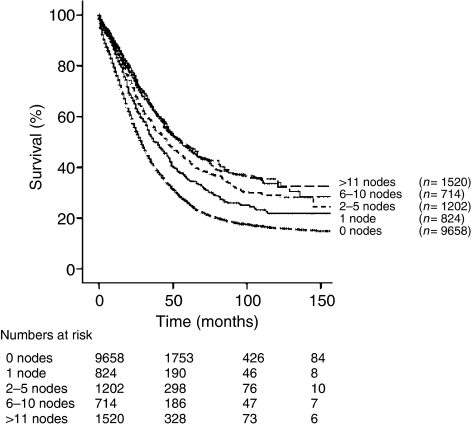
The aim of the study is to determine the role of lymphadenectomy in advanced epithelial ovarian cancer. The data were obtained from the Surveillance, Epidemiology and End Results (SEER) program reported between 1988 and 2001. Kaplan-Meier estimates and Cox proportional hazards regression models were used for analysis. Of 13 918 women with stage III-IV epithelial ovarian cancer (median age: 64 years), 87.9% were Caucasian, 5.6% African Americans, and 4.4% Asians. A total of 4260 (30.6%) underwent lymph node dissections with a median number of six nodes reported. For all patients, a more extensive lymph node dissection (0, 1, 2-5, 6-10, 11-20, and >20 nodes) was associated with an improved 5-year disease-specific survival of 26.1, 35.2, 42.6, 48.4, 47.5, and 47.8%, respectively (P<0.001). Of the stage IIIC patients with nodal metastases, the extent of nodal resection (1, 2-5, 6-10, 11-20, and >20 nodes) was associated with improved survivals of 36.9, 45.0, 47.8, 48.7, and 51.1%, respectively (P=0.023). On multivariate analysis, the extent of lymph node dissection and number of positive nodes were significant independent prognosticators after adjusting for age, year at diagnosis, stage, and grade of disease. The extent of lymphadenectomy is associated with an improved disease-specific survival of women with advanced epithelial ovarian cancer.
Figures
References
-
- Arango HA, Hoffman MS, Roberts WS, DeCesare SL, Fiorica JV, Drake J (2000) Accuracy of lymph node palpation to determine need for lymphadenectomy in gynecologic malignancies. Obstet Gynecol 95: 553–556 - PubMed
-
- Baiocchi G, Grosso G, di Re E, Fontanelli R, Raspagliesi F, di Re F (1998) Systematic pelvic and paraaortic lymphadenectomy at second-look laparotomy for ovarian cancer. Gynecol Oncol 69: 151–156 - PubMed
-
- Benedetti Panici P, Maggioni A, Hacker N, Landoni F, Ackermann S, Campagnutta E, Tamussino K, Winter R, Pellegrino A, Greggi S, Angioli R, Manci N, Scambia G, Dell'Anna T, Fossati R, Floriani I, Rossi RS, Grassi R, Favalli G, Raspagliesi F, Giannarelli D, Martella L, Mangioni C (2005) Systematic aortic and pelvic lymphadenectomy versus resection of bulky nodes only in optimally debulked advanced ovarian cancer: a randomized clinical trial. J Natl Cancer Inst 97: 560–566 - PubMed
-
- Bristow RE, Tomacruz RS, Armstrong DK, Trimble EL, Montz FJ (2002) Survival effect of maximal cytoreductive surgery for advanced ovarian carcinoma during the platinum era: a meta-analysis. J Clin Oncol 20: 1248–1259 - PubMed
-
- Burghardt E, Girardi F, Lahousen M, Tamussino K, Stettner H (1991) Patterns of pelvic and paraaortic lymph node involvement in ovarian cancer. Gynecol Oncol 40: 103–106 - PubMed
