


SOX2 anophthalmia syndrome: 12 new cases demonstrating broader phenotype and high frequency of large gene deletions
- PMID: 17522144
- PMCID: PMC2095460
- DOI: 10.1136/bjo.2007.117929
SOX2 anophthalmia syndrome: 12 new cases demonstrating broader phenotype and high frequency of large gene deletions
Abstract
Background: Developmental eye anomalies, which include anophthalmia (absent eye) or microphthalmia (small eye) are an important cause of severe visual impairment in infants and young children. Heterozygous mutations in SOX2, a SOX1B-HMG box transcription factor, have been found in up to 10% of individuals with severe microphthalmia or anophthalmia and such mutations could also be associated with a range of non-ocular abnormalities.
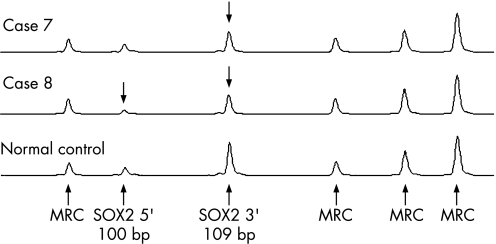
Methods: We performed mutation analysis on a new cohort of 120 patients with congenital eye abnormalities, mainly anophthalmia, microphthalmia and coloboma. Multiplex ligation-dependent probe amplification (MLPA) and fluorescence in situ hybridisation (FISH) were used to detect whole gene deletion.
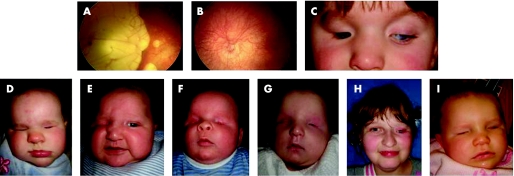
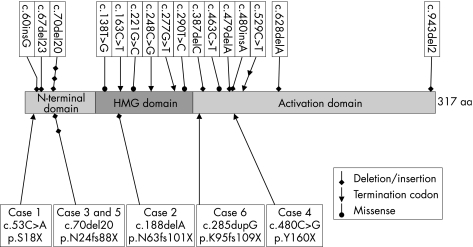
Results: We identified four novel intragenic SOX2 mutations (one single base deletion, one single base duplication and two point mutations generating premature translational termination codons) and two further cases with the previously reported c.70del20 mutation. Of 52 patients with severe microphthalmia or anophthalmia analysed by MLPA, 5 were found to be deleted for the whole SOX2 gene and 1 had a partial deletion. In two of these, FISH studies identified sub-microscopic deletions involving a minimum of 328 Kb and 550 Kb. The SOX2 phenotypes include a patient with anophthalmia, oesophageal abnormalities and horseshoe kidney, and a patient with a retinal dystrophy implicating SOX2 in retinal development.
Conclusion: Our results provide further evidence that SOX2 haploinsufficiency is a common cause of severe developmental ocular malformations and that background genetic variation determines the varying phenotypes. Given the high incidence of whole gene deletion we recommend that all patients with severe microphthalmia or anophthalmia, including unilateral cases be screened by MLPA and FISH for SOX2 deletions.
Conflict of interest statement
Competing interests: None.
References
-
- Clementi M, Turolla L, Mammi I.et al Clinical anophthalmia: an epidemiological study in northeast Italy based on 368,256 consecutive births. Teratology 199246551–553. - PubMed
-
- Fantes J, Ragge N K, Lynch S A.et al Mutations in SOX2 cause anophthalmia. Nat Genet 200333461–463. - PubMed
-
- Ragge N K, Lorenz B, Schneider A.et al SOX2 anophthalmia syndrome. Am J Med Genet A 20051351–7 discussion 8. - PubMed
Publication types
MeSH terms
Substances
LinkOut - more resources
Full Text Sources
Medical
