Comparative Study
. 2007 Jul 3;104(27):11130-7.
doi: 10.1073/pnas.0703538104. Epub 2007 May 23.

Up-regulation of heat shock proteins is essential for cold survival during insect diapause

Affiliations
Comparative Study

Up-regulation of heat shock proteins is essential for cold survival during insect diapause

Joseph P Rinehart et al. Proc Natl Acad Sci U S A. .

Abstract

Diapause, the dormancy common to overwintering insects, evokes a unique pattern of gene expression. In the flesh fly, most, but not all, of the fly's heat shock proteins (Hsps) are up-regulated. The diapause up-regulated Hsps include two members of the Hsp70 family, one member of the Hsp60 family (TCP-1), at least four members of the small Hsp family, and a small Hsp pseudogene. Expression of an Hsp70 cognate, Hsc70, is uninfluenced by diapause, and Hsp90 is actually down-regulated during diapause, thus diapause differs from common stress responses that elicit synchronous up-regulation of all Hsps. Up-regulation of the Hsps begins at the onset of diapause, persists throughout the overwintering period, and ceases within hours after the fly receives the signal to reinitiate development. The up-regulation of Hsps appears to be common to diapause in species representing diverse insect orders including Diptera, Lepidoptera, Coleoptera, and Hymenoptera as well as in diapauses that occur in different developmental stages (embryo, larva, pupa, adult). Suppressing expression of Hsp23 and Hsp70 in flies by using RNAi did not alter the decision to enter diapause or the duration of diapause, but it had a profound effect on the pupa's ability to survive low temperatures. We thus propose that up-regulation of Hsps during diapause is a major factor contributing to cold-hardiness of overwintering insects.


Conflict of interest statement

The authors declare no conflict of interest.

Figures
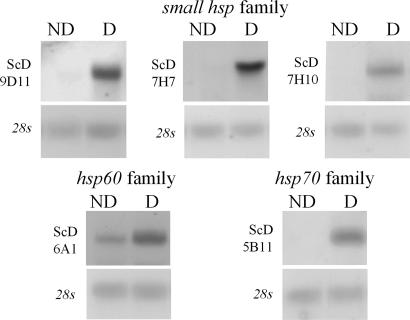
Fig. 1.
Fig. 1.
Developmental up-regulation of several Hsps (three small Hsps, an Hsp60 family member, and a new form of Hsp70) during pupal diapause in the flesh fly, S. crassipalpis, based on Northern blot hybridization. ND, nondiapausing pupae maintained at 20°C; D, diapausing pupae maintained for 20 days at 20°C.
Fig. 2.
Fig. 2.
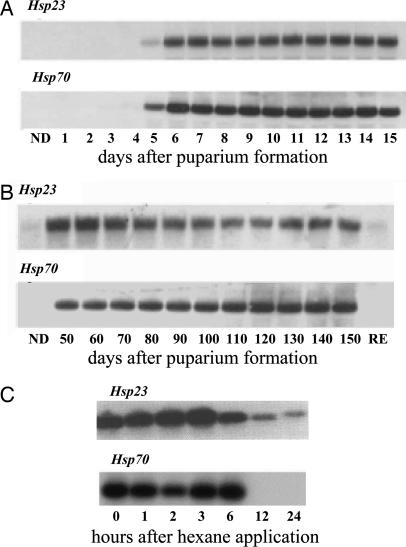
Temporal patterns of Hsp23 and Hsp70 expression in S. crassipalpis show that Hsps are turned on at the onset of pupal diapause, continue to be expressed throughout diapause and the postdiapause period, and are turned off within hours after the pupae receive a signal to resume development. (A) Expression at the onset and early phase of pupal diapause (diapause begins 5d after puparium formation). (B) During late diapause and postdiapause development (postdiapause begins ≈60 d after puparium formation). Adapted from Hayward et al. (47). (C) Rapid decline in expression of Hsp23 and Hsp70 when pupal diapause is terminated artificially by the application of hexane. Adapted from Yocum et al. (17) and Rinehart et al. (18). ND, nondiapausing pupae; RE, red eye stage of pharate adult development. The 28s was used as the control gene.
Fig. 3.
Fig. 3.
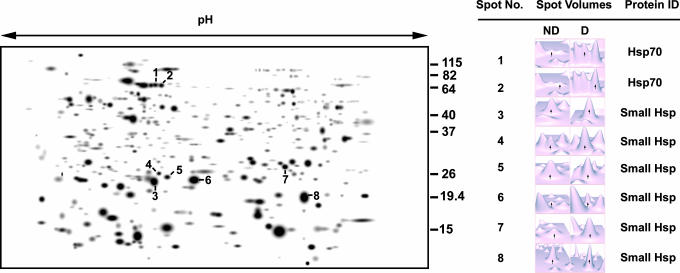
Two-dimensional gel depicting brain proteins from diapausing pupae of S. crassipalpis. The numbered proteins, which are either unique to or more abundant in the diapausing brain, are all heat shock proteins. Numbers to the right of the gel represent kilodalton size markers. ND, nondiapause; D, diapause. Adapted from Li et al. 2007.
Fig. 4.
Fig. 4.
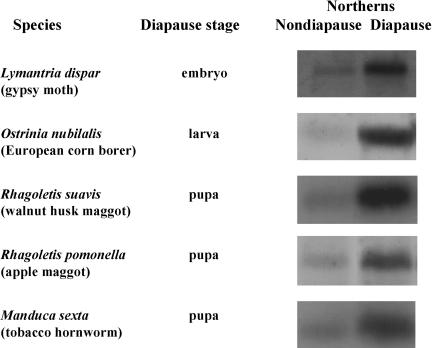
Evidence that Hsp70 is up-regulated during diapause in several additional insects representing different orders and different stages of diapause. Northern blot hybridizations are based on Hsp70 clones developed for each species. L. dispar (Lepidoptera) has an obligate diapause as a late embryo (pharate first-instar larva), and the comparison is made between a chilled diapausing embryo and one that has just terminated diapause. O. nubilalis (Lepidoptera) diapauses during its last larval instar in response to short day length and low temperature; the comparison is made between nondiapausing larvae reared at long day length vs. diapausing larvae reared at short day length. R. suavis and R. pomonella (Diptera) both have a facultative pupal diapause; the comparison is made between pupae in diapause and those that have terminated diapause. M. sexta (Lepidoptera) diapauses as a pupa in response to short day length. Here, the comparison is made between a diapausing pupa reared at short day length vs. a nondiapausing pupa reared at long day length.
Fig. 5.
Fig. 5.
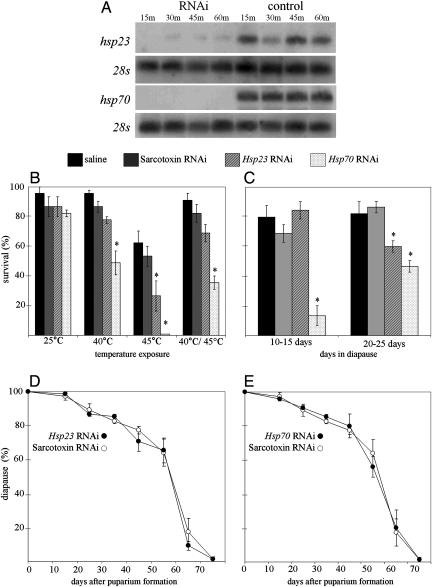
RNAi demonstrates that suppression of Hsp23 and Hsp70 expression results in a loss of both heat and cold tolerance. (A) Suppression of Hsp23 and Hsp70 expression in flesh flies that were injected as third-instar wandering larvae with 1.0 μg of dsRNA and then subjected to 45°C heat shocks of various durations. (B) Reduction in heat tolerance of flies injected with dsRNA and then exposed to 25°C (rearing temperature), 40°C for 2 h, 45°C for 1 h, or to 40°C for 2 h and then to 45°C for 1 h. Mean ± SE of three replicates of 15 individuals each. (C) Reduction of cold tolerance in diapausing pupae injected as wandering third-instar larvae with dsRNA. Survival of pupae after a 24-h exposure to −15°C was evaluated 10–15 d or 20–25 d after the onset of pupal diapause. Mean ± SE of three replicates of 15 individuals each. (D and E) Diapause incidence and duration in flies injected with Hsp23 dsRNA (D) or Hsp70 dsRNA (E) as wandering third-instar larvae. Mean ± SE of three replicates of 25 individuals each. Sarcotoxin dsRNA was used as the control in BE. The asterisks indicates significant differences based on Tukey's test of the least-squares means.

References

    1. Tauber MJ, Tauber CA, Masaki S. Seasonal Adaptations of Insects. Oxford: Oxford Univ Press; 1986.
    1. Danks HV. Insect Dormancy: An Ecological Perspective. Ottawa, Canada: Biological Survey; 1987.
    1. Denlinger DL, Yocum GD, Rinehart JP. In: Comprehensive Insect Molecular Science. Gilbert LI, Iatrou K, Gill S, editors. Vol 3. Amsterdam: Elsevier; 2005. pp. 615–640.
    1. Denlinger DL. Annu Rev Entomol. 2002;47:93–122. - PubMed
    1. Lee RE. In: Insects at Low Temperature. Lee RE, Denlinger DL, editors. New York: Chapman & Hall; 1991. pp. 17–46.

Publication types

MeSH terms