


Comparison of three perioperative fluid regimes for laparoscopic donor nephrectomy : A prospective randomized dose-finding study
- PMID: 17522928
- PMCID: PMC2169269
- DOI: 10.1007/s00464-007-9391-9
Comparison of three perioperative fluid regimes for laparoscopic donor nephrectomy : A prospective randomized dose-finding study
Abstract
Background: Pneumoperitoneum (PP), as used for laparoscopic procedures, impairs stroke volume, renal blood flow, glomerular filtration rate and urine output. This study investigated whether perioperative fluid management can abolish these negative effects of PP on hemodynamics.
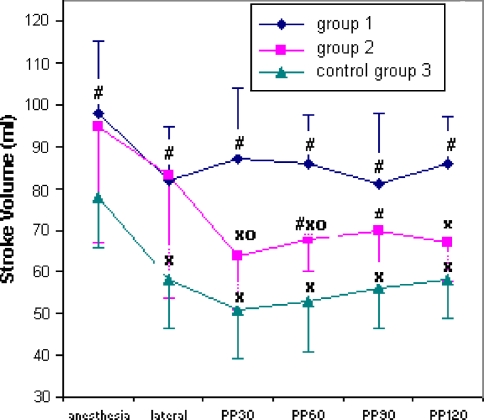
Methods: Twenty-one patients undergoing laparoscopic donor nephrectomy (LDN) were randomized into three groups: group 1 received overnight infusion and received a bolus of colloid before induction of anesthesia, followed by a bolus just before PP; group 2 received overnight infusion and a colloid bolus before anesthesia; group 3 served as controls and received only infusion during operation. All three groups received the same total amount of crystalloids and colloids until nephrectomy. Data analysis of the donor included; mean arterial pressure (MAP), stroke volume (SV), left ventricular ejection time (LVETc), perioperative urine output and renal function measured as the creatinine clearance (CrCl) until one-year post-operative.
Results: SV was significantly higher in group 1 compared to controls for all measurements. In the control group SV significantly decreased after changing from the supine to lateral position whereas there was no change in SV in both pre-hydrated groups. In all groups, MAP decreased after induction of anesthesia, and restored to pre-anesthetic values during PP. CrCl decreased in the control group during PP, but not in the other groups. From two days postoperative, CrCl was comparable between the three study groups.
Conclusion: Overnight infusion and a bolus of colloid just before PP attenuate hemodynamic compromise from PP.
Figures
References
-
- Bergman S, Feldman LS, Carli F, Anidjar M, Vassiliou MC, Andrew CG, Stanbridge DD, Fried GM (2004) Intraoperative fluid management in laparoscopic live-donor nephrectomy: challenging the dogma. Surg Endosc 18: 1625–30 - PubMed
-
- Chiu AW, Chang LS, Birkett DH, Babayan RK (1995) The impact of pneumoperitoneum, pneumoretroperitoneum, and gasless laparoscopy on the systemic and renal hemodynamics. J Am Coll Surg 181: 397–406 - PubMed
Publication types
MeSH terms
Substances
LinkOut - more resources
Full Text Sources
Medical
Miscellaneous
