Attenuated glial reactions and photoreceptor degeneration after retinal detachment in mice deficient in glial fibrillary acidic protein and vimentin
- PMID: 17525210
- PMCID: PMC2613948
- DOI: 10.1167/iovs.06-1398
Attenuated glial reactions and photoreceptor degeneration after retinal detachment in mice deficient in glial fibrillary acidic protein and vimentin
Abstract
Purpose: To characterize the reactions of retinal glial cells (astrocytes and Müller cells) to retinal injury in mice that lack glial fibrillary acidic protein (GFAP) and vimentin (GFAP-/-Vim-/-) and to determine the role of glial cells in retinal detachment (RD)-induced photoreceptor degeneration.
Methods: RD was induced by subretinal injection of sodium hyaluronate in adult wild-type (WT) and GFAP-/-Vim-/- mice. Astroglial reaction and subsequent monocyte recruitment were quantified by measuring extracellular signal-regulated kinase (Erk) and c-fos activation and the level of expression of chemokine monocyte chemoattractant protein (MCP)-1 and by counting monocytes/microglia in the detached retinas. Immunohistochemistry, immunoblotting, real-time quantitative polymerase chain reaction (PCR), and enzyme-linked immunosorbent assay (ELISA) were used. RD-induced photoreceptor degeneration was assessed by terminal deoxynucleotidyl transferase dUTP nick-end labeling (TUNEL) and measurement of outer nuclear layer (ONL) thickness.
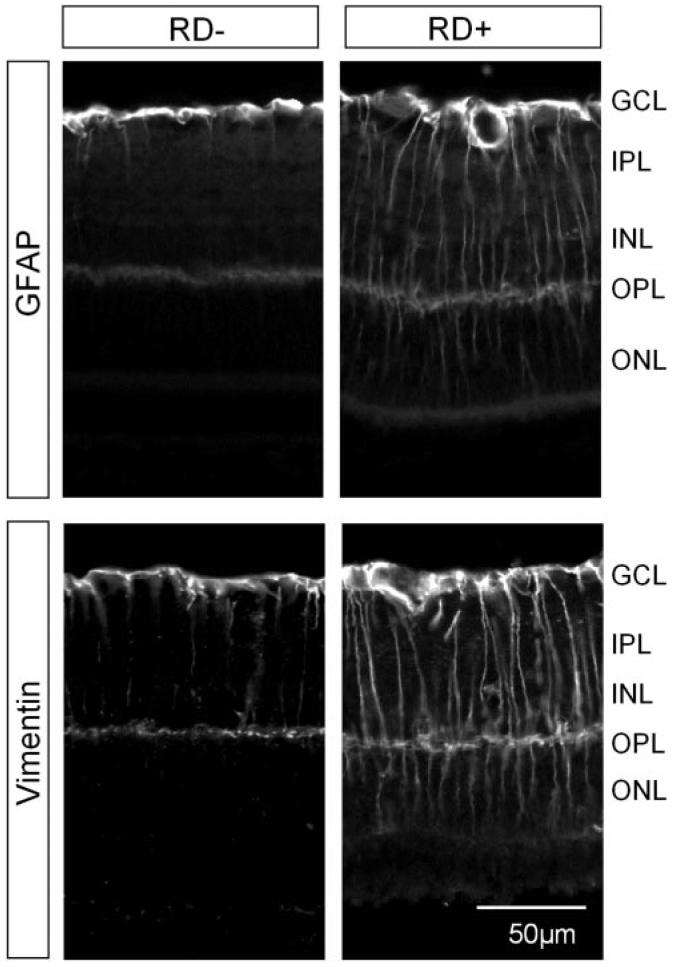
Results: RD-induced reactive gliosis, characterized by GFAP and vimentin upregulation, Erk and c-fos activation, MCP-1 induction, and increased monocyte recruitment in WT mice. Absence of GFAP and vimentin effectively attenuated reactive responses of retinal glial cells and monocyte infiltration. As a result, detached retinas of GFAP-/-Vim-/- mice exhibited significantly reduced numbers of TUNEL-positive photoreceptor cells and increased ONL thickness compared with those of WT mice.
Conclusions: The absence of GFAP and vimentin attenuates RD-induced reactive gliosis and, subsequently, limits photoreceptor degeneration. Results of this study indicate that reactive retinal glial cells contribute critically to retinal damage induced by RD and provide a new avenue for limiting photoreceptor degeneration associated with RD and other retinal diseases or damage.
Figures


References
-
- Caicedo A, Espinosa-Heidmann DG, Pina Y, Hernandez EP, Cousins SW. Blood-derived macrophages infiltrate the retina and activate Muller glial cells under experimental choroidal neovascularization. Exp Eye Res. 2005;81:38–47. - PubMed
-
- Lewis GP, Matsumoto B, Fisher SK. Changes in the organization and expression of cytoskeletal proteins during retinal degeneration induced by retinal detachment. Invest Ophthalmol Vis Sci. 1995;36:2404–2416. - PubMed
-
- Sethi CS, Lewis GP, Fisher SK, et al. Glial remodeling and neural plasticity in human retinal detachment with proliferative vitreoretinopathy. Invest Ophthalmol Vis Sci. 2005;46:329–342. - PubMed
-
- Wang L, Cioffi GA, Cull G, Dong J, Fortune B. Immunohistologic evidence for retinal glial cell changes in human glaucoma. Invest Ophthalmol Vis Sci. 2002;43:1088–1094. - PubMed
-
- Mizutani M, Gerhardinger C, Lorenzi M. Muller cell changes in human diabetic retinopathy. Diabetes. 1998;47:445–449. - PubMed
Publication types
MeSH terms
Substances
Grants and funding
LinkOut - more resources
Full Text Sources
Other Literature Sources
Medical
Molecular Biology Databases
Research Materials
Miscellaneous