. 2007 Jun 20;26(12):2923-32.
doi: 10.1038/sj.emboj.7601730. Epub 2007 May 24.

The human DNA repair factor XPC-HR23B distinguishes stereoisomeric benzo[a]pyrenyl-DNA lesions

Affiliations

The human DNA repair factor XPC-HR23B distinguishes stereoisomeric benzo[a]pyrenyl-DNA lesions

Vincent Mocquet et al. EMBO J. .

Abstract

Benzo[a]pyrene (B[a]P), a known environmental pollutant and tobacco smoke carcinogen, is metabolically activated to highly tumorigenic B[a]P diol epoxide derivatives that predominantly form N(2)-guanine adducts in cellular DNA. Although nucleotide excision repair (NER) is an important cellular defense mechanism, the molecular basis of recognition of these bulky lesions is poorly understood. In order to investigate the effects of DNA adduct structure on NER, three stereoisomeric and conformationally different B[a]P-N(2)-dG lesions were site specifically incorporated into identical 135-mer duplexes and their response to purified NER factors was investigated. Using a permanganate footprinting assay, the NER lesion recognition factor XPC/HR23B exhibits, in each case, remarkably different patterns of helix opening that is also markedly distinct in the case of an intra-strand crosslinked cisplatin adduct. The different extents of helix distortions, as well as differences in the overall binding of XPC/HR23B to double-stranded DNA containing either of the three stereoisomeric B[a]P-N(2)-dG lesions, are correlated with dual incisions catalyzed by a reconstituted incision system of six purified NER factors, and by the full NER apparatus in cell-free nuclear extracts.


Figures
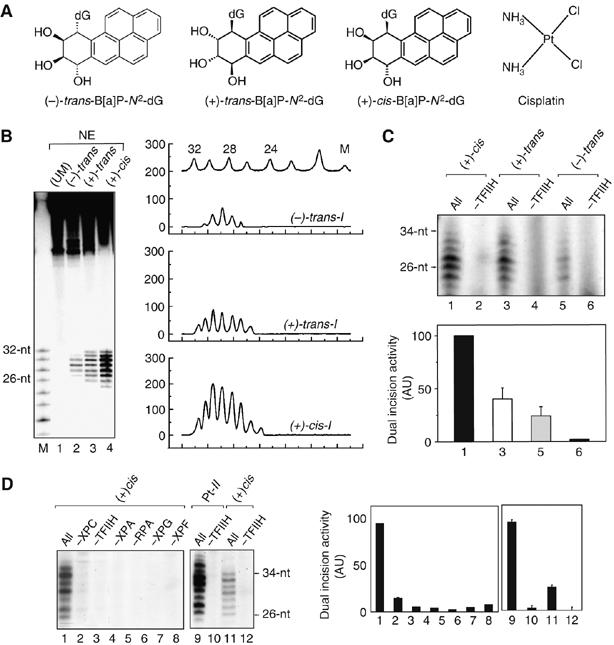
Figure 1
Figure 1
NER of modified 135-mer duplexes. (A) Structures of the the stereoisomeric (+)-cis−, (+)-trans−, and (−)-trans-B[a]P-N2-dG adducts and cisplatin. (B) Autoradiographs of dual excision products: NER of (+)-cis-I, (+)-trans-I, and (−)-trans-I 135-mer duplexes. The duplexes were internally 32P 5′ end labeled at C−6 (Table I). Dual incision products obtained after incubation with NEs for 60 min at 30°C from human HeLa cells (lanes 2–4). Lane 1: unmodified oligonucleotide 135-mer duplex control after treatment with NE. Lane M: oligonucleotide size markers 32, 30, 28, 26, 24, etc. nucleotides long (from top to bottom). Densitometric analysis of lanes M, 2, 3, and 4 (top to bottom). After normalization with respect to the total radioactivity in each lane, quantitative analysis indicates that the ratio of dual excision products of the (+)-cis-I, (+)-trans-I, and (−)-trans-I duplexes is ∼5:1:0.9, with error bars of ±20% using different extracts (eight experiments). (C) Dual incision products of internally labeled (+)-cis-I, (+)-trans-I, and (-)-trans-I duplexes were catalyzed by the RIS of purified NER factors RIS (labeled ‘All', lanes 1, 3, and 5), or RIS minus TFIIH (labeled −TFIIH, lanes 2, 4, and 6) with an XPC/HR23B concentration of 3.9 nM. The experiments were reproduced at least three times. The incision signals were quantified and plotted in a graph (lower graph, (+)-cis-I: black bar; (+)-trans-I: white bar; (−)-trans-I: gray bar)) (D) Comparison of NER of the same concentrations of the (+)-cis-I and Pt-II duplexes by RIS (‘All', lanes 1 and 9, respectively). The omission of any one of the six NER factors in RIS abolishes the dual incisions (lanes 2–8). NER of the Pt-II duplex DNA by RIS (All, lane 9) or RIS without TFIIH (lane 10). The levels of incision of two independent experiments were quantified and plotted in the bar graph.
Figure 2
Figure 2
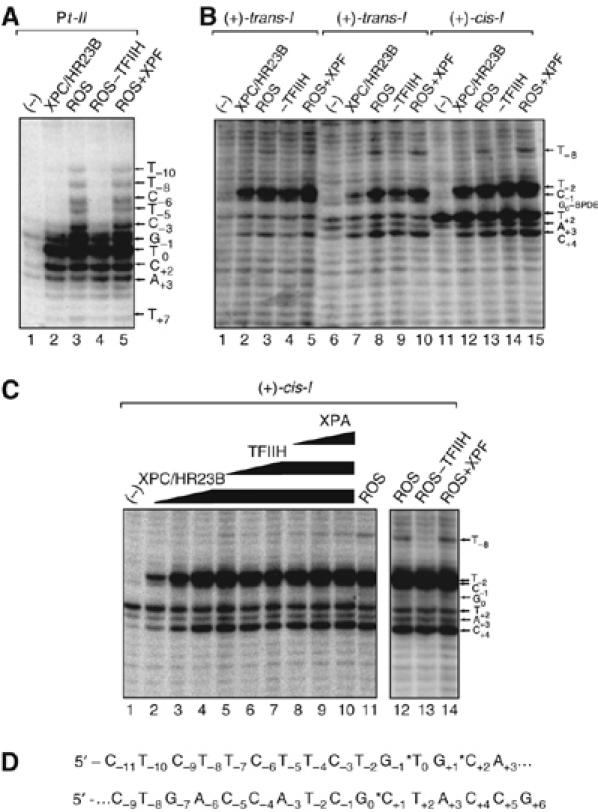
Contribution of XPC/HR23B and the ROS to the opening of the (+)-cis-I, (+)-trans-I, (−)-trans-I, and Pt-II duplexes. (A) KMnO4 footprinting experiments carried out either with (A) the Pt-II duplex or (B) the (+)-trans-I (lanes 1–5), (−)-trans-I (lanes 6–10), or the (+)-cis-I duplexes (lanes 11–15). (ROS: XPC/HR23B, TFIIH, XPA, RPA, and XPG). The 135-mer duplexes (5.7 nM final concentrations) were incubated in solutions with either ROS, ROS–TFIIH, or RIS (labeled ROS+XPF) as indicated at the top of each panel. The bases modified by KMNO4 are indicated by the arrows on the right side of the panels. (C) Effects of increasing amounts of XPC/HR23B (1.3, 2.6, and 5.2 nM final concentrations), followed by the addition of TFIIH, and subsequently XPA, on the opening of the (+)-cis-I duplexes (5.7 nM). Filled squares, (+)-cis-I; open triangles, (+)-trans-I; filled diamonds, (−)-trans-I. (D) Sequence of the Pt-II duplex (top) and the B[a]P-modified duplexes I (bottom). Details are provided in Table I.
Figure 3
Figure 3
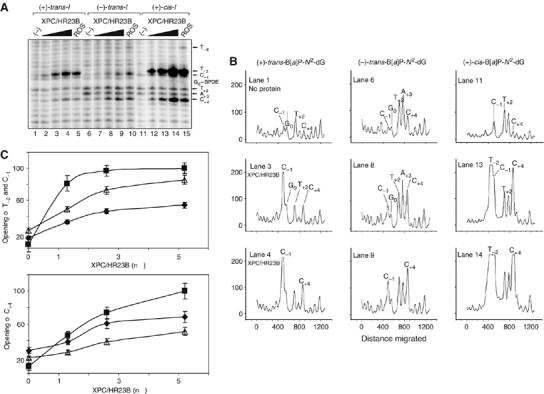
The patterns and extent of opening of the modified duplexes by XPC/HR23B depends on B[a]P-N2-dG adduct stereochemistry. (A) Increasing amounts of XPC/HR23B (1.5, 2.5, and 5.5 nM) were incubated with either the (+)-trans-I (lanes 1–4), (−)-trans-I (lanes 6–9), or the (+)-cis-I duplexes (lanes 11–14); a shorter exposure permitted a better resolution of the cleaved bands. (B) Densitometric analysis of the autoradiogram (panel A) showing the distributions and relative intensities of KMnO4-induced bands at different nucleotides in the vicinity of the B[a]P-N2-dG adducts. The vertical scales are identical in each of the nine panels. (C) The experiment was carried out two times and the signals in T−2 and C−1 (upper graph) or C+4 (lower graph) were quantified and plotted in a graph ((+)-cis-I, black square; (+)-trans-I, open triangle; (−)-trans-I, black diamonds).
Figure 4
Figure 4
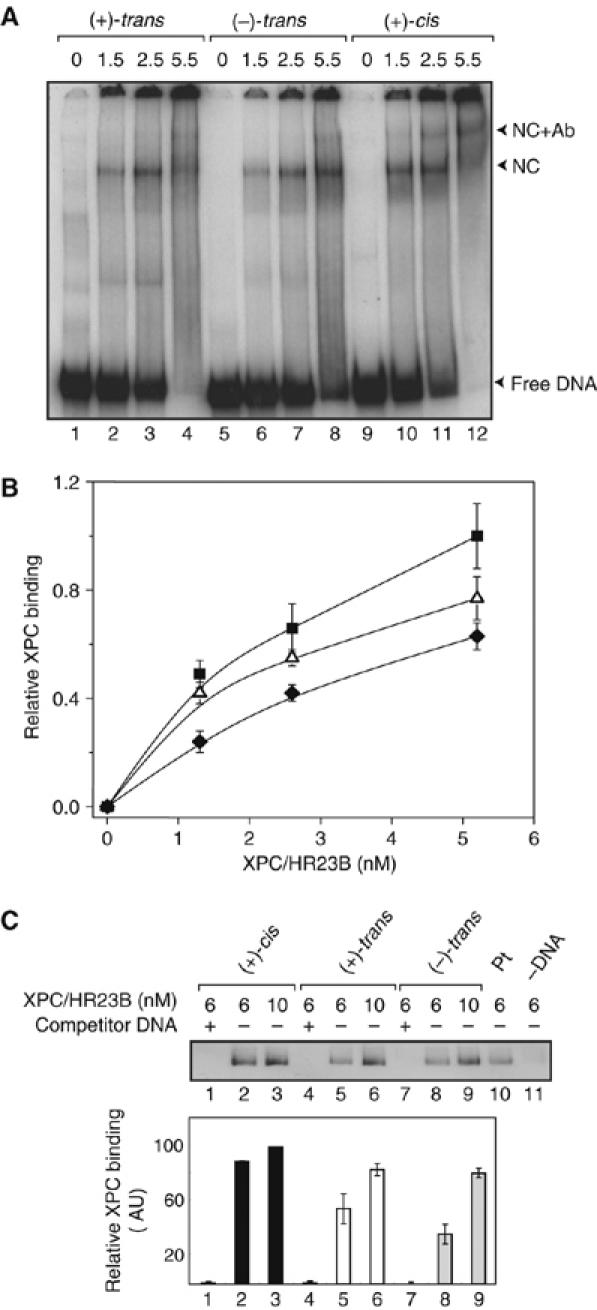
The XPC/HR23B binding to the DNA depends on the B[a]P-N2-dG adduct stereochemistry. (A) An EMSA experiment (4% native polyacrylamide gel) was carried out with 5.7 nM of (+)-trans-I (lanes 1–4), (−)-trans-I (lanes 5–8), or the (+)-cis-I and the indicated amount of XPC/HR23B. The shifts due to the formation of the nucleocomplexes (NC) with XPC/HR23B and supershifts due to XPC/HR23B plus a mouse anti-XPC antibody (MAb 2H1, IGBMC, Illkirch, France) are indicated by the lower and upper arrowheads, respectively, on the right side of the gel. (B) Fractions of DNA molecules bound to XPC/HR23B as a function of concentration of the latter ((+)-cis-I, squares; (+)-trans-I, triangles; (−)-trans-I, diamonds). (C) Binding efficiencies of XPC/HR23B on immobilized (+)-cis-I (lanes 1–3), (+)-trans-I (lanes 4–6), and (−)-trans-I (lanes 7–9) substrates (10 nM final concentration) were analyzed by Western blotting methods. The addition of identical, but unlabeled competitor DNA duplexes (lanes 1, 4, and 7) demonstrates that the binding of XPC/HR23B is specific to the B[a]P-N2-dG lesions in each case. Immobilized platinated DNA (lane 10) and magnetic beads without immobilized DNA (lane 11) were used as controls. The experiments were reproduced three times. The signals were quantified and plotted in the graph ((+)-cis-I, black bar; (+)-trans-I, open bar (−)-trans-I, gray bar).
Figure 5
Figure 5
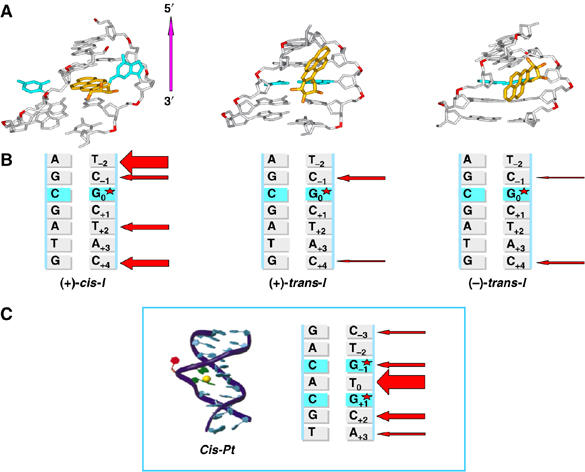
Conformations of the three stereoisomeric B[a]P-N2-dG adducts. (A) View of the central 5-mers of (+)-cis-I′·IC, (+)-trans-I′·IC, and (−)-trans-I′·IC duplexes looking into the minor groove. The structures shown are the best representatives of the ensembles derived from the last 1.5 ns of each molecular dynamic simulation (see Materials and methods and Supplementary data). The B[a]P moiety is colored gold, except for the oxygen atoms, which are orange. The modified guanine and its partner cytosine are cyan. The rest of the DNA duplexes are gray, except for the phosphorus atoms, which are red. Hydrogens and pendant phosphate oxygen atoms are not displayed for clarity. (B) Representations of permanganate-sensitive sites in complexes of XPC/HR23B with (+)-cis-I, (+)-trans-I, and (−)-trans-I duplexes. The thickness of individual red arrows indicates approximately the relative degrees of strand opening at the indicated sites (from Figure 2A and B). (C) Structure of an intrastrand crosslinked cisplatin lesion in a CTG*TG*TC sequence context (adapted and reprinted with permission from Teuben, JM, Bauer, C, Wang, AH and Reedijk, J (1999) Biochemistry, 38, 12305. Copyright (1999) American Chemical Society.
Figure 6
Figure 6
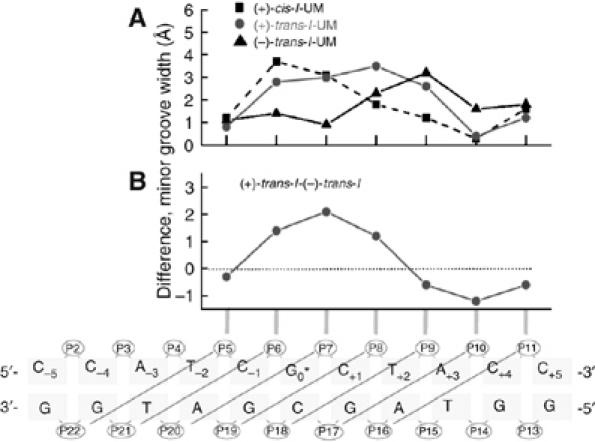
(A) Differences in the width of the minor grooves between the stereoisomeric (+)-cis-, (+)-trans-, and (−)-trans-I′·IC duplexes and the unmodified (UM) I′·I′C 11-mer duplexes in units of Å. The minor groove widths are the ensemble average calculated from individual time points of a 3 ns molecular dynamic simulation. (B) Differences in average minor groove widths between the (+)-trans-I′·I′C and (−)-trans-I′·I′C duplexes that correlate with the 5′- and 3′-orientations of the B[a]P residues in the minor groove relative to G0*. The schematic representation below panel B defines the minor groove widths (diagonal lines). The distances are defined by the phosphorus-to-phosphorus distances, less 5.8 Å to account for the phosphate group diameter in the groove. The absolute values of the minor groove widths in the unmodified I′·I′C duplexes are position dependent and vary from ∼4 to 8 Å (details are provided in Supplementary data).

References

    1. Buening MK, Wislocki PG, Levin W, Yagi H, Thakker DR, Akagi H, Koreeda M, Jerina DM, Conney AH (1978) Tumorigenicity of the optical enantiomers of the diastereomeric benzo[a]pyrene 7,8-diol-9,10-epoxides in newborn mice: exceptional activity of (+)-7beta,8alpha-dihydroxy-9alpha,10alpha-epoxy-7,8,9,10-tetrahydrobenzo[a ]pyrene. Proc Natl Acad Sci USA 75: 5358–5361 - PMC - PubMed
    1. Buschta-Hedayat N, Buterin T, Hess MT, Missura M, Naegeli H (1999) Recognition of nonhybridizing base pairs during nucleotide excision repair of DNA. Proc Natl Acad Sci USA 96: 6090–6095 - PMC - PubMed
    1. Buterin T, Meyer C, Giese B, Naegeli H (2005) DNA quality control by conformational readout on the undamaged strand of the double helix. Chem Biol 12: 913–922 - PubMed
    1. Cheatham TE, Cieplak P, Kollman PA (1999) A modified version of the Cornell et al force field with improved sugar pucker phases and helical repeat. J Biomol Struct Dyn 16: 845–862 - PubMed
    1. Conney AH (1982) Induction of microsomal enzymes by foreign chemicals and carcinogenesis by polycyclic aromatic hydrocarbons. Cancer Res 42: 4875–4917 - PubMed

Publication types