


doi: 10.1128/JB.00435-07.
Epub 2007 May 25.
Identification of Pseudomonas syringae pv. syringae 61 type III secretion system Hrp proteins that can travel the type III pathway and contribute to the translocation of effector proteins into plant cells
Affiliations
- PMID: 17526708
- PMCID: PMC1951817
- DOI: 10.1128/JB.00435-07
Item in Clipboard
Identification of Pseudomonas syringae pv. syringae 61 type III secretion system Hrp proteins that can travel the type III pathway and contribute to the translocation of effector proteins into plant cells
J Bacteriol.
2007 Aug.
Abstract
Pseudomonas syringae translocates effector proteins into plant cells via an Hrp1 type III secretion system (T3SS). T3SS components HrpB, HrpD, HrpF, and HrpP were shown to be pathway substrates and to contribute to elicitation of the plant hypersensitive response and to translocation and secretion of the model effector AvrPto1.
Figures
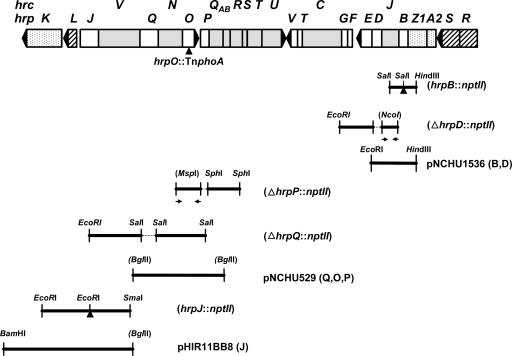
The T3SS gene cluster of P. syringae pv. syringae and newly constructed hrp mutations. The figure shows the hrpK-hrpR gene cluster of P. syringae pv. syringae 61, which is carried on pLN18 and encodes a functional T3SS enabling P. fluorescens to translocate T3SS substrates. The hrc genes are shaded, genes encoding positive regulators are denoted with diagonal lines, genes encoding Hrp proteins previously shown to be T3SS substrates are stippled, and the 11 hrp genes analyzed in this report are white (including hrpJ, whose product in P. syringae pv. tomato DC3000 was recently shown to travel the Hrp pathway [16]). The cloned DNA fragments used to construct or complement mutations are also shown (the parenthetical letters after each complementing plasmid denote the mutations complemented by that plasmid), and their origins are described in Table S1 in the supplemental material (25, 32). The ΔhrpQ mutation was also complemented with pCPP2082 (hrcN::TnphoA) (23). Fragments generated by PCR are indicated with opposing arrows, and restriction sites that were lost during mutant construction are given in parentheses. Note that designations such as hrpA2 and hrpZ1 reflect a new, unified nomenclature for P. syringae T3SS substrates (36).
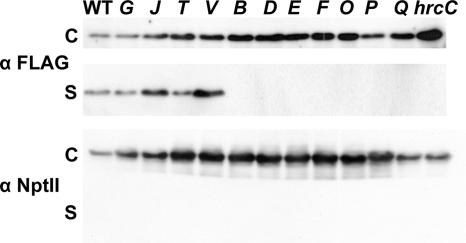
AvrPto1-FLAG is secreted by hrpG, hrpJ, hrpV, and hrpT mutants in P. syringae pv. syringae 61. The indicated wild-type, hrp mutant, or ΔhrcC strains were grown in Hrp-inducing minimal medium to an optical density at 600 nm of 0.3. Cultures were centrifuged to separate cell pellet (C) and supernatant (S) fractions. Fractions were separated by sodium dodecyl sulfate-polyacrylamide gel electrophoresis and transferred to a polyvinylidene difluoride membrane. AvrPto1-FLAG and NptII were detected by immunoblotting with either anti-FLAG or anti-NPTII antibodies, followed by secondary antibodies conjugated to alkaline phosphatase. NptII is a cytoplasmic protein used as a control for cell lysis.
References
-
- Agrain, C., I. Callebaut, L. Journet, I. Sorg, C. Paroz, L. J. Mota, and G. R. Cornelis. 2005. Characterization of a type III secretion substrate specificity switch (T3S4) domain in YscP from Yersinia enterocolitica. Mol. Microbiol. 56:54-67. - PubMed
-
- Agrain, C., I. Sorg, C. Paroz, and G. R. Cornelis. 2005. Secretion of YscP from Yersinia enterocolitica is essential to control the length of the injectisome needle but not to change the type III secretion substrate specificity. Mol. Microbiol. 57:1415-1427. - PubMed
-
- Alfano, J. R., and A. Collmer. 2004. Type III secretion system effector proteins: double agents in bacterial disease and plant defense. Annu. Rev. Phytopathol. 42:385-414. - PubMed
-
- Alfano, J. R., H.-S. Kim, T. P. Delaney, and A. Collmer. 1997. Evidence that the Pseudomonas syringae pv. syringae hrp-linked hrmA gene encodes an Avr-like protein that acts in a hrp-dependent manner within tobacco cells. Mol. Plant-Microbe Interact. 10:580-588. - PubMed
Publication types
MeSH terms
Substances
LinkOut - more resources
Full Text Sources
