


Protective immune responses to a recombinant adenovirus type 35 tuberculosis vaccine in two mouse strains: CD4 and CD8 T-cell epitope mapping and role of gamma interferon
- PMID: 17526747
- PMCID: PMC1951991
- DOI: 10.1128/IAI.00004-07
Protective immune responses to a recombinant adenovirus type 35 tuberculosis vaccine in two mouse strains: CD4 and CD8 T-cell epitope mapping and role of gamma interferon
Abstract
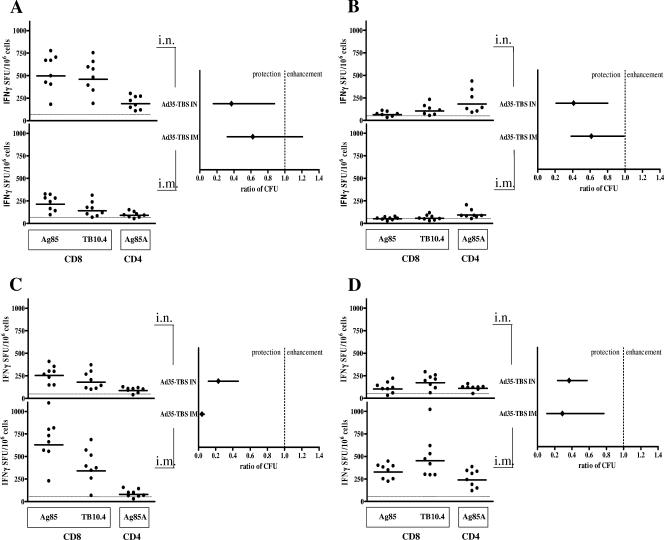
There is an urgent need for an efficacious vaccine against tuberculosis (TB). Cellular immune responses are key to an effective protective response against TB. Recombinant adenovirus (rAd) vectors are especially suited to the induction of strong T-cell immunity and thus represent promising vaccine vehicles for the prevention of TB. We have previously reported on rAd vector serotype 35, the serotype of choice due to low preexisting immunity worldwide, which expresses a unique fusion protein of Mycobacterium tuberculosis antigens Ag85A, Ag85B, and TB10.4 (Ad35-TBS). Here, we demonstrate that Ad35-TBS confers protection against M. tuberculosis when administered to mice through either an intranasal or an intramuscular route. Histological evaluation of lung tissue corroborated the protection and, in addition, demonstrated differences between two mouse strains, with diffuse inflammation in BALB/c mice and distinct granuloma formation in C57BL/6 mice. Epitope mapping analysis in these mouse strains showed that the major T-cell epitopes are conserved in the artificial fusion protein, while three novel CD8 peptides were discovered. Using a defined set of T-cell epitopes, we reveal differences between the two mouse strains in the type of protective immune response, demonstrating that different antigen-specific gamma interferon (IFN-gamma)-producing T cells can provide protection against M. tuberculosis challenge. While in BALB/c (H-2(d)) mice, a dominant CD8 T-cell response was detected, in C57BL/6 (H-2(b)) mice, more balanced CD4/CD8 T-cell responses were observed, with a more pronounced CD4 response in the lungs. These results unify conflicting reports on the relative importance of CD4 versus CD8 T-cell responses in protection and emphasize the key role of IFN-gamma.
Figures
References
-
- Barouch, D. H., and G. J. Nabel. 2005. Adenovirus vector-based vaccines for human immunodeficiency virus type 1. Hum. Gene Ther. 16:149-156. - PubMed
-
- Barouch, D. H., M. G. Pau, J. H. Custers, W. Koudstaal, S. Kostense, M. J. Havenga, D. M. Truitt, S. M. Sumida, M. G. Kishko, J. C. Arthur, B. Korioth-Schmitz, M. H. Newberg, D. A. Gorgone, M. A. Lifton, D. L. Panicali, G. J. Nabel, N. L. Letvin, and J. Goudsmit. 2004. Immunogenicity of recombinant adenovirus serotype 35 vaccine in the presence of pre-existing anti-Ad5 immunity. J. Immunol. 172:6290-6297. - PubMed
-
- Baumann, S., A. N. Eddine, and S. H. Kaufmann. 2006. Progress in tuberculosis vaccine development. Curr. Opin. Immunol. 18:438-448. - PubMed
-
- Capone, S., A. Meola, B. B. Ercole, A. Vitelli, M. Pezzanera, L. Ruggeri, M. E. Davies, R. Tafi, C. Santini, A. Luzzago, T. M. Fu, A. Bett, S. Colloca, R. Cortese, A. Nicosia, and A. Folgori. 2006. A novel adenovirus type 6 (Ad6)-based hepatitis C virus vector that overcomes preexisting anti-Ad5 immunity and induces potent and broad cellular immune responses in rhesus macaques. J. Virol. 80:1688-1699. - PMC - PubMed
MeSH terms
Substances
LinkOut - more resources
Full Text Sources
Other Literature Sources
Medical
Research Materials
