


doi: 10.1128/AEM.02351-06.
Epub 2007 May 25.
Insertional mutagenesis to generate lantibiotic resistance in Lactococcus lactis
Affiliations
- PMID: 17526796
- PMCID: PMC1932815
- DOI: 10.1128/AEM.02351-06
Item in Clipboard
Insertional mutagenesis to generate lantibiotic resistance in Lactococcus lactis
Appl Environ Microbiol.
2007 Jul.
Abstract
While the potential emergence of food spoilage and pathogenic bacteria with resistance to lantibiotics is a concern, the creation of derivatives of starter cultures and adjuncts that can grow in the presence of these antimicrobials may have applications in food fermentations. Here a bank of Lactococcus lactis IL1403 mutants was created and screened, and a number of novel genetic loci involved in lantibiotic resistance were identified.
Figures
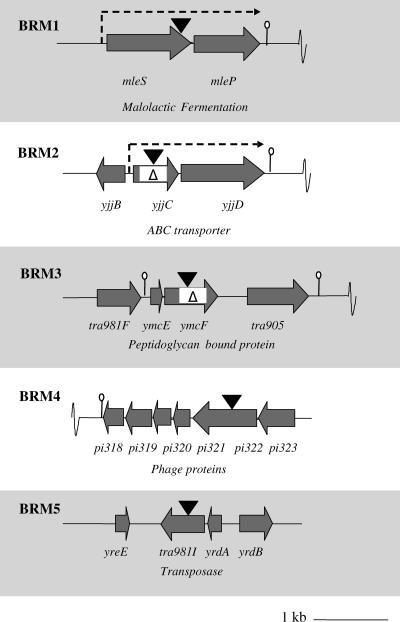
Genes disrupted in the L. lactis IL1403 genome. Black arrowheads point to the sites of pORI19 insertion in IL1403 lacticin 3147-resistant mutants. White regions in BRM2 and BRM3 mutant strains indicate the positions of deletions made through splicing by overlap extension PCR. Putative terminators are indicated by lollipops, and operons proven experimentally are represented by broken-line arrows.
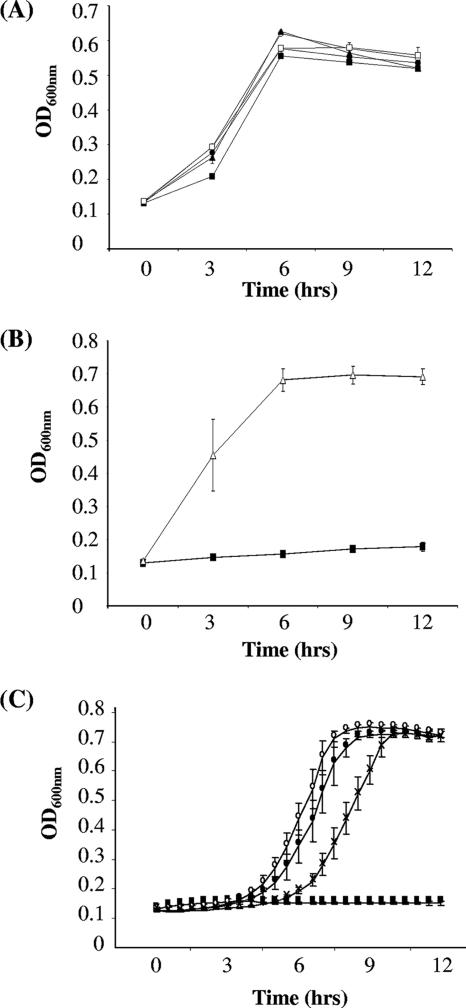
Growth of L. lactis IL1403 pORI19 mutants in the presence of 25 AU/ml of lacticin 3147 (A) and growth of pORI19::tra981I in 50 AU/ml of lacticin 3147 (B) at 30°C. Symbols: ▪, IL1403; □, pORI19::mleS; •, pORI19::yjjC; ○, pORI19::ymcF; ▴, pORI19::pi322; Δ, pORI19::tra981I. (C) Growth of IL1403 (▪), IL1403ΔyjjC (•), IL1403ΔymcF (○) and IL1403ΔyjjCΔymcF (×) in 4 μg/ml of nisin powder (Sigma).
References
-
- Abachin, E., C. Poyart, E. Pellegrini, E. Milohanic, F. Fiedler, P. Berche, and P. Trieu-Cuot. 2002. Formation of D-alanyl-lipoteichoic acid is required for adhesion and virulence of Listeria monocytogenes. Mol. Microbiol. 43:1-14. - PubMed
-
- Ansanay, V., S. Dequin, B. Blondin, and P. Barre. 1993. Cloning, sequence and expression of the gene encoding the malolactic enzyme from Lactococcus lactis. FEBS Lett. 332:74-80. - PubMed
-
- Bandell, M., V. Ansanay, N. Rachidi, S. Dequin, and J. S. Lolkema. 1997. Membrane potential-generating malate (MleP) and citrate (CitP) transporters of lactic acid bacteria are homologous proteins. Substrate specificity of the 2-hydroxycarboxylate transporter family. J. Biol. Chem. 272:18140-18146. - PubMed
-
- Bonnet, M., and T. J. Montville. 2005. Acid-tolerant Listeria monocytogenes persist in a model food system fermented with nisin-producing bacteria. Lett. Appl. Microbiol. 40:237-242. - PubMed
Publication types
MeSH terms
Substances
LinkOut - more resources
Full Text Sources
Medical
