


Melanoma incidence and mortality in Scotland 1979-2003
- PMID: 17533392
- PMCID: PMC2359933
- DOI: 10.1038/sj.bjc.6603801
Melanoma incidence and mortality in Scotland 1979-2003
Abstract
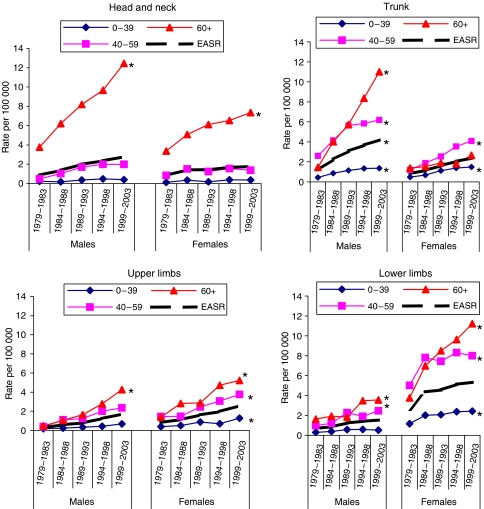
We studied 12,450 cases of invasive melanoma diagnosed in Scotland in 1979-2003, by thickness, pathological type, and body site at ages under 40, 40-59, and 60 years and over. Melanoma incidence trebled in males from 3.57 to 10.93/10(5) per year, and increased 2.3-fold in females from 5.60 to 12.96/10(5) per year. The rate of increase fell in each successive 5-year period. The greatest increase was in males aged 60 years and over at diagnosis. Significant incidence increases were seen in melanomas < 1 mm in all three age groups, but those > 4 mm only increased significantly at ages 60 years and over. All histological types increased significantly at ages 60 years and over, and in this age group the greatest increase was seen on the head and neck. Five-year disease-free survival improved steadily. Survival figures for 1994-1998 ranged from 93.6% for males and 95.8% for females with tumours < 1 mm, to 52.4 and 48.3%, respectively, for those with tumours > 4 mm. Over the 25 years, melanoma mortality doubled in males from 1.1 to 2.4/10(5) per year, but was unchanged in females at 1.5/10(5) per year. Public education on melanoma is required both for primary prevention and earlier diagnosis, particularly for older males.
Figures


References
-
- Baade P, Coory M (2005) Trends in melanoma mortality in Australia 1950–2002 and their implications for melanoma control. Aust N Z J Public Health 29: 383–386 - PubMed
-
- Bosetti C, La Vecchia C, Naldi L, Lucchini F, Negri E, Levi F (2004) Mortality from cutaneous melanoma in Europe. Has the epidemic levelled off? Melanoma Res 14: 301–309 - PubMed
-
- Burton RC, Armstrong BK (1998) Non-metastasising melanoma? J Surg Oncol 67: 73–76 - PubMed
-
- Coory M, Baade P, Aitken J, Smithers M, Mcleod GRC, Ring I (2006) Trends for in situ and invasive melanoma in Queensland, Australia, 1982–2002. Cancer causes and control 17: 21–27 - PubMed
-
- de Vries E, Coebergh JW (2004) Cutaneous malignant melanoma in Europe. Eur J Cancer 40: 2355–2366 - PubMed
Publication types
MeSH terms
LinkOut - more resources
Full Text Sources
Medical
