


Chemogenomic approaches to drug discovery: similar receptors bind similar ligands
- PMID: 17533415
- PMCID: PMC1978276
- DOI: 10.1038/sj.bjp.0707308
Chemogenomic approaches to drug discovery: similar receptors bind similar ligands
Abstract
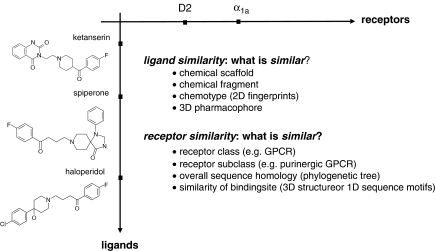
Within recent years, a paradigm shift from traditional receptor-specific studies to a cross-receptor view has taken place within pharmaceutical research to increase the efficiency of modern drug discovery. Receptors are no longer viewed as single entities but grouped into sets of related proteins or receptor families that are explored in a systematic manner. This interdisciplinary approach attempting to derive predictive links between the chemical structures of bioactive molecules and the receptors with which these molecules interact is referred to as chemogenomics. Insights from chemogenomics are used for the rational compilation of screening sets and for the rational design and synthesis of directed chemical libraries to accelerate drug discovery.
Figures
Comment on
-
Chemogenomic approaches to rational drug design.Br J Pharmacol. 2007 Sep;152(1):38-52. doi: 10.1038/sj.bjp.0707307. Epub 2007 May 29. Br J Pharmacol. 2007. PMID: 17533416 Free PMC article. Review.
References
-
- Balakin KV, Tkachenko SE, Lang SA, Okun I, Ivashchenko AA, Savchuk NP. Property-based design of GPCR-targeted library. J Chem Inf Comput Sci. 2002;42:1332–1342. - PubMed
-
- Bock JR, Gough DA. Virtual screen for ligands of orphan G-protein coupled receptors. J Chem Inf Model. 2005;45:1402–1414. - PubMed
-
- Caron PR, Mullican MD, Mashal RD, Wilson KP, Su MS, Murcko MA. Chemogenomic approaches to drug discovery. Curr Opin Chem Biol. 2001;5:464–470. - PubMed
-
- Frimurer TM, Ulven T, Elling CE, Gerlach LO, Kostenis E, Hogberg T. A physicogenetic method to assign ligand-binding relationships between 7TM receptors. Bioorg Med Chem Lett. 2005;15:3707–3712. - PubMed
-
- Klabunde T.Chemogenomic approaches to ligand design Ligand Design for G Protein-coupled Receptors 2006Wiley-VCH: Weinheim; In: Rognan D, (Ed)
Publication types
MeSH terms
Substances
LinkOut - more resources
Full Text Sources
Other Literature Sources
