


The role of resilience on psychological adjustment and physical health in patients with diabetes
- PMID: 17535497
- PMCID: PMC2899486
- DOI: 10.1348/135910707X186994
The role of resilience on psychological adjustment and physical health in patients with diabetes
Abstract
Objective: This study used a longitudinal design to investigate the buffering role of resilience on worsening HbA(1c) and self-care behaviours in the face of rising diabetes-related distress.
Method: A total of 111 patients with diabetes completed surveys and had their glycosylated haemoglobin (HbA(1c)) assessed at baseline and at 1-year follow-up. Resilience was defined by a factor score of self-esteem, self-efficacy, self-mastery and optimism. Diabetes-related distress and self-care behaviours were also assessed.
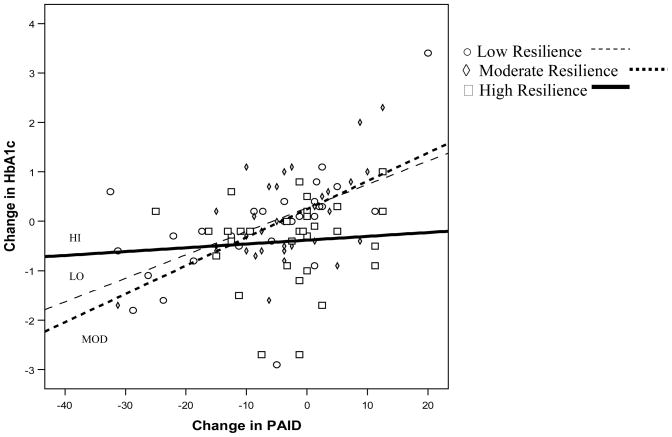
Results: Baseline resilience, diabetes-related distress and their interaction predicted physical health (HbA(1c)) at 1 year. Patients with low, moderate and high resilience were identified. Those with low or moderate resilience levels showed a strong association between rising distress and worsening HbA(1c) across time (r=.57, .56, respectively). However, those with high resilience scores did not show the same associations (r=.08). Low resilience was also associated with fewer self-care behaviours when faced with increasing distress (r=-.55). These correlation coefficients remained significant after controlling for starting-points.
Conclusion: In patients with diabetes, resilience resources predicted future HbA(1c) and buffered worsening HbA(1c) and self-care behaviours in the face of rising distress levels.
Figures
References
-
- Baron L, Eisman H, Scuello M, Veyzer A, Lieberman M. Stress resilience, locus of control, and religion in children of Holocaust victims. The Journal of Psychology. 1996;130:513–525. - PubMed
-
- Becker G, Newsom E. Resilience in the face of serious illness among chronically ill African Americans later in life. Journal of Gerontology. 2005;60B:S214–S223. - PubMed
-
- Cederblad M, Dahlin L, Hagnell O, Hansson K. Salutogenic childhood factors reported by middle-aged individuals. European Archives of Psychiatry and Clinical Neuroscience. 1994;244:1–11. - PubMed
-
- Cicchetti D, Rogosch FA, Lynch M, Holt KD. Resilience in maltreated children: Processes leading to adaptive outcome. Development and Psychopathology. 1993;5:629–647.
-
- Cohen S, Wills TA. Stress, social support, and the buffering hypothesis. Psychological Bulletin. 1985;98:310–357. - PubMed
MeSH terms
Substances
Grants and funding
LinkOut - more resources
Full Text Sources
Medical
Miscellaneous
