


Cognitive appraisals, distress and disability among persons in low vision rehabilitation
- PMID: 17535505
- PMCID: PMC3627369
- DOI: 10.1348/135910707X209835
Cognitive appraisals, distress and disability among persons in low vision rehabilitation
Abstract
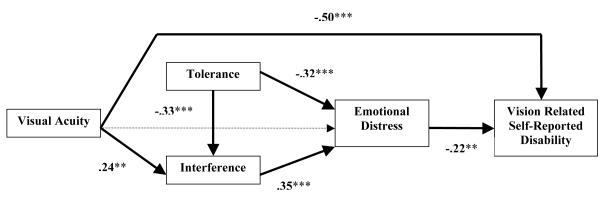
Objective: Examined cognitive appraisals of interference and tolerance in the prediction of distress and self-reported disability among persons presenting for low vision rehabilitation.
Design: Cross-sectional; correlational and path analyses.
Methods: One-hundred and thirteen patients (mean age, 71 years; 52 men and 61 women) presenting for low vision rehabilitation at a university-based centre for low vision rehabilitation participated in an initial clinical vision examination and completed several questionnaires to evaluate cognitive appraisals, emotional distress and self-reported disability.
Results: Path analyses indicated that greater tolerance was associated with less interference imposed by vision loss. Greater tolerance was also associated with less emotional distress and symptom severity (visual acuity) was associated with self-reported disability. Cognitive appraisals (tolerance and interference) indirectly influenced self-reported disability through emotional distress.
Conclusions: The data indicate that appraisals of personal ability to tolerate vision loss and the perceived interference of vision loss on goal-directed behaviour and expected activities have greater influence on distress and are subsequently predictive of disability in comparison with objective symptoms (visual acuity). Implications for clinical interventions and further research are discussed.
Figures
References
-
- Averill J. Anger and aggression: An essay on emotion. Springer-Verlag; New York: 1982.
-
- Averill J. Studies on anger and aggression. American Psychologist. 1983;8:1145–1160. - PubMed
-
- Bailey I, Lovie J. New design principles for visual acuity letter charts. American Journal of Optometry & Physiological Optics. 1976;53:740–745. - PubMed
-
- Bentler P. Comparitive fit indexes in structural models. Psychological Bulletin. 1990;107:238–246. - PubMed
-
- Berkowitz L. Frustration-aggression hypothesis: Examination and reformulation. Psychological Bulletin. 1989;106:59–73. - PubMed
Publication types
MeSH terms
Grants and funding
LinkOut - more resources
Full Text Sources
Medical
