Unplanned general surgical re-admissions - how many, which patients and why?
- PMID: 17535612
- PMCID: PMC1963581
- DOI: 10.1308/003588407X183409
Unplanned general surgical re-admissions - how many, which patients and why?
Abstract
Introduction: The unplanned re-admission rate is a national key performance indicator employed by the UK Department of Health. An adjusted figure, based on admission information data on the hospital electronic Patient Administration System (PAS), but adjusted to take account of case mix is compared with a calculated 'expected'. While previous studies have investigated unplanned re-admission rates in age-, procedure- or process-specific conditions, 'all-cause' general surgical re-admission rate is yet to be studied. The aim of this study was to assess the accuracy of hospital unplanned re-admission data, and identify patterns or possible causes of unplanned general surgical re-admissions.
Patients and methods: Retrospective audit of case note records of all patients identified from the hospital electronic PAS as unplanned, general surgical re-admissions over a period of 4 consecutive months.
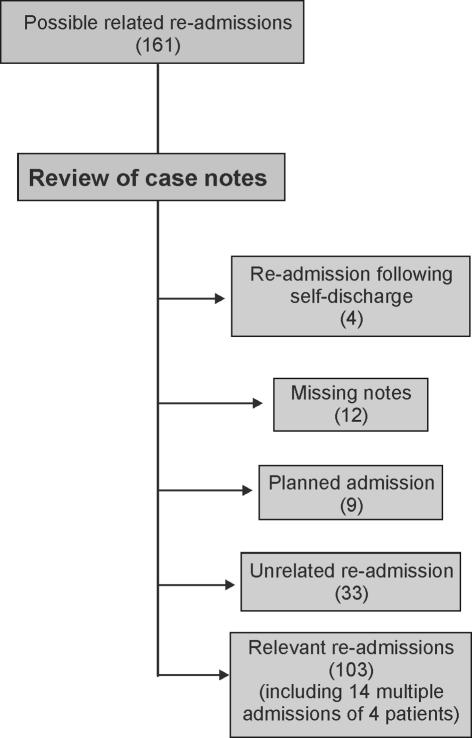
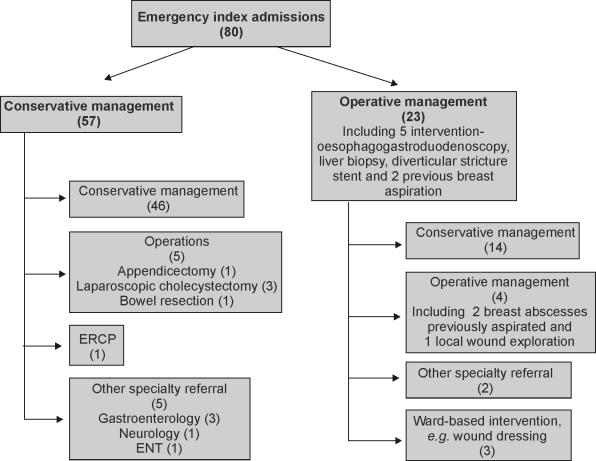
Results: Of all 161 re-admissions in this study, 46 (29%) were unrelated to the index admission, planned or involved patient self-discharge during the index admission. Of the 'genuine', unplanned re-admissions, 80 (78%) followed an emergency index admission, 58 (56%) had chronic or recurrent symptoms, for which 26 (25%) were on waiting lists. Fourteen (14%) were multiple admissions of 4 patients, while 8 (8%) re-admissions required further surgery for significant postoperative complications.
Conclusions: Unplanned. general surgical re-admission rates collated from hospital PAS systems may be inaccurate. Nearly half of 'genuine', unplanned re-admissions involved patients with chronic and/or recurrent symptoms, which are predictable and may be preventable. Significant postoperative complications accounted for few re-admissions in this study.
Figures
References
-
- Weissman JS, Ayanian JZ, Chasan-Taber S, Sherwood MJ, Roth C, Epstein AM. Hospital re-admissions and quality of care. Med Care. 1999;37:490–501. - PubMed
-
- Jimenez-Puente A, Garcia-Alegria J, Gomez-Aracena J, Hidalgo-Rojas L, Lorenzo-Nogueiras L, Perea-Milla-Lopez E, et al. Readmission rate as an indicator of hospital performance: the case of Spain. Int J Technol Assess Health Care. 2004;20:385–91. - PubMed
-
- Rathore SS, Foody JM, Wang Y, Smith GL, Herrin J, Masoudi FA, et al. Race, quality of care, and outcomes of elderly patients hospitalized with heart failure. JAMA. 2003;289:2517–24. - PubMed
-
- Boockvar KS, Halm EA, Litke A, Silberzweig SB, McLaughlin M, Penrod JD, et al. Hospital re-admissions after hospital discharge for hip fracture: surgical and nonsurgical causes and effect on outcomes. J Am Geriatr Soc. 2003;51:399–403. - PubMed
MeSH terms
LinkOut - more resources
Full Text Sources
Medical