. 2007 Aug 22;274(1621):1921-9.
doi: 10.1098/rspb.2007.0245.

Grazing protozoa and the evolution of the Escherichia coli O157:H7 Shiga toxin-encoding prophage

Affiliations

Grazing protozoa and the evolution of the Escherichia coli O157:H7 Shiga toxin-encoding prophage

Karyn Meltz Steinberg et al. Proc Biol Sci. .

Abstract

Humans play little role in the epidemiology of Escherichia coli O157:H7, a commensal bacterium of cattle. Why then does E. coli O157:H7 code for virulence determinants, like the Shiga toxins (Stxs), responsible for the morbidity and mortality of colonized humans? One possibility is that the virulence of these bacteria to humans is coincidental and these virulence factors evolved for and are maintained for other roles they play in the ecology of these bacteria. Here, we test the hypothesis that the carriage of the Stx-encoding prophage of E. coli O157:H7 increases the rate of survival of E. coli in the presence of grazing protozoa, Tetrahymena pyriformis. In the presence but not the absence of Tetrahymena, the carriage of the Stx-encoding prophage considerably augments the fitness of E. coli K-12 as well as clinical isolates of E. coli O157 by increasing the rate of survival of the bacteria in the food vacuoles of these ciliates. Grazing protozoa in the environment or natural host are likely to play a significant role in the ecology and maintenance of the Stx-encoding prophage of E. coli O157:H7 and may well contribute to the evolution of the virulence of these bacteria to colonize humans.


Figures
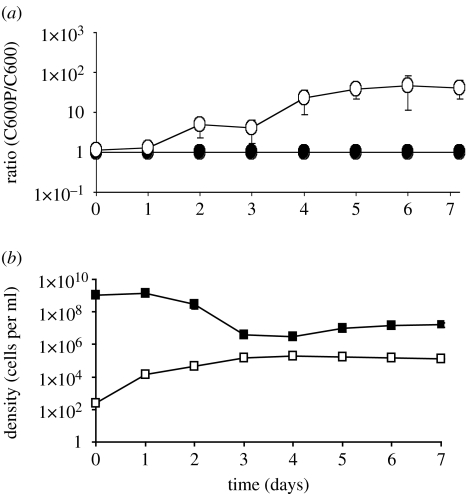
Figure 1
Figure 1
Mixtures of E. coli C600 with and without the Stx2-encoding prophage, C600 and C600P, respectively, in the presence and absence of Tetrahymena. Means ±s.e. for two control (Tetrahymena-free) and six experimental (with Tetrahymena) cultures. (a) Change in ratio of C600P/C600 in the presence and absence of Tetrahymena. Open circles, with Tetrahymena; filled circles, without Tetrahymena. (b) Change in the total densities of bacteria and Tetrahymena in the culture shown in (a). Filled squares, total bacteria; open squares, Tetrahymena.
Figure 2
Figure 2
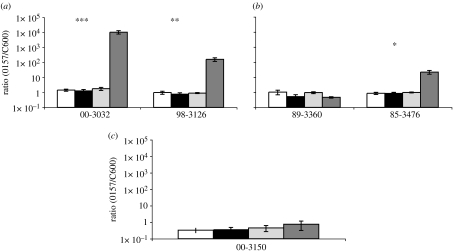
Mixtures of clinical isolates of E. coli O157:H7 or E. coli O157:H− and C600 in the presence and absence of Tetrahymena. Ratio of O157 to C600 initially and after 3 days with and without Tetrahymena, means ±s.e. (a) Clinical isolates with Stx1- and Stx2-encoding prophage. (b) Clinical isolates with Stx1-encoding prophage. (c) Clinical isolates with no Stx-encoding prophage. For each experiment, there were two control and six experimental cultures (*p<0.05, **p<0.005 and ***p<0.0005). White bars, initial without Tetrahymena; black bars, after 3 days without Tetrahymena; light grey bars, initial with Tetrahymena; dark grey bars, after 3 days with Tetrahymena.
Figure 3
Figure 3
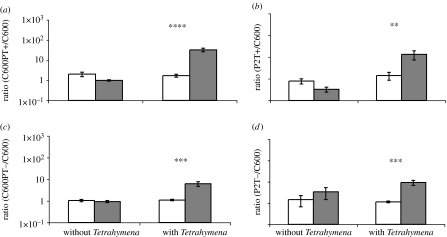
Mixtures of lysogens and non-lysogens in the presence and absence of Tetrahymena initially and after 3 days, means ±s.e. (a) Ratio of C600 with an Stx2-encoding prophage, C600PT+, and C600. (b) Ratio of E. coli O157:H7 with an Stx2-encoding prophage, P2T+, and C600. (c) Ratio of C600 with the toxin-negative construct of the Stx2-encoding prophage, C600PT−, and C600. (d) Ratio of the toxin-negative E. coli O157:H7 construct of the Stx2-encoding prophage, P2T−, and C600. In all experiments, there were three control and nine experimental cultures (**p<0.005, ***p<0.0005 and ****p<0.00005). White bars, initial; grey bars, after 3 days.
Figure 4
Figure 4
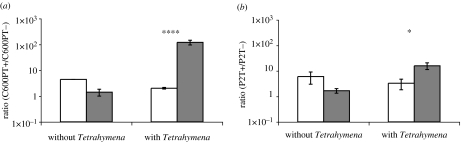
Mixtures of stx2-positive strains and isogenic stx2-negative constructs in the presence and absence of Tetrahymena initially and after 3 days, means ±s.e. (a) Ratio of C600PT+ and C600PT−. (b) Ratio of P2T+ and P2T−. For each experiment, there were two control and six experimental cultures (*p<0.05 and ****p<0.00005). White bars, initial; grey bars, after 3 days.
Figure 5
Figure 5
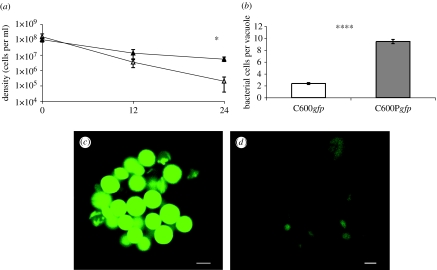
C600gfp (prophage negative) and C600Pgfp (prophage positive) exposed to high density of Tetrahymena. (a) Estimated bacterial densities (CFU data) at 12 and 24 h, C600Pgfp (closed triangles) and C600gfp (open triangles). (b) Number of viable C600gfp and C600Pgfp cells per food vacuole, direct counts of fluorescing cells (*p<0.05 and ****p<0.00005). (c) C600Pgfp in food vacuoles. (d) C600gfp in food vacuoles. Scale bar, 5 μm.
Figure 6
Figure 6
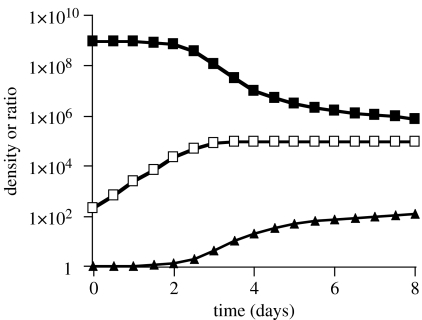
Simulation result changes in the total density of bacteria and protozoa and the ratio of prophage-bearing (Tox+) and prophage-free (Tox−) E. coli 0157:H7. Parameters γB=2×10⁻⁶, γM=2×10⁻⁶ and γT=5×10⁻⁷; e=10−4, k=10−7. The initial densities of the populations were B=109, M=T=5×10⁴ and P=2×10² cells ml−1. Open squares, density of Tetrahymena; filled squares, density of bacteria; filled triangles, ratio (Tox+/Tox−).

References

    1. Barker J, Brown M.R. Trojan horses of the microbial world: protozoa and the survival of bacterial pathogens in the environment. Microbiology. 1994;140:1253–1259. - PubMed
    1. Barker J, Brown M.R, Collier P.J, Farrell I, Gilbert P. Relationship between Legionella pneumophila and Acanthamoeba polyphaga: physiological status and susceptibility to chemical inactivation. Appl. Environ. Microbiol. 1992;58:2420–2425. - PMC - PubMed
    1. Besser R.E, Griffin P.M, Slutsker L. Escherichia coli O157:H7 gastroenteritis and the hemolytic uremic syndrome: an emerging infectious disease. Annu. Rev. Med. 1999;50:355–367. doi:10.1146/annurev.med.50.1.355 - DOI - PubMed
    1. Brandl M.T. Fitness of human enteric pathogens on plants and implications for food safety. Annu. Rev. Phytopathol. 2006;44:367–392. doi:10.1146/annurev.phyto.44.070505.143359 - DOI - PubMed
    1. Brandl M.T, Rosenthal B.M, Haxo A.F, Berk S.G. Enhanced survival of Salmonella enterica in vesicles released by a soilborne Tetrahymena species. Appl. Environ. Microbiol. 2005;71:1562–1569. doi:10.1128/AEM.71.3.1562-1569.2005 - DOI - PMC - PubMed

MeSH terms