Comparative Study
. 2007 Jun 5;104(23):9906-10.
doi: 10.1073/pnas.0702340104. Epub 2007 May 29.

A specific c-type cytochrome maturation system is required for oxygenic photosynthesis

Affiliations
Comparative Study

A specific c-type cytochrome maturation system is required for oxygenic photosynthesis

Richard Kuras et al. Proc Natl Acad Sci U S A. .

Abstract

Oxygenic photosynthesis is an important bioenergetic process that maintains the Earth's atmosphere and allows carbon fixation. A critical enzyme in this process, the cytochrome b(6)f complex, differs from other protein complexes of the same family by an unusual covalently attached cofactor chemically defined as a c' heme. We have identified a set of pioneer proteins that carry the biogenesis of this c' heme and started their characterization. They are encoded by the genomes of all organisms performing oxygenic photosynthesis, whatever their phylogenetic distances. These proteins are thus among the few that distinguish photosynthetic cells evolving oxygen from other types of living cells.


Conflict of interest statement

The authors declare no conflict of interest.

Figures
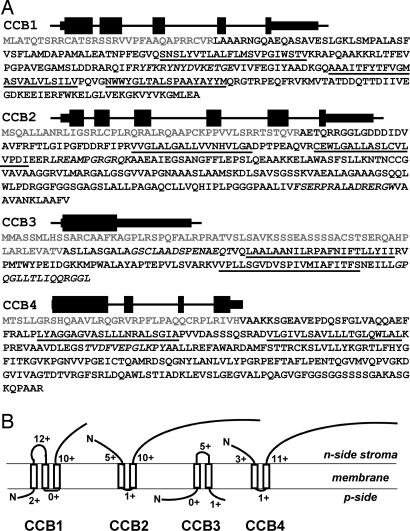
Fig. 1.
Fig. 1.
Molecular identification of CCB factors. (A) CCB gene models and CCB protein sequences. Exons are shown by thick lines, chloroplast transit peptides as predicted by ChloroP are shown in gray, predicted transmembrane domains from sequences aligned by TMAP are underlined, and sequences of anti-peptides are shown in italic. (B) Topology of the CCB chloroplast membrane protein apparatus as predicted by TMAP and the positive inside rule. The numbers of positively charged residues are indicated for predicted mature proteins.
Fig. 2.
Fig. 2.
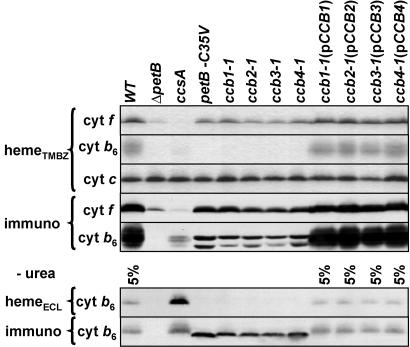
Biochemical study of heme-binding mutants. Detection of heme peroxidase activity by using tetramethylbenzidine (hemeTMBZ) or chemiluminescence (hemeECL) and immunodetection (immuno) of cytochrome (cyt) f and cytochrome b6 in cells of the following strains: WT, cytochrome b6 deletion mutant ΔpetB, system II maturation mutant ccsA, cytochrome b6 substitution mutant petB-C35V, ccb mutants (ccb1-1, ccb2-1, ccb3-1, and ccb4-1), and complemented transformants [ccb1-1(pCCB1), ccb2-1(pCCB2), ccb3-1(pCCB3), ccb4-1(pCCB4)]. Polypeptides were separated on SDS/polyacrylamide gels with urea except when indicated (−urea). Loading was 100% (see cyt c) except when indicated to be 5% (in which case samples were mixed with 95% ΔpetB).
Fig. 3.
Fig. 3.
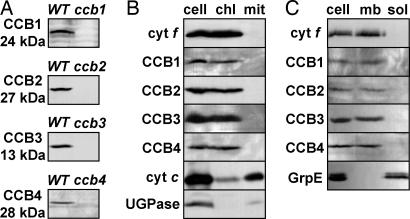
Biochemical study of CCB factors. (A) CCB immunodetection with CCB anti-peptide antibodies in cells of WT and ccb (as given in Fig. 2) strains. (B) Presence of CCBs in chloroplasts (chl) and absence of CCBs in mitochondria (mit). (C) CCBs are membrane proteins (mb). Markers were as follows: cytochrome f (cyt f), chloroplast and membrane; holocytochrome c (cyt c), mitochondria; UDP-glucose pyrophosphorylase (UGPase), cytoplasm; and GrpE, soluble (sol). Polypeptides were separated on SDS/polyacrylamide gels with urea.
Fig. 4.
Fig. 4.
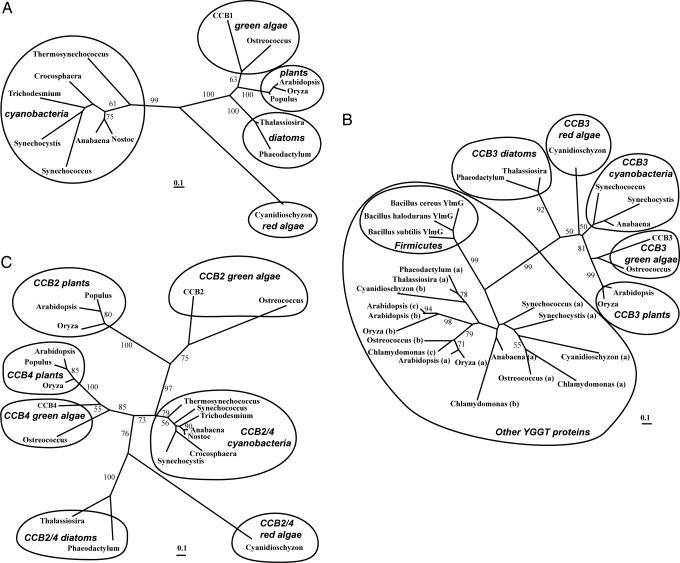
Unrooted maximum likelihood phylogenetic trees. The scale bar represents the number of changes per sites. Bootstrap values of ≥50% are indicated. Accession numbers of the sequences are given in SI Table 1. (A) CCB1 phylogeny. (B) CCB3 and other YGGT phylogeny from cyanobacteria, firmicutes, and photosynthetic eukaryotes. Letters in parentheses used to name non-CCB3 YGGT proteins are arbitrary. (C) CCB2 and CCB4 phylogeny.

References

    1. Xia D, Yu CA, Kim H, Xia ZZ, Kachurin AM, Zhang L, Yu L, Deisenhofer J. Science. 1997;277:60–66. - PubMed
    1. Zhang Z, Huang L, Shulmeister VM, Chi YI, Kim KK, Hung LW, Crofts AR, Berry EA, Kim SH. Nature. 1998;392:677–684. - PubMed
    1. Stroebel D, Choquet Y, Popot J-L, Picot D. Nature. 2003;426:413–418. - PubMed
    1. Kurisu G, Zhang H, Smith JL, Cramer WA. Science. 2003;302:1009–1014. - PubMed
    1. de Vitry C, Desbois A, Redeker V, Zito F, Wollman F-A. Biochemistry. 2004;43:3956–3968. - PubMed

Publication types

Associated data

LinkOut - more resources