


Acute EGCG supplementation reverses endothelial dysfunction in patients with coronary artery disease
- PMID: 17536120
- PMCID: PMC3773609
- DOI: 10.1080/07315724.2007.10719590
Acute EGCG supplementation reverses endothelial dysfunction in patients with coronary artery disease
Abstract
Background: Epidemiological studies demonstrate an inverse relation between dietary flavonoid intake and cardiovascular risk. Recent studies with flavonoid-containing beverages suggest that the benefits of these nutrients may relate, in part, to improved endothelial function.
Objective: We hypothesized that dietary supplementation with epigallocatechin gallate (EGCG), a major catechin in tea, would improve endothelial function in humans.
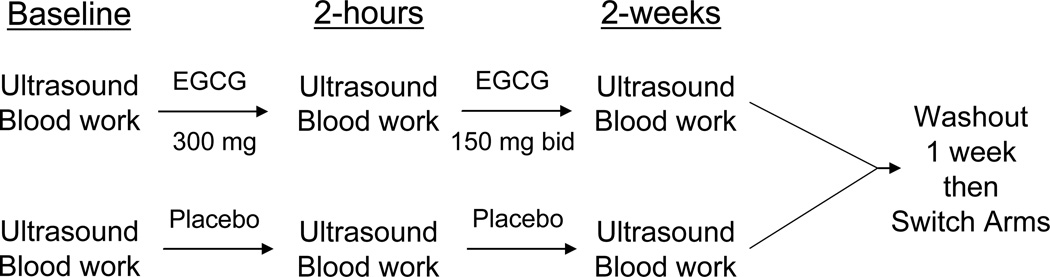
Design: We examined the effects of EGCG on endothelial function in a double blind, placebo-controlled, crossover design study. We measured brachial artery flow-mediated dilation by vascular ultrasound at six time points: prior to treatment with EGCG or placebo, two hours after an initial dose of EGCG (300 mg) or placebo, and after two weeks of treatment with EGCG (150 mg twice daily) or placebo. The order of treatments (EGCG or placebo) was randomized and there was a one-week washout period between treatments.
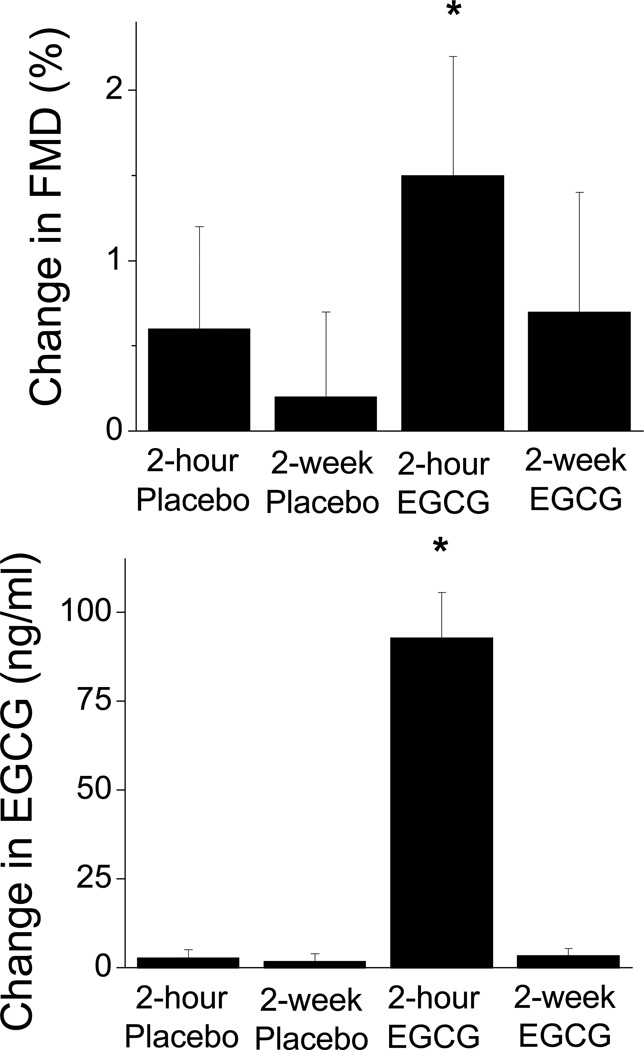
Results: A total of 42 subjects completed the study, and brachial artery flow-mediated dilation improved from 7.1 +/- 4.1 to 8.6 +/- 4.7% two hours after the first dose of 300 mg of EGCG (P = 0.01), but was similar to baseline (7.8 +/- 4.2%, P = 0.12) after two weeks of treatment with the final measurements made approximately 14 hours after the last dose. Placebo treatment had no significant effect, and there were no changes in reactive hyperemia or the response to sublingual nitroglycerin. The changes in vascular function paralleled plasma EGCG concentrations, which increased from 2.6 +/- 10.9 to 92.8 +/- 78.7 ng/ml after acute EGCG (P < 0.001), but were unchanged from baseline after two weeks of treatment (3.4 +/- 13.1 ng/ml).
Conclusion: EGCG acutely improves endothelial function in humans with coronary artery disease, and may account for a portion of the beneficial effects of flavonoid-rich food on endothelial function.
Conflict of interest statement
No other author has a conflict of interest to report.
Figures
References
-
- Bazzano LA, He J, Ogden LG, et al. Fruit and vegetable intake and risk of cardiovascular disease in US adults: the first National Health and Nutrition Examination Survey Epidemiologic Follow-up Study. Am J Clin Nutr. 2002;76:93–99. - PubMed
-
- Krauss RM, Eckel RH, Howard B, et al. AHA Dietary Guidelines: revision 2000: A statement for healthcare professionals from the Nutrition Committee of the American Heart Association. Circulation. 2000;102:2284–2299. - PubMed
-
- Hertog MGL, Feskens EJM, Hollman PCH, et al. Dietary antioxidant flavonoids and risk of coronary heart disease: The Zutphen Elderly Study. Lancet. 1993;342:1007–1011. - PubMed
-
- Higdon JV, Frei B. Tea catechins and polyphenols: health effects, metabolism, and antioxidant functions. Crit Rev Food Sci Nutr. 2003;43:89–143. - PubMed
-
- Peters U, Poole C, Arab L. Does tea affect cardiovascular disease? a meta-analysis. Am J Epidemiol. 2001;154:495–503. - PubMed
Publication types
MeSH terms
Substances
Grants and funding
LinkOut - more resources
Full Text Sources
Medical
