. 2007 May 30:5:19.
doi: 10.1186/1477-7827-5-19.

Developmental expression of DAX1 in the European sea bass, Dicentrarchus labrax: lack of evidence for sexual dimorphism during sex differentiation

Affiliations

Developmental expression of DAX1 in the European sea bass, Dicentrarchus labrax: lack of evidence for sexual dimorphism during sex differentiation

Rute S T Martins et al. Reprod Biol Endocrinol. .

Abstract

Background: DAX1 (NR0B1), a member of the nuclear receptors super family, has been shown to be involved in the genetic sex determination and in gonadal differentiation in several vertebrate species. In the aquaculture fish European sea bass, Dicentrarchus labrax, and in the generality of fish species, the mechanisms of sex determination and differentiation have not been elucidated. The present study aimed at characterizing the European DAX1 gene and its developmental expression at the mRNA level.

Methods: A full length European sea bass DAX1 cDNA (sbDAX1) was isolated by screening a testis cDNA library. The structure of the DAX1 gene was determined by PCR and Southern blot. Multisequence alignments and phylogenetic analysis were used to compare the translated sbDAX1 product to that of other vertebrates. sbDAX1 expression was analysed by Northern blot and relative RT-PCR in adult tissues. Developmental expression of mRNA levels was analysed in groups of larvae grown either at 15 degrees C or 20 degrees C (masculinising temperature) during the first 60 days, or two groups of fish selected for fast (mostly females) and slow growth.

Results: The sbDAX1 is expressed as a single transcript in testis and ovary encoding a predicted protein of 301 amino acids. A polyglutamine stretch of variable length in different DAX1 proteins is present in the DNA binding domain. The sbDAX1 gene is composed of two exons, separated by a single 283 bp intron with conserved splice sites in same region of the ligand binding domain as other DAX1 genes. sbDAX1 mRNA is not restricted to the brain-pituitary-gonadal axis and is also detected in the gut, heart, gills, muscle and kidney. sbDAX1 mRNA was detected as early as 4 days post hatching (dph) and expression was not affected by incubation temperature. Throughout gonadal sex differentiation (60-300 dph) no dimorphic pattern of expression was observed.

Conclusion: The sbDAX1 gene and putative protein coding region is highly conserved and has a wide pattern of tissue expression. Although gene expression data suggests sbDAX1 to be important for the development and differentiation of the gonads, it is apparently not sex specific.


Figures
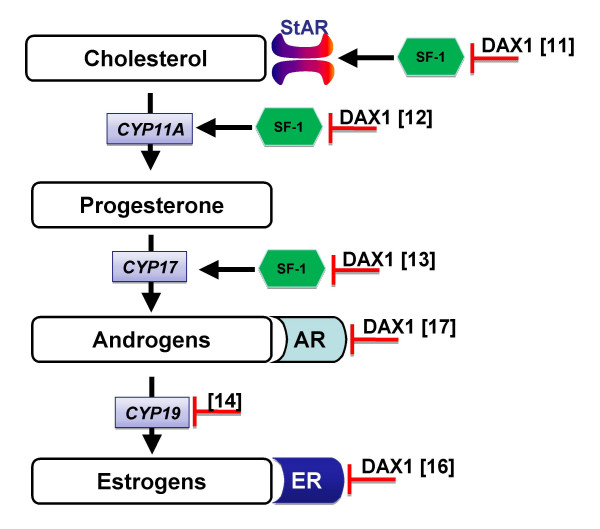
Figure 1
Figure 1
Schematic representation of pathway for the biosynthesis of sexual steroids. DAX1 regulates key steps for androgen production by repressing the transcriptional activation of SF-1 on the promoters of StAR [11], CYP11A [12] and CYP17 [13]. DAX1 binds directly to the CYP19 promoter to downregulate its transcription [14]. It also regulates estrogen [16] and androgen receptors [17] through protein-protein interactions. CYP11A, CYP17 and CYP19 are, respectively, genes that encode for the P450 enzymes cholesterol side chain cleavage, 17-hydroxylase and aromatase. StAR is the mitochondrial cholesterol transporter protein. AR and ER are respectively androgen and estrogen receptors (α and β). Supporting references for the scheme are indicated by numbers within [].
Figure 2
Figure 2
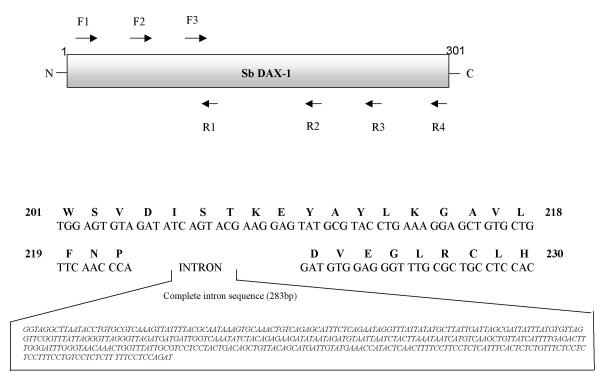
The European sea bass DAX1 gene structure. Different sets of forward (F1-F3) and reverse (R1-R4) primers were used to amplify the DAX1 gene from genomic DNA. PCR amplification yielded a single 381 bp intron sequence, positioned between amino acids 221 and 222 within the LBD.
Figure 3
Figure 3
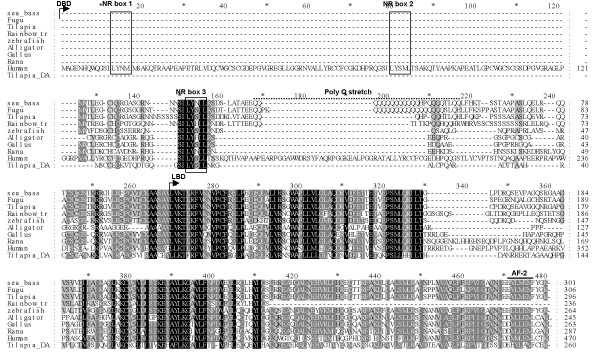
Multisequence alignment of DAX1 protein. Identical and similar amino acids are marked with asterisks and dots, respectively. The putative DNA-binding domain (DBD) and ligand binding domain (LBD) are indicated. The conserved LXXLL-like motif and the AF-2 core, in the DBD and LBD, respectively, are indicated inside boxes.
Figure 4
Figure 4
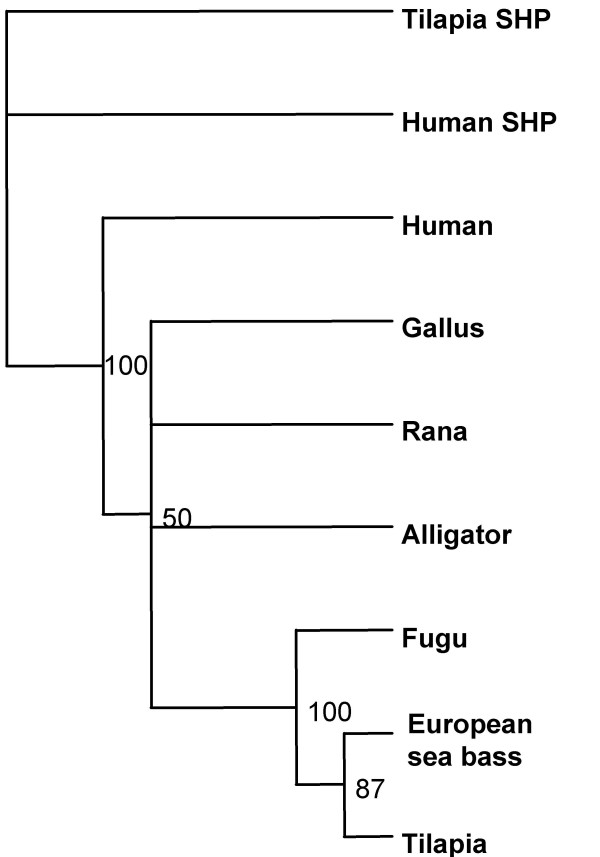
Phylogenetic tree of DAX1 protein. Consensus tree obtained by parsimony analysis with corresponding bootstrap values from sampling 1000 trees. Human (accession Q15466) and tilapia (accession AAN17674) small heterodimer partner (SHP) were used to root the tree. The other amino acid sequences used are mentioned in the Materials and Methods.
Figure 5
Figure 5
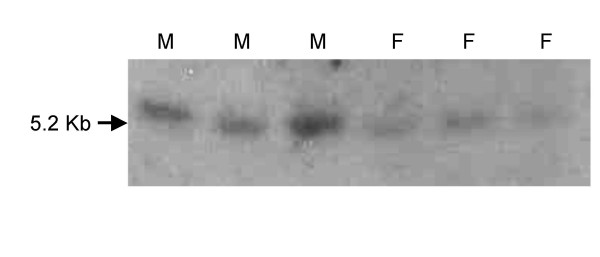
Southern blot hybridizations of DAX1. Genomic DNA of three males (M) and three females (F) was digested with EcoRI and hybridized with the sea bass DAX-1 gene.
Figure 6
Figure 6
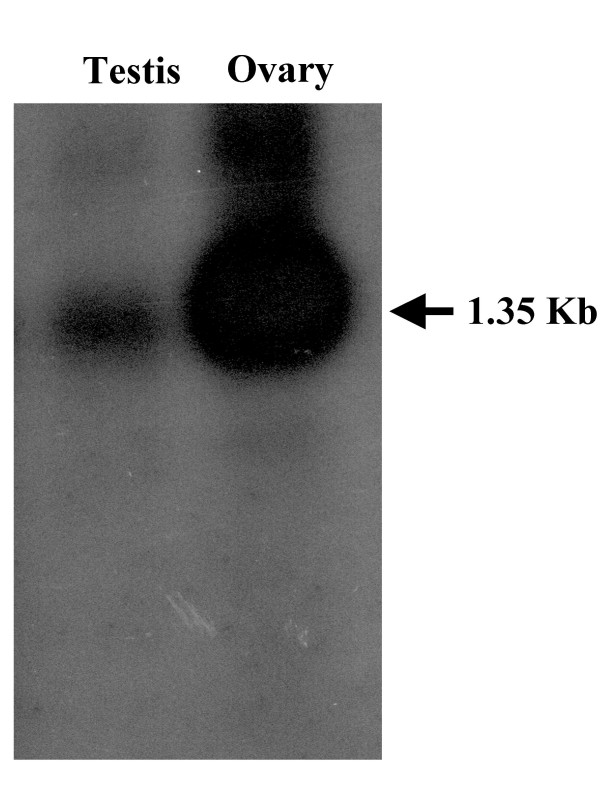
Northern blot hybridizations of DAX1. Total RNA from testis (5 μg) or ovary (10 μg) was run on 1% denaturing formaldehyde gel, transferred onto a nylon membrane and hybridized with the sea bass DAX1 full length cDNA.
Figure 7
Figure 7
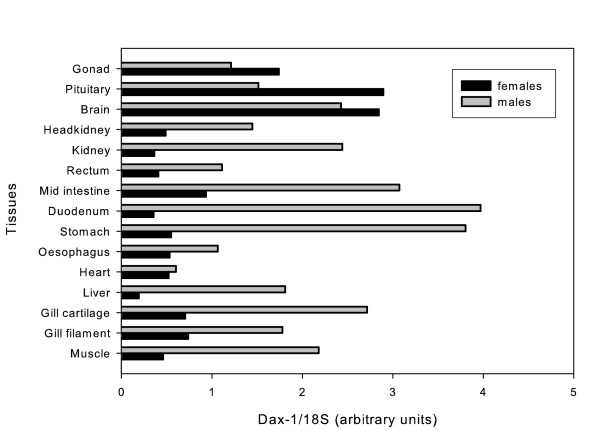
DAX1 gene expression in different tissues from adult European sea bass. RT-PCR of DAX1 relative to 18S in pools of tissues from three females or three males.
Figure 8
Figure 8
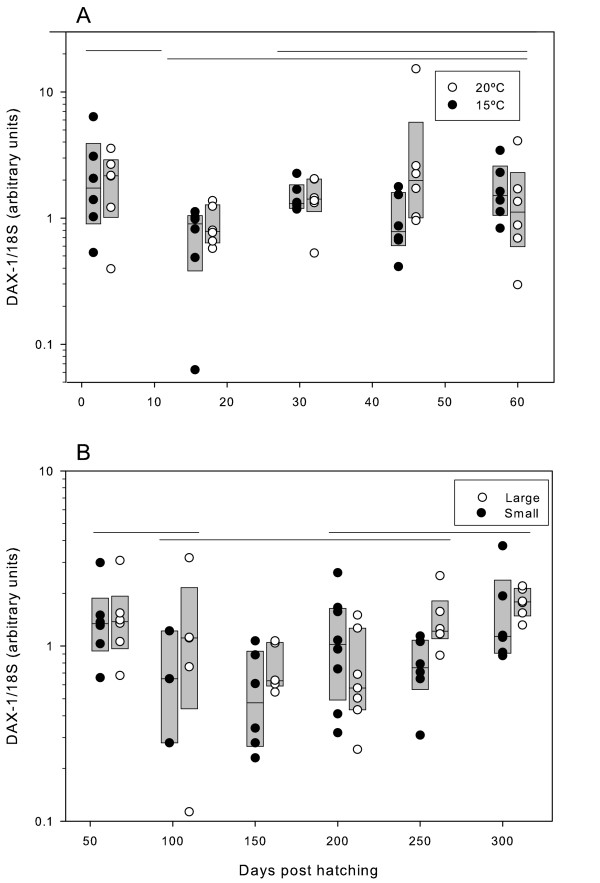
DAX1 gene expression during early development in European sea bass. RT-PCR of DAX1 relative to 18S in sea bass larvae. A) Whole larvae during the thermo sensitive period for sex determination (n = 6 at each sampling point). Larvae were grown at either 15°C or 20°C resulting, respectively, in 77.5% and 28% females. B) Whole larvae (56 days), body trunks (98, 150, 200 and 250 days) or gonads (300 days) during the period of sex differentiation (n = 3–8). Larvae were repeatedly graded according to size. Larger fish developed into a majority of females (96.0% females) and smaller fish developed into a majority of males (35.4% females). Groups covered by horizontal line at the same level are not statistically different.

References

    1. Bardoni B, Zanaria E, Guioli S, Floridia G, Worley KC, Tonini G, Ferrante E, Chiumello G, McCabe ER, Fraccaro M, Zuffardi O, Camerino G. A dosage sensitive locus at chromosome Xp21 is involved in male to female sex reversal. Nat Genet. 1994;7:497–501. doi: 10.1038/ng0894-497. - DOI - PubMed
    1. Muscatelli F, Strom TM, Walker AP, Zanaria E, Recan D, Meindl A, Bardoni B, Guioli S, Zehetner G, Rabl W, Schwarz HP, Kaplan J-C, Camerino G, Meitinger T, Monaco AP. Mutations in the DAX-1 gene give rise to both X-linked adrenal hypoplasia congenita and hypogonadotropic hypogonadism. Nature. 1994;372:672–676. doi: 10.1038/372672a0. - DOI - PubMed
    1. Swain A, Narvaez V, Burgoyne P, Camerino G, Lovell-Badge R. Dax1 antagonizes Sry action in mammalian sex determination. Nature. 1998;391:761–767. doi: 10.1038/35799. - DOI - PubMed
    1. Jeffs B, Meeks JJ, Ito M, Martinson FA, Matzuk MM, Jameson JL, Russell LD. Blockage of the rete testis and efferent ductules by ectopic Sertoli and Leydig cells causes infertility in Dax1-deficient male mice. Endocrinology. 2001;142:4486–4495. doi: 10.1210/en.142.10.4486. - DOI - PubMed
    1. Jeffs B, Ito M, Yu RN, Martinson FA, Wang ZJ, Doglio LT, Jameson JL. Sertoli cell-specific rescue of fertility, but not testicular pathology, in Dax1 (Ahch)-deficient male mice. Endocrinology. 2001;142:2481–2488. doi: 10.1210/en.142.6.2481. - DOI - PubMed

Publication types

MeSH terms

Substances

LinkOut - more resources