


Non-responders to bevacizumab (Avastin) therapy of choroidal neovascular lesions
- PMID: 17537784
- PMCID: PMC2000982
- DOI: 10.1136/bjo.2006.113902
Non-responders to bevacizumab (Avastin) therapy of choroidal neovascular lesions
Abstract
Aims: To determine the characteristics of "non-responders" to intravitreal bevacizumab treatment in choroidal neovascularisation (CNV).
Methods: Forty-three patients with visual loss due to neovascular age-related macular disease (ARMD) (44 eyes) underwent intravitreal injections of 1.25 mg (0.05 ml) bevacizumab and were followed up every 4 weeks for 2, 3 or 6 months. Re-injection was performed when persistent leakage of the CNV was determined by fluorescein angiography and retinal oedema was assessed by optical coherence tomography (OCT). Non-responders were defined as those patients having reduced or stable visual acuity at the last follow-up.
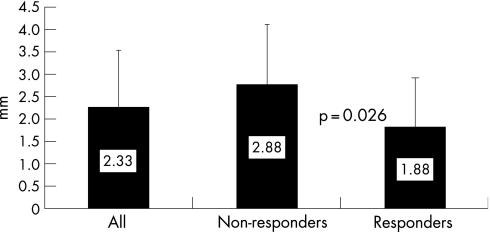
Results: 45% of the patients were non-responders. In this group the initial CNV size was significantly larger than in the responders. Initial reading ability was significantly lower in non-responders, but the initial foveal oedema was similar in both groups. Gains in mean visual acuity and reading ability were independent of lesion type. The proportion of non-responders to responders in the different lesion type groups was equally distributed. Only patients with the classic type of CNV seemed to respond better.
Conclusions: In this study initial reasons for non-responders to intravitreal bevacizumab treatment in CNV are given. The efficiency of bevacizumab depends on initial lesion size and initial reading ability, but is independent of the amount of intraretinal and subretinal fluid. There was no general ineffectiveness of bevacizumab with any particular lesion type.
Conflict of interest statement
Competing interests: None.




Comment in
-
Anti-VEGF for neovascular ARMD: visual improvement as the goal of therapy?Br J Ophthalmol. 2007 Oct;91(10):1259-60. doi: 10.1136/bjo.2007.120303. Br J Ophthalmol. 2007. PMID: 17895411 Free PMC article.
-
Non-responders to bevacizumab (Avastin) therapy of choroidal neovascular lesions.Br J Ophthalmol. 2008 Jun;92(6):864-5; author reply 865-6. Br J Ophthalmol. 2008. PMID: 18523095 Free PMC article. No abstract available.
References
-
- Gragoudas E S, Adamis A P, Cunningham E T.et al Pegaptanib for neovascular age‐related macular degeneration. N Engl J Med 20043512805–2816. - PubMed
-
- Brown D M, Kaiser P K, Michels M.et al ANCHOR study group: Ranibizumab vs. verteporfin for neovascular age‐related macular degeneration. N Engl J Med 20063551432–1444. - PubMed
-
- Ladewig M S, Ziemssen F, Jaissle G.et al Intravitreales Bevacizumab bei der neovasculären altersbedingten Maculadegeneration. Der Ophthalmologe Online first: 6 May 2006 - PubMed
-
- Rich R M, Rosenfeld P J, Puliafito C A.et al Short‐term safety and efficacy of intravitreal bevacizumab (Avastin) for neovascular age‐related macular generation. Retina 200626495–511. - PubMed
-
- Ferris F L, Kassoff A, Bresnick G H.et al New visual acuity charts for clinical research. Am J Ophthalmol 19829491–96. - PubMed
Publication types
MeSH terms
Substances
LinkOut - more resources
Full Text Sources
Other Literature Sources
Medical
