


Placental insufficiency results in temporal alterations in the renin angiotensin system in male hypertensive growth restricted offspring
- PMID: 17537837
- PMCID: PMC2841000
- DOI: 10.1152/ajpregu.00725.2006
Placental insufficiency results in temporal alterations in the renin angiotensin system in male hypertensive growth restricted offspring
Abstract
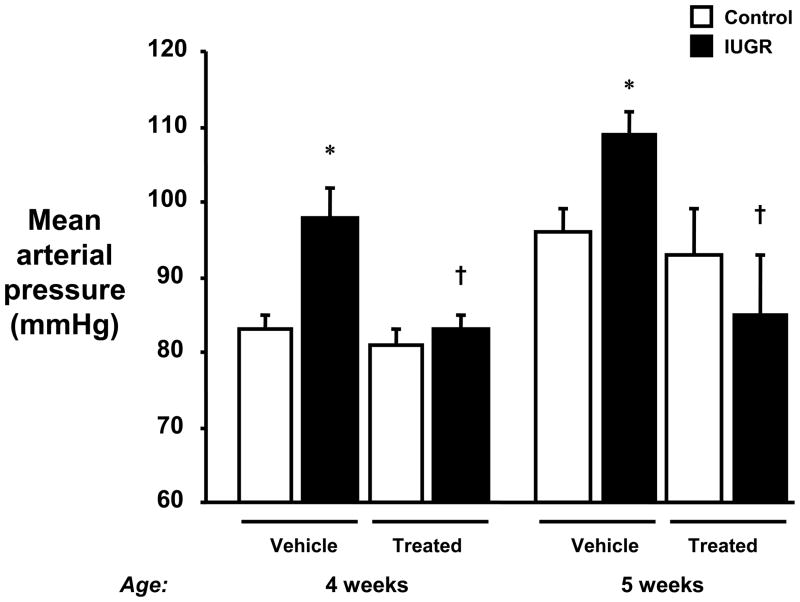
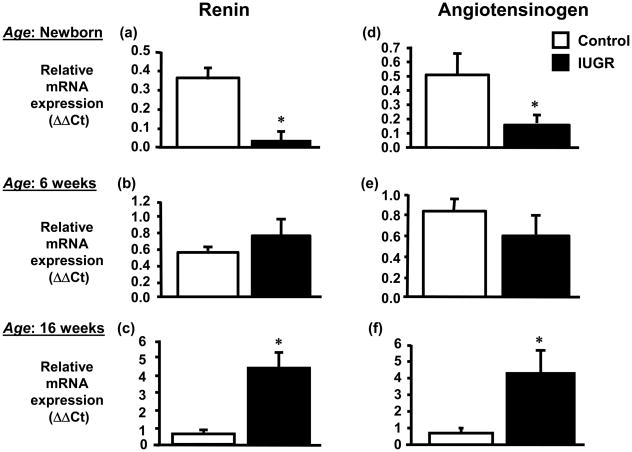
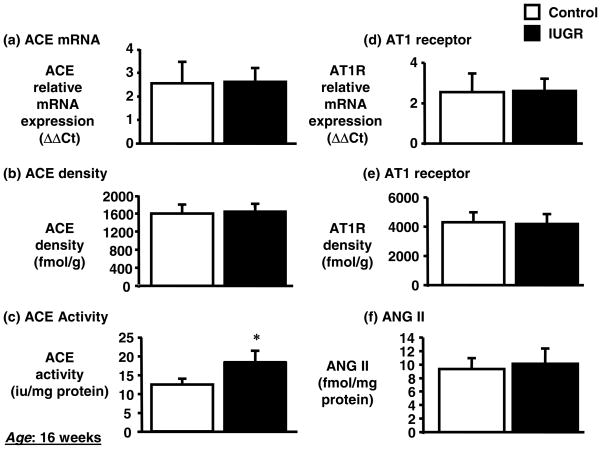
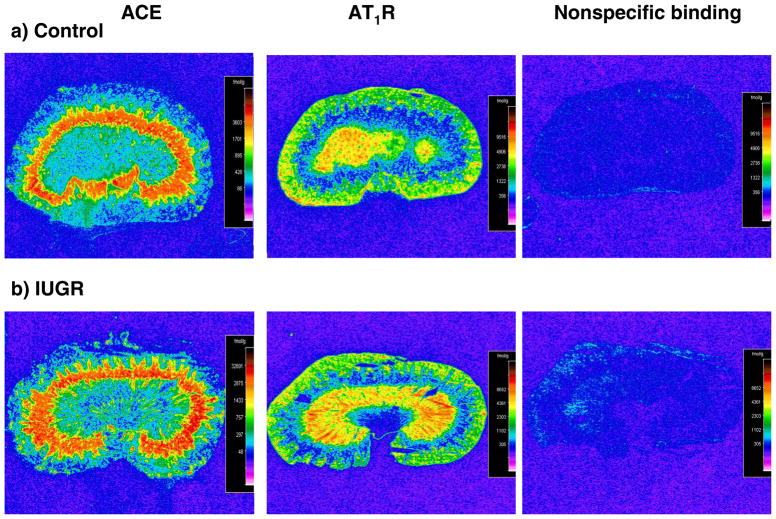
Reduced uterine perfusion initiated in late gestation in the rat results in intrauterine growth restriction (IUGR) and development of hypertension by 4 wk of age. We hypothesize that the renin angiotensin system (RAS), a regulatory system important in the long-term control of blood pressure, may be programmed by placental insufficiency and may contribute to the etiology of IUGR hypertension. We previously reported that RAS blockade abolished hypertension in adult IUGR offspring; however, the mechanisms responsible for the early phase of hypertension are unresolved. Therefore, the purpose of this study was to examine RAS involvement in early programmed hypertension and to determine whether temporal changes in RAS expression are observed in IUGR offspring. Renal renin and angiotensinogen mRNA expression were significantly decreased at birth (80 and 60%, respectively); plasma and renal RAS did not differ in conjunction with hypertension (mean increase of 14 mmHg) in young IUGR offspring; however, hypertension (mean increase of 22 mmHg) in adult IUGR offspring was associated with marked increases in renal angiotensin-converting enzyme (ACE) activity (122%) and renal renin and angiotensinogen mRNA (7-fold and 7.4-fold, respectively), but no change in renal ANG II or angiotensin type 1 receptor. ACE inhibition (enalapril, 10 mg x kg(-1) x day(-1), administered from 2 to 4 wk of age) abolished hypertension in IUGR at 4 wk of age (decrease of 15 mmHg, respectively) with no significant depressor effect in control offspring. Therefore, temporal alterations in renal RAS are observed in IUGR offspring and may play a key role in the etiology of IUGR hypertension.
Figures
References
-
- Alexander BT. Placental insufficiency leads to development of hypertension in growth-restricted offspring. Hypertension. 2003;41(3):457–462. - PubMed
-
- Alexander BT. Fetal programming of hypertension. Am J Physiol Regul Integr Comp Physiol. 2006;290(1):R1–R10. - PubMed
-
- Alexander BT, Hendon AE, Ferril G, Dwyer TM. Renal denervation abolishes hypertension in low birth weight offspring from pregnant rats with reduced uterine perfusion. Hypertension. 2005;45(4):754–758. - PubMed
-
- Allen AM, Zhuo J, Mendelsohn FA. Localization of angiotensin AT1 and AT2 receptors. J Am Soc Nephrol. 1999;10(S11):S23–29. - PubMed
-
- Bagby SP, LeBard LS, Luo Z, Ogden BE, Corless C, McPherson ED, Speth RC. ANG II AT(1) and AT(2) receptors in developing kidney of normal microswine. Am J Physiol Renal Physiol. 2002;283(4):F755–F764. - PubMed
Publication types
MeSH terms
Substances
Grants and funding
LinkOut - more resources
Full Text Sources
Medical
Miscellaneous
