


Comparative support for the niche variation hypothesis that more generalized populations also are more heterogeneous
- PMID: 17537912
- PMCID: PMC1891261
- DOI: 10.1073/pnas.0703743104
Comparative support for the niche variation hypothesis that more generalized populations also are more heterogeneous
Abstract
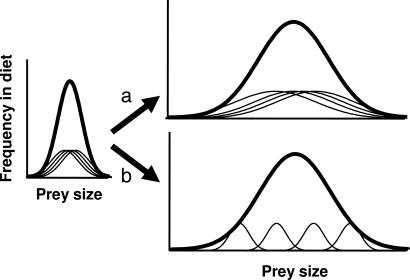
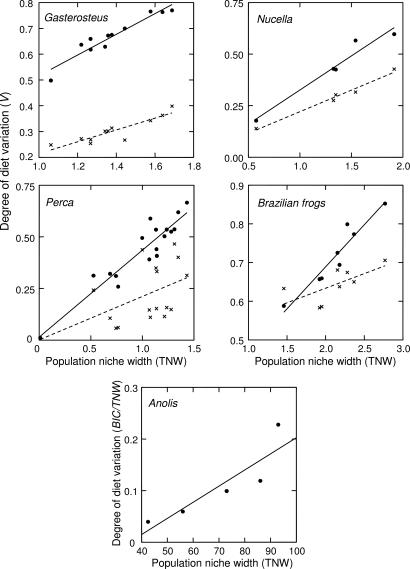
There is extensive evidence that some species of ecological generalists, which use a wide diversity of resources, are in fact heterogeneous collections of relatively specialized individuals. This within-population variation, or "individual specialization," is a key requirement for frequency-dependent interactions that may drive a variety of types of evolutionary diversification and may influence the population dynamics and ecological interactions of species. Consequently, it is important to understand when individual specialization is likely to be strong or weak. The niche variation hypothesis (NVH) suggests that populations tend to become more generalized when they are released from interspecific competition. This niche expansion was proposed to arise via increased variation among individuals rather than increased individual niche breadth. Consequently, we expect ecological generalists to exhibit stronger individual specialization, but this correlation has been repeatedly rejected by empiricists. The drawback with previous empirical tests of the NVH is that they use morphological variation as a proxy for niche variation, ignoring the role of behavior and complex phenotype-function relationships. Here, we used diet data to directly estimate niche variation among individuals. Consistent with the NVH, we show that more generalized populations also exhibit more niche variation. This trend is quite general, appearing in all five case studies examined: three-spine stickleback, Eurasian perch, Anolis lizards, intertidal gastropods, and a community of neotropical frogs. Our results suggest that generalist populations may tend to be more ecologically variable. Whether this translates into greater genetic variation, evolvability, or ecological stability remains to be determined.
Conflict of interest statement
The authors declare no conflict of interest.
Figures
References
Publication types
MeSH terms
LinkOut - more resources
Full Text Sources
