


Late Pleistocene and Holocene environmental history of the Iguala Valley, Central Balsas Watershed of Mexico
- PMID: 17537917
- PMCID: PMC1880864
- DOI: 10.1073/pnas.0703442104
Late Pleistocene and Holocene environmental history of the Iguala Valley, Central Balsas Watershed of Mexico
Abstract
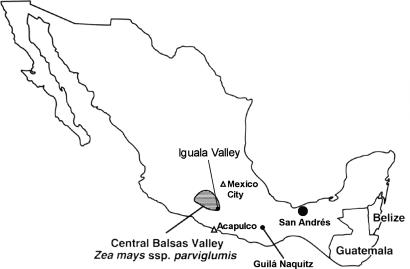
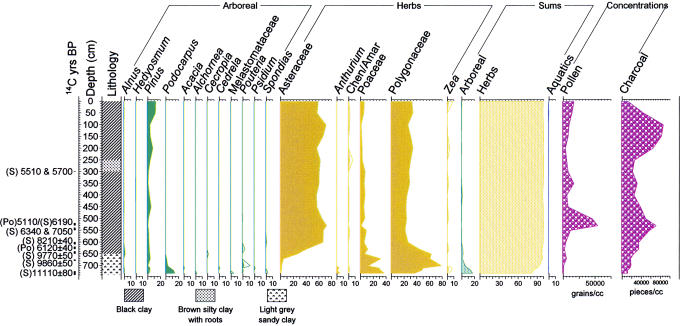
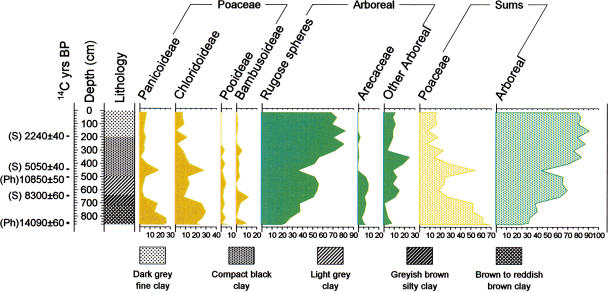
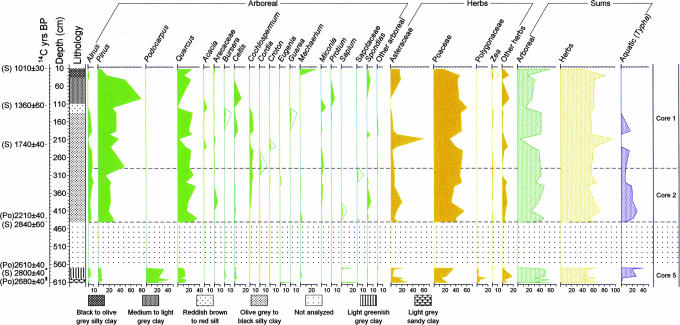
The origin of agriculture was a signal development in human affairs and as such has occupied the attention of scholars from the natural and social sciences for well over a century. Historical studies of climate and vegetation are closely associated with crop plant evolution because they can reveal the ecological contexts of plant domestication together with the antiquity and effects of agricultural practices on the environment. In this article, we present paleoecological evidence from three lakes and a swamp located in the Central Balsas watershed of tropical southwestern Mexico that date from 14,000 B.P. to the modern era. [Dates expressed in B.P. years are radiocarbon ages. Calibrated (calendar) ages, expressed as cal B.P., are provided for dates in the text.] Previous molecular studies suggest that maize (Zea mays L.) and other important crops such as squashes (Cucurbita spp.) were domesticated in the region. Our combined pollen, phytolith, charcoal, and sedimentary studies indicate that during the late glacial period (14,000-10,000 B.P.), lake beds were dry, the climate was cooler and drier, and open vegetational communities were more widespread than after the Pleistocene ended. Zea was a continuous part of the vegetation since at least the terminal Pleistocene. During the Holocene, lakes became important foci of human activity, and cultural interference with a species-diverse tropical forest is indicated. Maize and squash were grown at lake edges starting between 10,000 and 5,000 B.P., most likely sometime during the first half of that period. Significant episodes of climatic drying evidenced between 1,800 B.P. and 900 B.P. appear to be coeval with those documented in the Classic Maya region and elsewhere, showing widespread instability in the late Holocene climate.
Conflict of interest statement
The authors declare no conflict of interest.
Figures
References
-
- Leyden B, Brenner M, Hodell D, Curtis JH. Geophys Monogr. 1993;78:165–178.
-
- Piperno DR, Pearsall DM. The Origins of Agriculture in the Lowland Neotropics. San Diego: Academic; 1998.
-
- Colinvaux PA, De Oliveira PE, Moreno JE, Miller MC, Bush MB. Science. 1996;274:85–88.
-
- Harris DR. In: Evolution on Planet Earth: The Impact of the Physical Environment. Rothschild L, Lister A, editors. London: Elsevier; 2003.
Publication types
MeSH terms
LinkOut - more resources
Full Text Sources
Miscellaneous
