


New highly divergent rRNA sequence among biodiverse genotypes of Enterocytozoon bieneusi strains isolated from humans in Gabon and Cameroon
- PMID: 17537939
- PMCID: PMC1951207
- DOI: 10.1128/JCM.02554-06
New highly divergent rRNA sequence among biodiverse genotypes of Enterocytozoon bieneusi strains isolated from humans in Gabon and Cameroon
Abstract
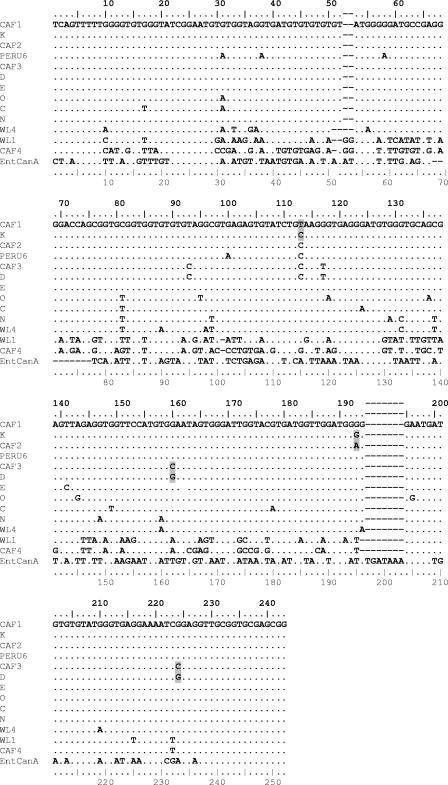
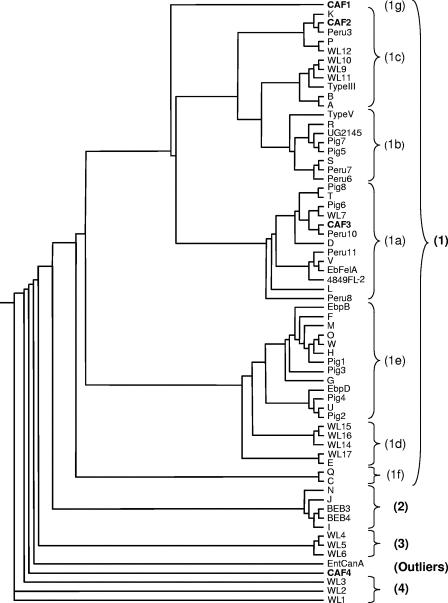
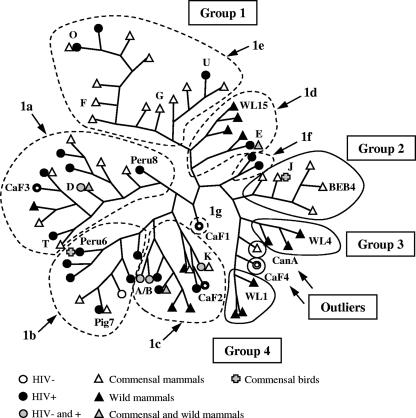
Intestinal microsporidiosis due to Enterocytozoon bieneusi is a leading cause of chronic diarrhea in severely immunocompromised human immunodeficiency virus (HIV)-positive patients. It may be a public health problem in Africa due to the magnitude of the HIV pandemic and to poor sanitary conditions. We designed two prevalence studies of E. bieneusi in Central Africa, the first with HIV-positive patients from an urban setting in Gabon and the second with a nonselected rural population in Cameroon. Stool samples were analyzed by an immunofluorescence antibody test and PCR. Twenty-five out of 822 HIV-positive patients from Gabon and 22 out of 758 villagers from Cameroon were found to be positive for E. bieneusi. The prevalence rates of the two studies were surprisingly similar (3.0% and 2.9%). Genotypic analysis of the internal transcribed spacer region of the rRNA gene showed a high degree of diversity in samples from both countries. In Gabon, 15 isolates showed seven different genotypes: the previously reported genotypes A, D, and K along with four new genotypes, referred to as CAF1, CAF2, CAF3, and CAF4. In Cameroon, five genotypes were found in 20 isolates: the known genotypes A, B, D, and K and the new genotype CAF4. Genotypes A and CAF4 predominated in Cameroon, whereas K, CAF4, and CAF1 were more frequent in Gabon, suggesting that different genotypes present differing risks of infection associated with immune status and living conditions. Phylogenetic analysis of the new genotype CAF4, identified in both HIV-negative and HIV-positive subjects, indicates that it represents a highly divergent strain.
Figures
References
-
- Alfa Cisse, O., A. Ouattara, M. Thellier, I. Accoceberry, S. Biligui, D. Minta, O. Doumbo, I. Desportes-Livage, M. A. Thera, M. Danis, and A. Datry. 2002. Evaluation of an immunofluorescent-antibody test using monoclonal antibodies directed against Enterocytozoon bieneusi and Encephalitozoon intestinalis for diagnosis of intestinal microsporidiosis in Bamako (Mali). J. Clin. Microbiol. 40:1715-1718. - PMC - PubMed
-
- Bern, C., V. Kawai, D. Vargas, J. Rabke-Verani, J. Williamson, R. Chavez-Valdez, L. Xiao, I. Sulaiman, A. Vivar, E. Ticona, M. Navincopa, V. Cama, H. Moura, W. E. Secor, G. Visvesvara, and R. H. Gilman. 2005. The epidemiology of intestinal microsporidiosis in patients with HIV/AIDS in Lima, Peru. J. Infect. Dis. 191:1658-1664. - PubMed
-
- Breitenmoser, A. C., A. Mathis, E. Burgi, R. Weber, and P. Deplazes. 1999. High prevalence of Enterocytozoon bieneusi in swine with four genotypes that differ from those identified in humans. Parasitology 118:447-453. - PubMed
-
- Bretagne, S., F. Foulet, W. Alkassoum, J. Fleury-Feith, and M. Develoux. 1993. Prévalence des spores d'Enterocytozoon bieneusi dans les selles de patients sidéens et d'enfants Africains non infectés par le VIH. Bull. Soc. Pathol. Exot. 86:351-357. - PubMed
Publication types
MeSH terms
Substances
Associated data
- Actions
- Actions
- Actions
- Actions
- Actions
- Actions
- Actions
- Actions
- Actions
- Actions
- Actions
- Actions
LinkOut - more resources
Full Text Sources
