Comparative Study
. 2007 May 30;27(22):5849-56.
doi: 10.1523/JNEUROSCI.0626-07.2007.

The functional impact of the intrastriatal dopamine neuron grafts in parkinsonian rats is reduced with advancing disease

Affiliations
Comparative Study

The functional impact of the intrastriatal dopamine neuron grafts in parkinsonian rats is reduced with advancing disease

Nathalie Breysse et al. J Neurosci. .

Abstract

Clinical trials involving intrastriatal transplants of human embryonic mesencephalic tissue have provided proof-of-principle that nigral dopamine (DA) neurons can survive and functionally integrate into the host neural circuitry. However, the degree of graft-induced symptomatic relief differs significantly between the patients. This variability has led to investigations aimed at identifying factors that could affect the clinical outcome. The extent and pattern of dopaminergic denervation in the brain may be one of the major determinants of the functional outcome after intrastriatal DA cell grafts. Here, we report that in animals subjected to an intrastriatal 6-hydroxydopamine lesion of the striatal dopaminergic afferent, the integrity of the host dopaminergic innervation outside the areas innervated by the graft is critical for optimal function of DA neurons placed in the striatum. Established graft-induced functional recovery, as assessed in the stepping and cylinder tests, was compromised in animals in which the dopaminergic lesion was extended to include also the medial and ventral striatum as well as the cortical and limbic DA projections. Poor clinical outcome after transplantation may, thus, at least in part, be caused by dopaminergic denervation in areas outside the graft-innervated territories, and similarly beneficial effects initially observed in patients may regress if the degeneration of the host extrastriatal DA projection systems proceeds with advancing disease. This would have two implications: first, patients with advanced disease involving the ventral striatum and/or nonstriatal DA projections would be unlikely to respond well to intrastriatal DA grafts and, second, to retain the full benefit of the grafts, progression of the disease should be avoided by, for example, combining cell therapy with a neuroprotective approach.


Figures
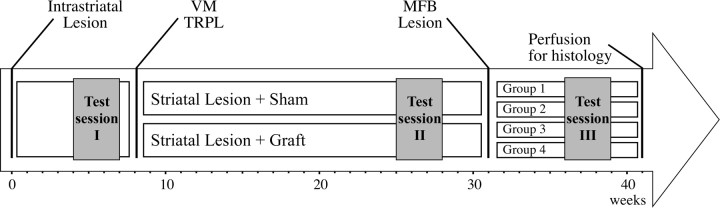
Figure 1.
Figure 1.
Time-line showing the design of the experiment. All animals received a four-site intrastriatal 6-OHDA lesion at the beginning of the experiment (week 0). After the completion of the first behavioral test session, they were divided into two balanced groups to receive either transplantation of fetal VM tissue (VM TRPL) prepared as single cell suspension or sham operation (week 8). They were then followed for an additional 23 weeks and tested for monitorization of the recovery of motor functions. At 31 weeks, each group was further divided into two behaviorally matched subgroups to receive a second lesion at the level of the MFB to remove the remaining host ascending dopamine projections to the forebrain (mainly the nonstriatal projections originating from the ventral tegmental area), or were sham operated. All four groups of animals were followed for an additional 10 weeks. During this time, the impact of the dopamine depletion in the nonstriatal targets was assessed on behaviors (session 3), all of which had initially showed graft-induced recovery. All tissue was processed for histological analysis at 41 weeks after the first lesion.
Figure 2.
Figure 2.
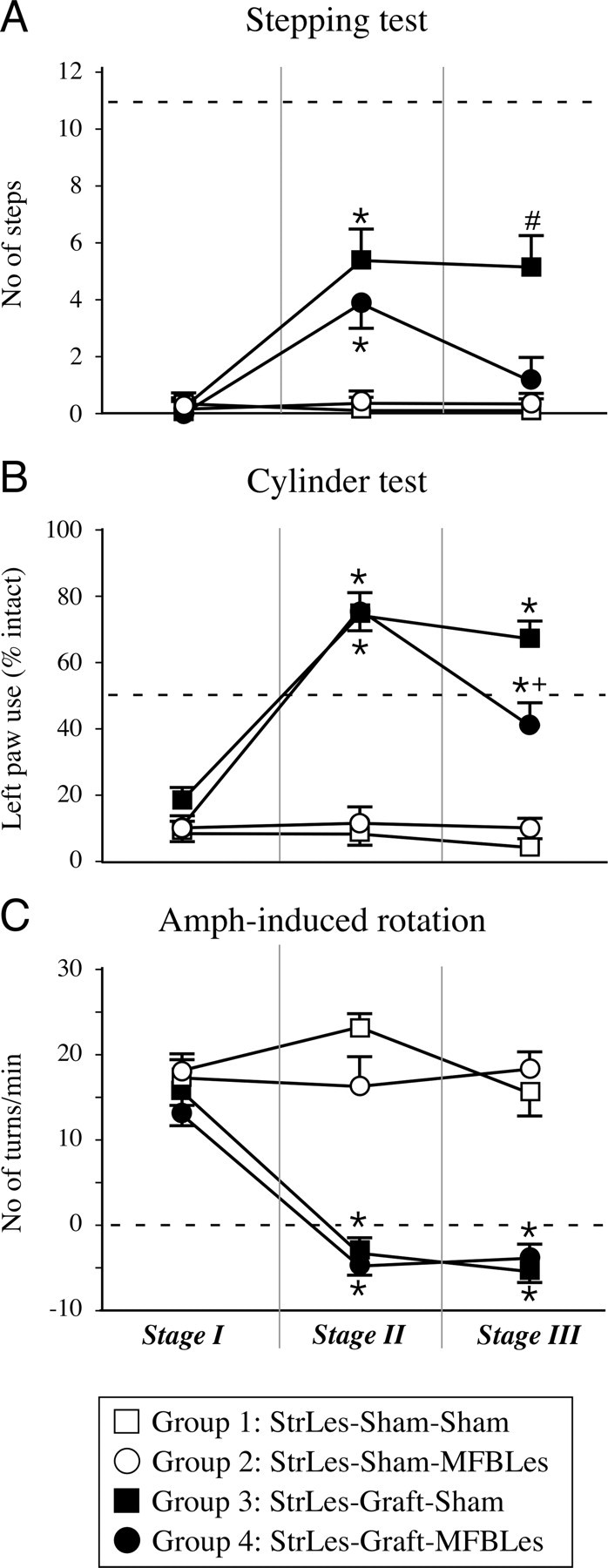
Behavioral tests. A–C, At every stage of the experiment, the animals were monitored in a battery of behavioral tests including the forelimb akinesia in the stepping test (A), paw use bias in the cylinder test (B), and rotational asymmetry after activation by amphetamine administration (C). The behavioral testing in stage 1 of the experiment was performed after the partial injury of the dopaminergic system (test session 1), where mainly the nigrostriatal projections were lesioned. This test session formed the basis for inclusion criteria in the experiment as well as the behavioral measures on which the groups were divided into two subgroups for stage 2. Basically, all animals that were included in the experiment had severe impairments in the stepping test and performed <1 step on average, representing >90% loss of function (A). Similarly, use of the left paw for wall touches in the cylinder test was reduced to <15% (B), and a high rotational bias was seen in all animals in the amphetamine rotation (C). Stage 2 testing was performed 17–20 weeks after grafting, where the functional effects of the VM grafts were obvious in all three tests. Whereas in the stepping test the recovery was partial and the performance of the animals reached up to ∼50% of normal, in both the cylinder and amphetamine-induced rotation tests there was a full recovery. Behavioral tests in stage 3 were performed after the second lesion aimed at removing the remaining dopamine projections mainly to extrastriatal targets. The consequence of this on the behaviors that were initially improved by the graft was different. The benefits in the stepping test were dramatically reduced back to baseline values (A), but only a partial but significant reduction was seen in the cylinder test. However, the amphetamine rotation test did not demonstrate any change from stage 2. The dashed line in each panel represents the expected behavior of an intact animal. *Different from its control group; +different from striatal lesion (StrLes)-Graft-Sham group; #different from all other groups. MFBLes, MFB lesion. Error bars indicate SEM.
Figure 3.
Figure 3.
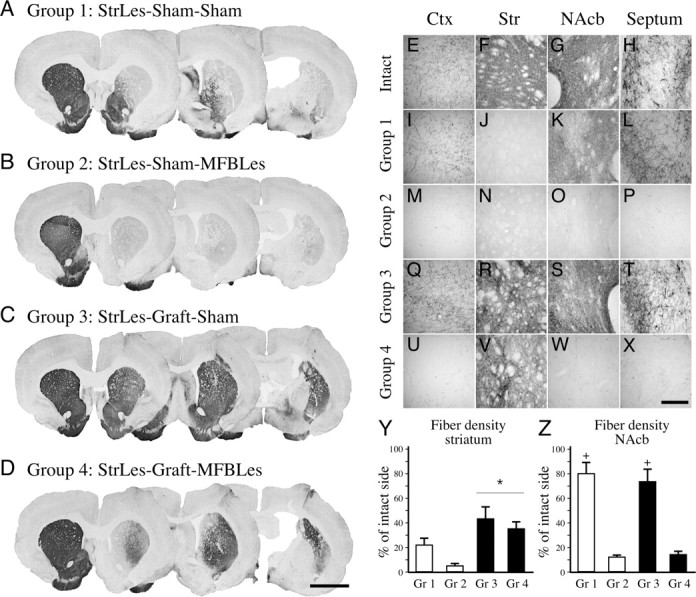
Ascending dopaminergic projections and fiber innervation provided by the graft. Four groups of animals were followed in this experiment. A, I–L, In group 1, the animals received a partial lesion depleting mainly the nigrostriatal projections to the dorsal and lateral striatum, leaving the mesocorticolimbic projections to the ventromedial striatum, nucleus accumbens, septum, and cortex intact. B, M–P, Group 2 consisted of animals that received a second lesion, which depleted the mesocorticolimbic pathway removing nearly all of the midbrain dopamine input to the forebrain areas. C, D, Q–X, Groups 3 (C, Q–T) and 4 (D, U–X) were animals that received transplants of fetal ventral mesencephalic tissue in multiple tracts to provide widespread reinnervation in the striatum in partially and completely denervated animals, respectively. In group 3, reinnervation of the striatal areas was sufficient to reinstitute the dopamine input systems to the forebrain; however, although the graft-derived fibers were equally abundant in the striatum in group 4, degeneration of the mesocorticolimbic fibers left the graft-derived dopamine input isolated (compare Q–T and U–X with E–H). Semiquantitative analysis of total TH-positive fiber density was measured in the striatum (Y) and the nucleus accumbens (Z). Ctx, Cortex; Str, striatum. Scale bars: (in D) A–D, 3 mm; (in X) E–X, 250 μm. *Different from nongrafted control groups; +different from the corresponding sham lesioned group. Error bars indicate SEM.
Figure 4.
Figure 4.
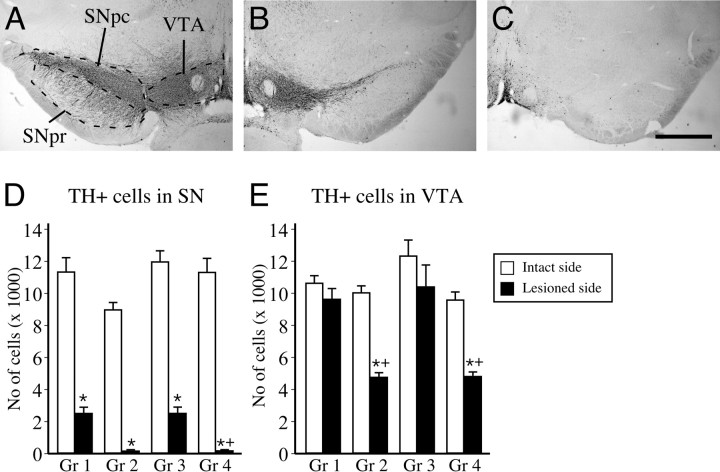
TH-positive cell numbers in the SN and the VTA that constitute the midbrain ascending projections to the forebrain. A, VTA neurons lie medially and project mainly to nonstriatal targets, whereas the laterally located SN cells preferentially innervate the striatum, as shown in a nonlesioned side of the brain. B, Striatal injection of the 6-OHDA toxin leads to lesion of the striatal dopamine terminals and a retrograde degeneration of the SN cells, leaving most of the VTA neurons intact. C, However, injection of the same toxin at the level of the medial forebrain bundle damages axons from both pathways and, thus, leads to a combined lesion affecting both projection systems. D, E, The total numbers of TH-positive cells present in each nuclei was quantified using computerized stereological estimation tools. We found that the striatal lesion in groups 1 and 3 lead to a comparable lesion of ∼75% in the SN. In these groups the VTA cell numbers were not affected. In the complete lesion animals (groups 2 and 4), however, not only the SN was completely depleted, but also the TH-positive cells in the VTA were reduced by ∼50%. SNpc, Substantia nigra pars compacta; SNpr, substantia nigra pars reticulata. Scale bar: (in C) A–C, 1 mm. *Different from intact side; +different from its control group. Error bars indicate SEM.
Figure 5.
Figure 5.
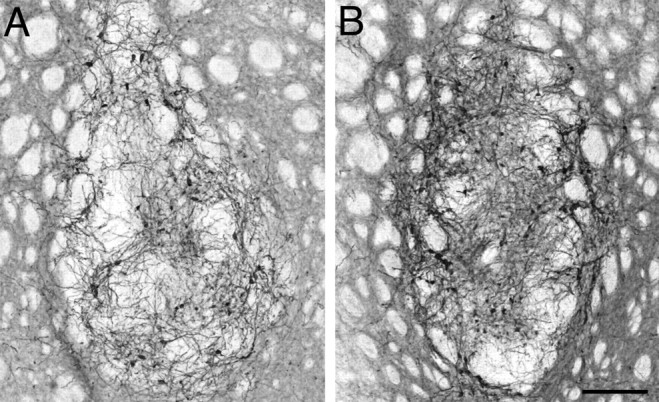
Survival of TH-positive cells in the striatum of animals grafted with ventral mesencephalic tissue. A, B, Two examples of graft deposits from a partially lesioned animal (A) and a complete lesion animal (B) are shown. We found that in both groups similar numbers of cells survived the transplantation (6865 ± 1374 and 5923 ± 988 cells in groups 3 and 4, respectively), showing that there was no effect of the second lesion on the grafted cells (unpaired t test, p = 0.58). Scale bar, 200 μm.

References

    1. Brundin P, Pogarell O, Hagell P, Piccini P, Widner H, Schrag A, Kupsch A, Crabb L, Odin P, Gustavii B, Bjorklund A, Brooks DJ, Marsden CD, Oertel WH, Quinn NP, Rehncrona S, Lindvall O. Bilateral caudate and putamen grafts of embryonic mesencephalic tissue treated with lazaroids in Parkinson's disease. Brain. 2000;123:1380–1390. - PubMed
    1. Cochen V, Ribeiro MJ, Nguyen JP, Gurruchaga JM, Villafane G, Loc'h C, Defer G, Samson Y, Peschanski M, Hantraye P, Cesaro P, Remy P. Transplantation in Parkinson's disease: PET changes correlate with the amount of grafted tissue. Mov Disord. 2003;18:928–932. - PubMed
    1. Damier P, Hirsch EC, Agid Y, Graybiel AM. The substantia nigra of the human brain. II. Patterns of loss of dopamine-containing neurons in Parkinson's disease. Brain. 1999;122:1437–1448. - PubMed
    1. Dunnett SB, Robbins TW. The functional role of mesotelencephalic dopamine systems. Biol Rev Camb Philos Soc. 1992;67:491–518. - PubMed
    1. Fearnley JM, Lees AJ. Ageing and Parkinson's disease: substantia nigra regional selectivity. Brain. 1991;114:2283–2301. - PubMed

Publication types