


Effects of life-long caloric restriction and voluntary exercise on age-related changes in levels of catecholamine biosynthetic enzymes and angiotensin II receptors in the rat adrenal medulla and hypothalamus
- PMID: 17540525
- PMCID: PMC2034493
- DOI: 10.1016/j.exger.2007.04.007
Effects of life-long caloric restriction and voluntary exercise on age-related changes in levels of catecholamine biosynthetic enzymes and angiotensin II receptors in the rat adrenal medulla and hypothalamus
Abstract
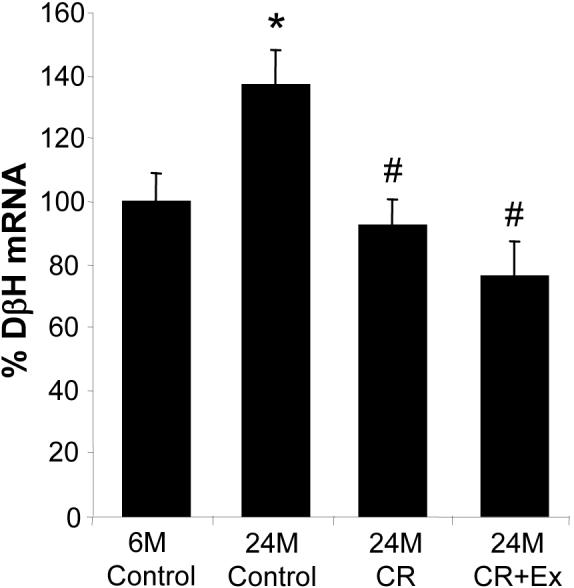
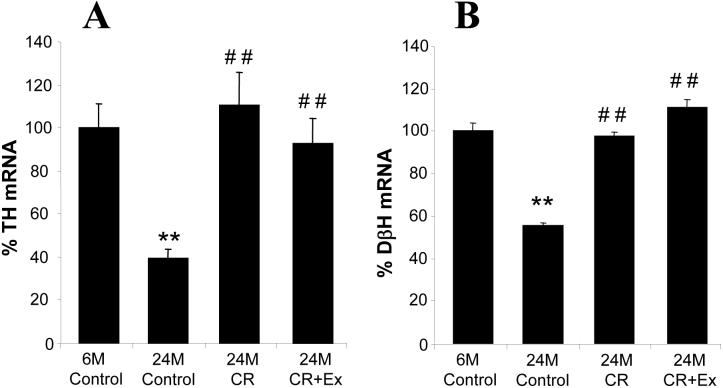
We examined if life-long mild caloric restriction (CR) alone or with voluntary exercise prevents the age-related changes in catecholamine biosynthetic enzyme levels in the adrenal medulla and hypothalamus. Ten-week-old Fisher-344 rats were assigned to: sedentary; sedentary+8% CR; or 8% CR+wheel running. Rats were euthanized at 6 or 24 months of age. Tyrosine hydroxylase (TH) mRNA expression was 4.4-fold higher in the adrenal medullae and 60% lower in the hypothalamus of old sedentary rats compared to young (p<0.01). Life-long CR reduced the age-related increase in adrenomedullary TH by 50% (p<0.05), and completely reversed the changes in hypothalamic TH. Voluntary exercise, however, had no additional effect over CR. Since angiotensin II is involved in the regulation of catecholamine biosynthesis, we examined the expressions of angiotensin II receptor subtypes in the adrenal medulla. AT(1) protein levels were 2.8-fold higher in the old animals compared to young (p<0.01), and while AT(1) levels were unaffected by CR alone, CR+wheel running decreased AT(1) levels by 50% (p<0.01). AT(2) levels did not change with age, however CR+wheel running increased its level by 42% (p<0.05). These data indicate that a small decrease in daily food intake can avert age-related changes in catecholamine biosynthetic enzyme levels in the adrenal medulla and hypothalamus, possibly through affecting angiotensin II signaling.
Figures


References
-
- Armando I, Carranza A, Nishimura Y, Hoe KL, Barontini M, Terron JA, Falcon-Neri A, Ito T, Juorio AV, Saavedra JM. Peripheral administration of an angiotensin II AT(1) receptor antagonist decreases the hypothalamic-pituitary-adrenal response to isolation Stress. Endocrinology. 2001;142:3880–3889. - PubMed
-
- Armando I, Jezova M, Bregonzio C, Baiardi G, Saavedra JM. Angiotensin II AT1 and AT2 receptor types regulate basal and stress-induced adrenomedullary catecholamine production through transcriptional regulation of tyrosine hydroxylase. Ann N Y Acad Sci. 2004;1018:302–309. - PubMed
-
- Avakian EV, Horvath SM, Colburn RW. Influence of age and cold stress on plasma catecholamine levels in rats. J Auton Nerv Syst. 1984;10:127–133. - PubMed
-
- Banerji TK, Parkening TA, Collins TJ. Adrenomedullary catecholaminergic activity increases with age in male laboratory rodents. J Gerontol. 1984;39:264–268. - PubMed
-
- Chen D, Steele AD, Lindquist S, Guarente L. Increase in activity during calorie restriction requires Sirt1. Science. 2005;310:1641. - PubMed
Publication types
MeSH terms
Substances
Grants and funding
LinkOut - more resources
Full Text Sources
Medical
Research Materials
