. 2007 Aug;73(15):5026-33.
doi: 10.1128/AEM.00600-07. Epub 2007 Jun 1.

NCgl2620 encodes a class II polyphosphate kinase in Corynebacterium glutamicum

Affiliations

NCgl2620 encodes a class II polyphosphate kinase in Corynebacterium glutamicum

Steffen N Lindner et al. Appl Environ Microbiol. 2007 Aug.

Abstract

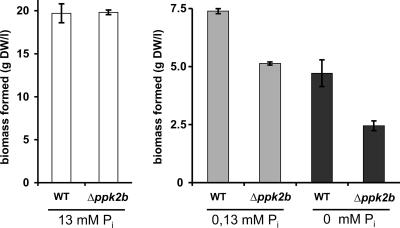
Corynebacterium glutamicum is able to accumulate up to 600 mM cytosolic phosphorus in the form of polyphosphate (poly P). Granular poly P (volutin) can make up to 37% of the internal cell volume. This bacterium lacks the classic enzyme of poly P synthesis, class I polyphosphate kinase (PPK1), but it possesses two genes, ppk2A (corresponds to NCgl0880) and ppk2B (corresponds to NCgl2620), for putative class II (PPK2) PPKs. Deletion of ppk2B decreased PPK activity and cellular poly P content, while overexpression of ppk2B increased both PPK activity and cellular poly P content. Neither deletion nor overexpression of ppk2A changed specific activity of PPK or cellular poly P content significantly. Purified PPK2B of C. glutamicum is active as a homotetramer and formed poly P with an average chain length of about 125, as determined with (31)P nuclear magnetic resonance. The catalytic efficiency of C. glutamicum PPK2B was higher in the poly P-forming direction than for nucleoside triphosphate formation from poly P. The ppk2B deletion mutant, which accumulated very little poly P and grew as C. glutamicum wild type under phosphate-sufficient conditions, showed a growth defect under phosphate-limiting conditions.


Figures
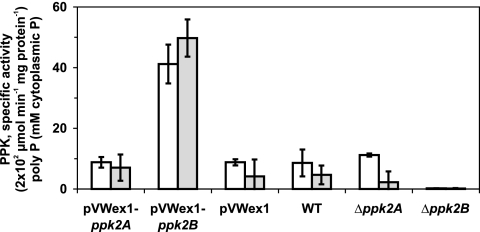
FIG. 1.
FIG. 1.
PPK activity and poly P accumulation in various strains of C. glutamicum. Open columns, PPK activity; shaded columns, poly P content. Average values and standard deviations of at least three independent determinations are given.
FIG. 2.
FIG. 2.
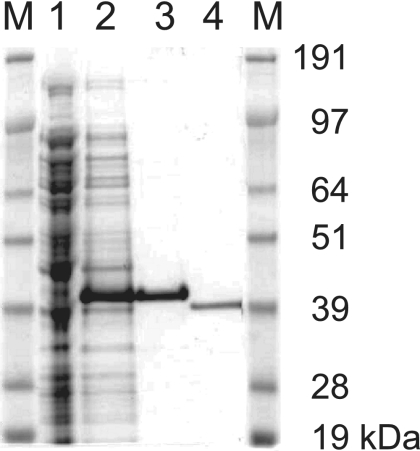
Purification of PPK2B of Corynebacterium glutamicum from Escherichia coli BL21(DE3) (pET16b-ppk2B). Sodium dodecyl sulfate-polyacrylamide gel electrophoresis analysis of protein from extracts before (lane 1) and after (lane 2) induction with 0.5 mM IPTG as well as from Ni-NTA chromatography purified (lane 3) and factor Xa-cleaved protein (lane 4) is shown. Lane M, SeeBlue Plus2 prestained standard (Invitrogen).
FIG. 3.
FIG. 3.
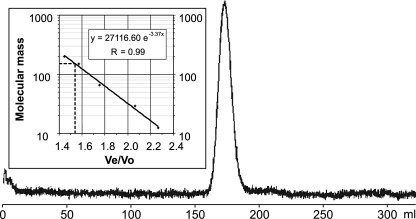
Molecular weight determination of PPK2B of C. glutamicum by gel filtration resulted in a single peak, as shown. The ratio of Ve (elution volume) and Vo (void volume; measured by blue dextran) of the standard proteins (see Materials and Methods) was plotted against the molecular weight, as seen in the inset. From this plot, the molecular weight of PPK2b was calculated.
FIG. 4.
FIG. 4.
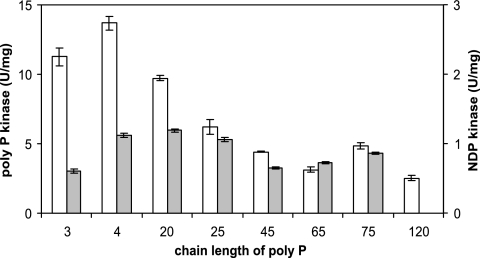
Influence of poly P chain length on the activities of the poly P and NDP kinase reactions of PPK2B. Open columns, PPK; shaded columns, NDP kinase. Bars represent standard errors of two to three determinations. For poly P standards, see Materials and Methods.
FIG. 5.
FIG. 5.
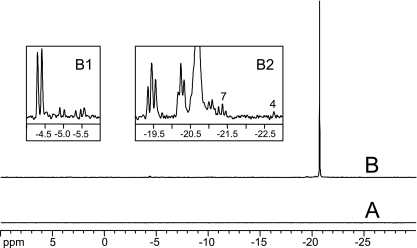
31P NMR analysis of the poly P product from the PPK2B reaction with ATP. (A) Heat-inactivated enzyme. (B) Reaction product after 24-h incubation in reaction buffer. B1 and B2 show selected regions of spectrum B. Major signals are doublets near −4.5 ppm (PP1); triplets around −19.5 and −20.3 (PP2 and PP3); and the core phosphates signal around −20.6 ppm (PP4); see Materials and Methods. In inset B1, the small signals at −5 and −5.5 ppm are due to traces of ATP, ADP, and PPi. In inset B2, the small signals from about 20.75 to 20.7 ppm are due to traces of cyclic polyphosphates (true metaphosphates; for assignment of tetra- and heptametaphosphate [4 and 7 in inset B2], indicated by numerals, see Materials and Methods); the other trace signals are unassigned metaphosphates. The spectra depicted in insets B1 and B2 were acquired with 122,880 scans to enhance details.
FIG. 6.
FIG. 6.
Biomass formation of C. glutamicum WT and Δppk2B after transfer to minimal medium with different phosphate concentrations. Cells cultured overnight on LB medium were used to inoculate CgXII minimal medium with 4% (wt/vol) glucose and either 13 mM, 0.13 mM, or 0 mM Pi. Biomass formation was determined after 26 h of cultivation, and average values and errors of at least two independent cultivations are given.

References

    1. Abe, S. G.-G., K. I. Takayama, and S. Kinoshita. 1967. Taxonomical studies on glutamic acid-producing bacteria. J. Gen. Appl. Microbiol. 13:279-285.
    1. Ahn, K., and A. Kornberg. 1990. Polyphosphate kinase from Escherichia coli. Purification and demonstration of a phosphoenzyme intermediate. J. Biol. Chem. 265:11734-11739. - PubMed
    1. Akiyama, M., E. Crooke, and A. Kornberg. 1992. The polyphosphate kinase gene of Escherichia coli. Isolation and sequence of the ppk gene and membrane location of the protein. J. Biol. Chem. 267:22556-22561. - PubMed
    1. Ault-Riché, D., C. D. Fraley, C. M. Tzeng, and A. Kornberg. 1998. Novel assay reveals multiple pathways regulating stress-induced accumulations of inorganic polyphosphate in Escherichia coli. J. Bacteriol. 180:1841-1847. - PMC - PubMed
    1. Ayraud, S., B. Janvier, A. Labigne, C. Ecobichon, C. Burucoa, and J. L. Fauchere. 2005. Polyphosphate kinase: a new colonization factor of Helicobacter pylori. FEMS Microbiol. Lett. 243:45-50. - PubMed

MeSH terms

LinkOut - more resources