


Late-life depressive symptoms are associated with both hyperactivity and hypoactivity of the hypothalamo-pituitary-adrenal axis
- PMID: 17545451
- PMCID: PMC2674314
- DOI: 10.1097/JGP.0b013e318033ed80
Late-life depressive symptoms are associated with both hyperactivity and hypoactivity of the hypothalamo-pituitary-adrenal axis
Abstract
Objective: Although depression has been associated with hyperactivity of the hypothalamo-pituitary-adrenal (HPA) axis, recent studies among depressed elderly have found decreased cortisol levels, which may be due to underlying physical frailty associated with HPA-axis hypoactivity. The authors examined the relationship between urinary cortisol level and late-life depressive symptoms. The authors also explored whether hypo- and hypercortisolemic depressive symptoms are qualitatively different.
Methods: Data are from 881 community-dwelling participants, average age 74.2 years, of the Aging in the Chianti Area Study. Depressive symptoms were assessed using the Center for Epidemiologic Studies Depression Scale (CES-D) scale and cortisol levels were determined in 24-hour urine samples.
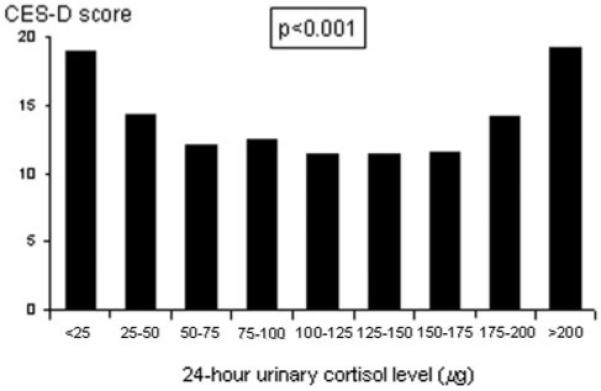
Results: Mean urinary cortisol level was 98.9 microg/24 hours (SD=47.8), and 31% of the sample had significant depressive symptoms (CES-D > or =16). There was no linear association between urinary cortisol level and depressive symptoms; however, there was a nonlinear association between urinary cortisol level and depressive symptoms. Older persons in the lowest and highest urinary cortisol deciles were 2.2 and 1.9 times more likely to have significant depressive symptoms than older persons in all other deciles. Depressed persons with low cortisol presented more physical frailty than depressed persons with high cortisol.
Conclusion: Late-life depressive symptoms are associated with both hyperactivity and hypoactivity of the HPA axis, which suggests distinct mechanisms for these associations.
Figures
Comment in
-
Late-life depressive symptoms are associated with both hyperactivity and hypoactivity of the hypothalamic-pituitary-adrenal axis.Am J Geriatr Psychiatry. 2007 Nov;15(11):985; author reply 985-6. doi: 10.1097/JGP.0b013e318151f9b1. Am J Geriatr Psychiatry. 2007. PMID: 17974872 Free PMC article. No abstract available.
References
-
- Gotthardt U, Schweiger U, Fahrenberg J, et al. Cortisol, ACTH, and cardiovascular response to a cognitive challenge paradigm in aging and depression. Am J Physiol. 1995;268:R865–R873. - PubMed
-
- Heuser IJ, Schweiger U, Gotthardt U, et al. Pituitary-adrenal-system regulation and psychopathology during amitriptyline treatment in elderly depressed patients and normal comparison subjects. Am J Psychiatry. 1996;153:93–99. - PubMed
-
- O’Brien JT, Ames D, Schweitzer I, et al. Clinical and magnetic resonance imaging correlates of hypothalamic-pituitary-adrenal axis function in depression and Alzheimer’s disease. Br J Psychiatry. 1996;168:679–687. - PubMed
-
- O’Brien JT, Lloyd A, McKeith I, et al. A longitudinal study of hippocampal volume, cortisol levels, and cognition in older depressed subjects. Am J Psychiatry. 2004;161:2081–2090. - PubMed
Publication types
MeSH terms
Substances
Grants and funding
LinkOut - more resources
Full Text Sources
Medical
