. 2007 Jun 4:4:48.
doi: 10.1186/1743-422X-4-48.

Efficient replication of pneumonia virus of mice (PVM) in a mouse macrophage cell line

Affiliations

Efficient replication of pneumonia virus of mice (PVM) in a mouse macrophage cell line

Kimberly D Dyer et al. Virol J. .

Abstract

Pneumonia virus of mice (PVM; family Paramyxoviridae, subfamily Pneumovirinae) is a natural respiratory pathogen of rodent species and an important new model for the study of severe viral bronchiolitis and pneumonia. However, despite high virus titers typically detected in infected mouse lung tissue in vivo, cell lines used routinely for virus propagation in vitro are not highly susceptible to PVM infection. We have evaluated several rodent and primate cell lines for susceptibility to PVM infection, and detected highest virus titers from infection of the mouse monocyte-macrophage RAW 264.7 cell line. Additionally, virus replication in RAW 264.7 cells induces the synthesis and secretion of proinflammatory cytokines relevant to respiratory virus disease, including tumor necrosis factor-alpha (TNF-alpha), interferon-beta (IFN-beta), macrophage inflammatory proteins 1alpha and 1beta (MIP-1alpha and MIP-1beta) and the functional homolog of human IL-8, mouse macrophage inflammatory peptide-2 (MIP-2). Identification and characterization of a rodent cell line that supports the replication of PVM and induces the synthesis of disease-related proinflammatory mediators will facilitate studies of molecular mechanisms of viral pathogenesis that will complement and expand on findings from mouse model systems.


Figures
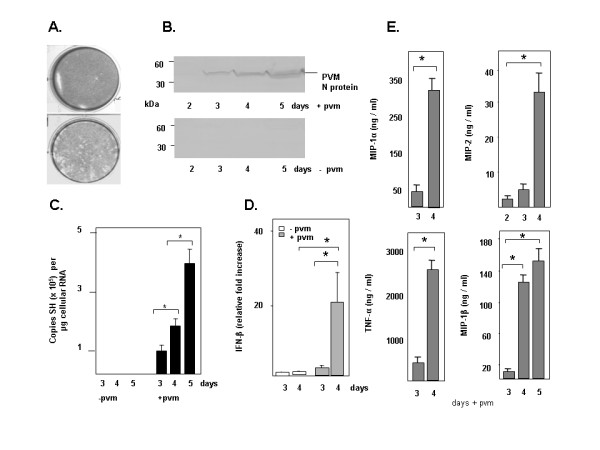
Figure 1
Figure 1
Infection of the mouse macrophage RAW 264.7 cell line with PVM. (A) A plaque assay targeting the standard BS-C-1 primate epithelial cell line (lower panel) compared to an uninfected control cell monolayer (upper panel). (B) Western blot of infected (+pvm) and control (-pvm) RAW 264.7 cell extracts (2 × 10⁶ cell equivalents/lane) probed with rabbit polyclonal antisera directed against a specific 15-mer of the PVM N peptide. (C) Q-RT-PCR detecting PVM SH gene per microgram RNA [13] from triplicate cultures of infected (+pvm) and uninfected (-pvm) RAW 264.7 cells demonstrating ongoing PVM replication in infected cells; *p < 0.05 as indicated. (D) Q-RT-PCR detection of interferon-β in RNA from triplicate cultures of infected (+pvm, grey bars) and uninfected control (-pvm, white bars) cells, day 3 no infection normalized to 1.0 [13]; *p < 0.02 as indicated. (E) Detection of proinflammatory cytokines (MIP-1α, MIP-1β, MIP-2 and TNF-α) in culture supernatants in response to infection, data shown with background levels subtracted; *p < 0.01 as indicated.

References

    1. Horsfall FL, Jr, Ginsberg H. The dependence of the pathological lesion upon the multiplication of pneumonia virus of mice (PVM) J Exp Med. 1951;93:139–150. doi: 10.1084/jem.93.2.139. - DOI - PMC - PubMed
    1. Ginsberg HS, Horsfall FL., Jr Characteristics of the multiplication cycle of pneumonia virus of mice (PVM) J Exp Med. 1951;93:151–160. doi: 10.1084/jem.93.2.151. - DOI - PMC - PubMed
    1. Boot R, van Herck H, van der Logt J. Mutual viral and bacterial infections after housing rats of various breeders within an experimental unit. Laboratory Animal. 1996;30:42–45. doi: 10.1258/002367796780744929. - DOI - PubMed
    1. Miyata H, Kishikawa M, Kondo H, Kai C, Watanabe Y, Ohsawa K, Sato H. New isolates of pneumonia virus of mice (PVM) from Japanese rat colonies and their characterization. Exp Animal. 1995;44:95–104. doi: 10.1538/expanim.44.95. - DOI - PubMed
    1. Zenner L, Regnault JP. Ten-year long monitoring of laboratory mouse and rat colonies in French facilities: a retrospective study. Lab Animal. 2000;34:76–83. doi: 10.1258/002367700780577957. - DOI - PubMed

Publication types

LinkOut - more resources
