. 2007 Jun 5:2:16.
doi: 10.1186/1747-1028-2-16.

The role of CDK in the initiation step of DNA replication in eukaryotes

Affiliations

The role of CDK in the initiation step of DNA replication in eukaryotes

Seiji Tanaka et al. Cell Div. .

Abstract

Cyclin-dependent kinases (CDKs) regulate the progression of the cell cycle in eukaryotes. One of the major roles of CDK is to promote chromosomal DNA replication. However, how CDKs promote DNA replication has been a long-standing question, because all the essential CDK substrates in DNA replication have not been identified yet. Recently Sld2 and Sld3 were identified as essential substrates of CDKs in the initiation step of DNA replication in budding yeast. Moreover, bypass of their phosphorylations is sufficient to promote DNA replication. Phosphorylation of Sld2 and Sld3 by CDKs enhances the formation of complex(es) with a BRCT (BRCA1 C-Terminal)-containing replication protein, Dpb11. We further propose that multiple phosphorylation by CDKs controls this process in budding yeast. Even though Sld3 orthologues in multicellular eukaryotes have not been identified, similar complex formation and, therefore, a similar mechanism of initiation control might be employed in eukaryotes.


Figures
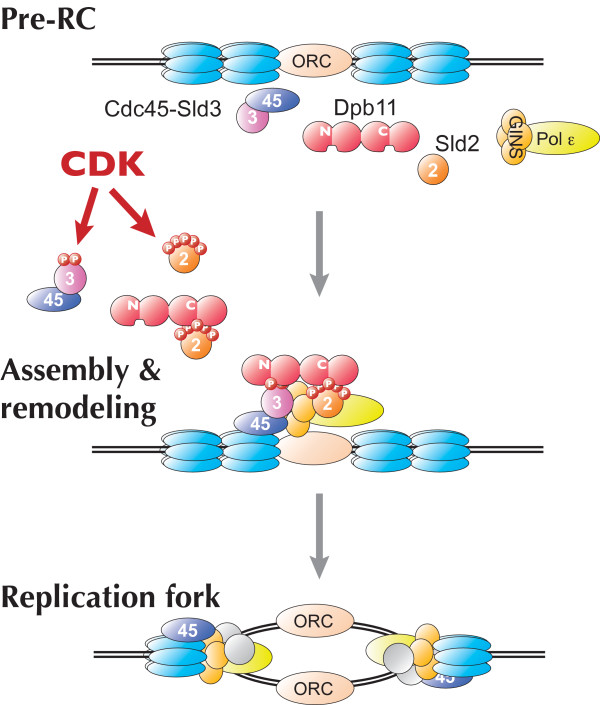
Figure 1
Figure 1
A model for CDK-regulated initiation of chromosome DNA replication. Pre-replicative complexes are formed at origins of DNA replication in G1 (top). When S-CDK is activated, it phosphorylates Sld2 and Sld3. These phosphorylations promote complex formation between Sld2 and Sld3 and Dpb11. This reaction triggers the initiation of DNA replication.
Figure 2
Figure 2
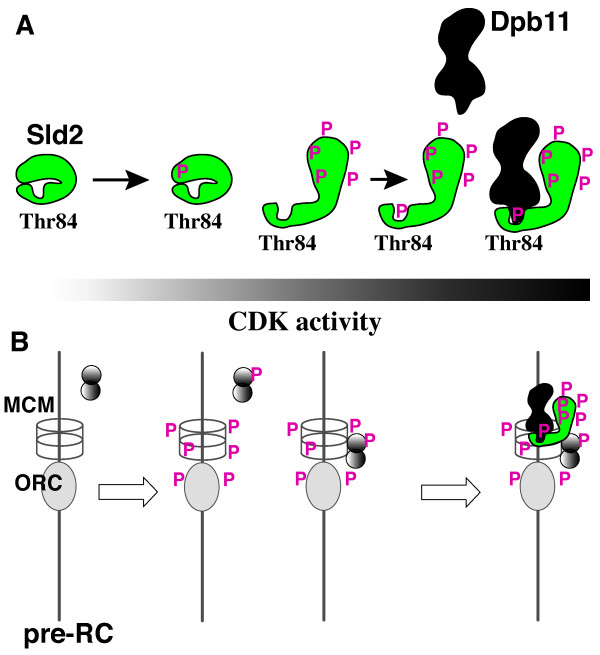
Regulatory model of the interaction between Dpb11 and Sld2 phosphorylated by CDK. (A) The phosphorylation level of Sld2 is proportional to the level of CDK activity. However, phosphorylation of Thr84 in Sld2 requires prior phosphorylation of other CDK phosphorylation motifs. When CDK activity increases beyond threshold, Sld2 may change its conformation by multiple phosphorylations and then CDK phosphorylates Thr84. When Thr84 is phosphorylated, Sld2 forms a complex with Dpb11 to initiate DNA replication. (B) The pre-replicative complex (pre-RC) essential for the initiation of chromosomal DNA replication is formed at replication origins from late M phase to G1 phase when CDK activity is low. When CDK activity increases at G1/S phase boundary, the pre-RC components are phosphorylated and inactivated for further formation of the pre-RC before Thr84 of Sld2 is phosphorylated. Some other proteins are also phosphorylated and may bind to origins before Thr84-phosphorylation. Thus, inactivation of the pre-RC formation and preceding origin association of some replication proteins are ensured by this mechanism.

References

    1. D'Urso G, Marraccino RL, Marshak DR, Roberts JM. Cell cycle control of DNA replication by a homologue from human cells of the p34cdc2 protein kinase. Science. 1990;250:786–791. doi: 10.1126/science.2173140. - DOI - PubMed
    1. Blow JJ, Nurse P. A cdc2-like protein is involved in the initiation of DNA replication in Xenopus egg extracts. Cell. 1990;62:855–862. doi: 10.1016/0092-8674(90)90261-C. - DOI - PubMed
    1. Hartwell LH, Culotti J, Pringle JR, Reid BJ. Genetic control of the cell division cycle in yeast. Science. 1974;183:46–51. doi: 10.1126/science.183.4120.46. - DOI - PubMed
    1. Schwob E, Nasmyth K. CLB5 and CLB6, a new pair of B cyclins involved in DNA replication in Saccharomyces cerevisiae. Genes Dev. 1993;7:1160–1175. doi: 10.1101/gad.7.7a.1160. - DOI - PubMed
    1. Zegerman P, Diffley JF. Phosphorylation of Sld2 and Sld3 by cyclin-dependent kinases promotes DNA replication in budding yeast. Nature. 2007;445:281–285. doi: 10.1038/nature05432. - DOI - PubMed

LinkOut - more resources