


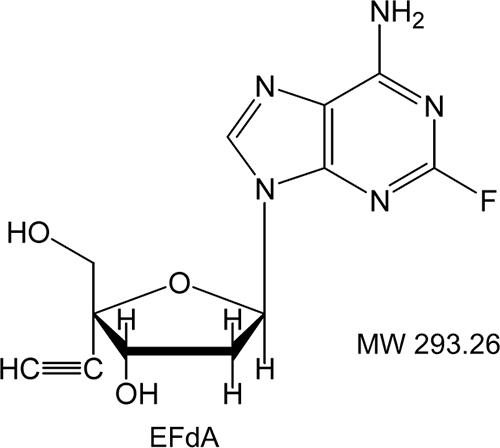
Activity against human immunodeficiency virus type 1, intracellular metabolism, and effects on human DNA polymerases of 4'-ethynyl-2-fluoro-2'-deoxyadenosine
- PMID: 17548498
- PMCID: PMC1932487
- DOI: 10.1128/AAC.00277-07
Activity against human immunodeficiency virus type 1, intracellular metabolism, and effects on human DNA polymerases of 4'-ethynyl-2-fluoro-2'-deoxyadenosine
Abstract
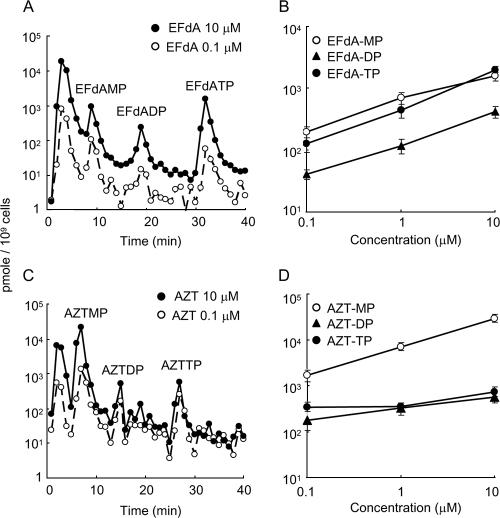
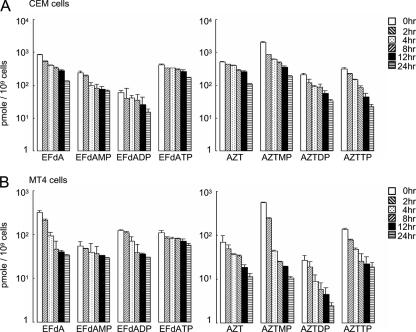
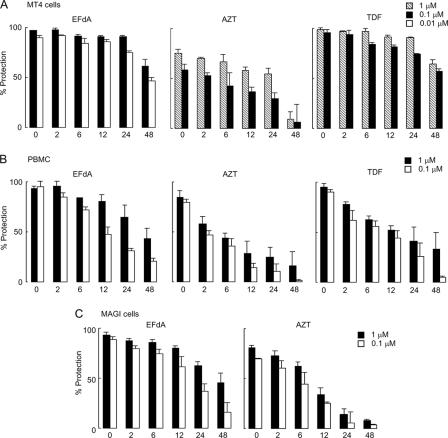
We examined the intracytoplasmic anabolism and kinetics of antiviral activity against human immunodeficiency virus type 1 (HIV-1) of a nucleoside reverse transcriptase inhibitor, 4'-ethynyl-2-fluoro-2'-deoxyadenosine (EFdA), which has potent activity against wild-type and multidrug-resistant HIV-1 strains. When CEM cells were exposed to 0.1 microM [(3)H]EFdA or [(3)H]3'-azido-2',3'-dideoxythymidine (AZT) for 6 h, the intracellular EFdA-triphosphate (TP) level was 91.6 pmol/10(9) cells, while that of AZT was 396.5 pmol/10(9) cells. When CEM cells were exposed to 10 microM [(3)H]EFdA, the amount of EFdA-TP increased by 22-fold (2,090 pmol/10(9) cells), while the amount of [(3)H]AZT-TP increased only moderately by 2.4-fold (970 pmol/10(9) cells). The intracellular half-life values of EFdA-TP and AZT-TP were approximately 17 and approximately 3 h, respectively. When MT-4 cells were cultured with 0.01 microM EFdA for 24 h, thoroughly washed to remove EFdA, further cultured without EFdA for various periods of time, exposed to HIV-1(NL4-3), and cultured for an additional 5 days, the protection values were 75 and 47%, respectively, after 24 and 48 h with no drug incubation, while those with 1 microM AZT were 55 and 9.2%, respectively. The 50% inhibitory concentration values of EFdA-TP against human polymerases alpha, beta, and gamma were >100 microM, >100 microM, and 10 microM, respectively, while those of ddA-TP were >100 microM, 0.2 microM, and 0.2 microM, respectively. These data warrant further development of EFdA as a potential therapeutic agent for those patients who harbor wild-type HIV-1 and/or multidrug-resistant variants.
Figures
References
-
- Amano, M., Y. Koh, D. Das, J. Li, S. Leschenko, Y. F. Wang, P. I. Boross, I. T. Weber, A. K. Ghosh, and H. Mitsuya. 2007. A novel bis-tetrahydrofuranylurethane-containing nonpeptidic protease inhibitor (PI), GRL-98065, is potent against multiple-PI-resistant human immunodeficiency virus in vitro. Antimicrob. Agents Chemother. 51:2143-2155. - PMC - PubMed
-
- Anderson, K. S. 2001. The molecular basis of inhibition and toxicity of modified cytosine analogues targetting HIV-1 reverse transcriptase. Antivir. Chem. Chemother. 12(Suppl.):13-17. - PubMed
-
- Balzarini, J., L. Naesens, S. Aquaro, T. Knispel, C. Perno, E. De Clercq, and C. Meier. 1999. Intracellular metabolism of CycloSaligenyl 3′-azido-2′, 3′-dideoxythymidine monophosphate, a prodrug of 3′-azido-2′, 3′-dideoxythymidine (zidovudine). Mol. Pharmacol. 56:1354-1361. - PubMed
-
- Chen, M. S., R. T. Suttmann, E. Papp, P. D. Cannon, M. J. McRoberts, C. Bach, W. C. Copeland, and T. S. Wang. 1993. Selective action of 4′-azidothymidine triphosphate on reverse transcriptase of human immunodeficiency virus type 1 and human DNA polymerases alpha and beta. Biochemistry 32:6002-6010. - PubMed
-
- Chen, M. S., R. T. Suttmann, J. C. Wu, and E. J. Prisbe. 1992. Metabolism of 4′-azidothymidine. A compound with potent and selective activity against the human immunodeficiency virus. J. Biol. Chem. 267:257-260. - PubMed
Publication types
MeSH terms
Substances
Grants and funding
LinkOut - more resources
Full Text Sources
Other Literature Sources
Medical
