Reading affect in the face and voice: neural correlates of interpreting communicative intent in children and adolescents with autism spectrum disorders
- PMID: 17548751
- PMCID: PMC3713233
- DOI: 10.1001/archpsyc.64.6.698
Reading affect in the face and voice: neural correlates of interpreting communicative intent in children and adolescents with autism spectrum disorders
Abstract
Context: Understanding a speaker's communicative intent in everyday interactions is likely to draw on cues such as facial expression and tone of voice. Prior research has shown that individuals with autism spectrum disorders (ASD) show reduced activity in brain regions that respond selectively to the face and voice. However, there is also evidence that activity in key regions can be increased if task demands allow for explicit processing of emotion.
Objectives: To examine the neural circuitry underlying impairments in interpreting communicative intentions in ASD using irony comprehension as a test case, and to determine whether explicit instructions to attend to facial expression and tone of voice will elicit more normative patterns of brain activity.
Design, setting, and participants: Eighteen boys with ASD (aged 7-17 years, full-scale IQ >70) and 18 typically developing (TD) boys underwent functional magnetic resonance imaging at the Ahmanson-Lovelace Brain Mapping Center, University of California, Los Angeles.
Main outcome measures: Blood oxygenation level-dependent brain activity during the presentation of short scenarios involving irony. Behavioral performance (accuracy and response time) was also recorded.
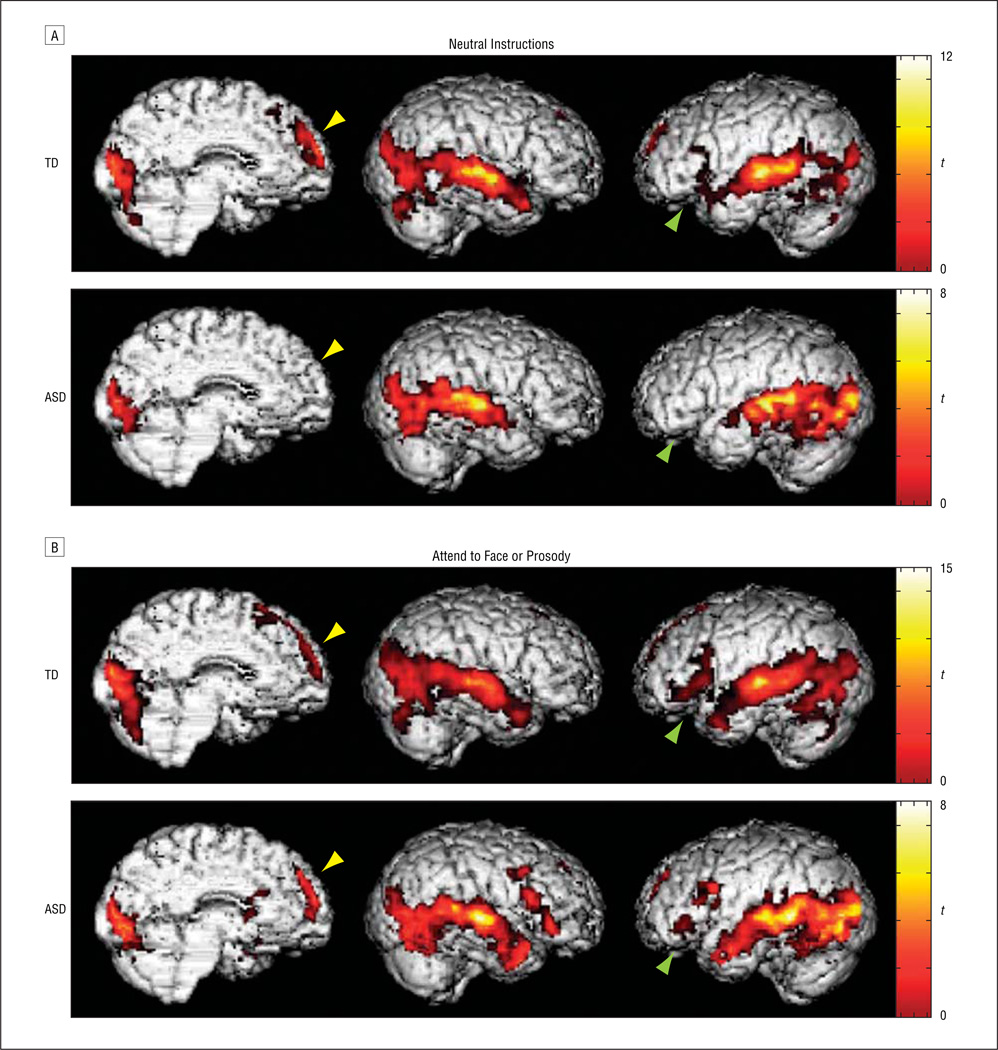
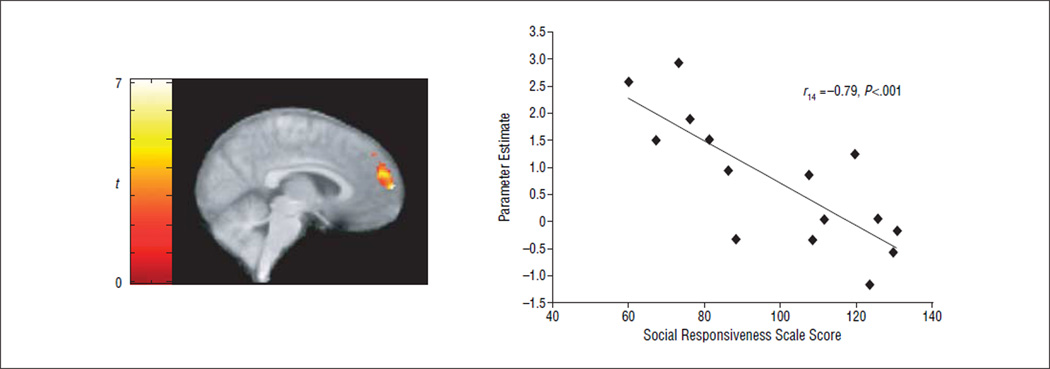
Results: Reduced activity in the medial prefrontal cortex and right superior temporal gyrus was observed in children with ASD relative to TD children during the perception of potentially ironic vs control scenarios. Importantly, a significant group x condition interaction in the medial prefrontal cortex showed that activity was modulated by explicit instructions to attend to facial expression and tone of voice only in the ASD group. Finally, medial prefrontal cortex activity was inversely related to symptom severity in children with ASD such that children with greater social impairment showed less activity in this region.
Conclusions: Explicit instructions to attend to facial expression and tone of voice can elicit increased activity in the medial prefrontal cortex, part of a network important for understanding the intentions of others, in children with ASD. These findings suggest a strategy for future intervention research.
Figures
References
-
- Lord C, Paul R. Language and communication in autism. In: Cohen DJ, Volkmar FR, editors. Handbook of Autism and Pervasive Developmental Disorders. 2nd ed. New York, NY: John Wiley & Sons; 1997. pp. 195–225.
-
- Tantam DJH. Asperger’s syndrome in adulthood. In: Frith U, editor. Autism and Asperger Syndrome. Cambridge, England: Cambridge University Press; 1991. pp. 147–183.
-
- Martin I, McDonald S. An exploration of causes of non-literal language problems in individuals with Asperger Syndrome. J Autism Dev Disord. 2004;34:311–328. - PubMed
-
- Happe FG. An advanced test of theory of mind: understanding of story characters’ thoughts and feelings by able autistic, mentally handicapped, and normal children and adults. J Autism Dev Disord. 1994;24:129–154. - PubMed