. 2007 Jun 12;104(24):10276-81.
doi: 10.1073/pnas.0703758104. Epub 2007 Jun 4.

Proteolysis of the barley receptor-like protein kinase RPG1 by a proteasome pathway is correlated with Rpg1-mediated stem rust resistance

Affiliations

Proteolysis of the barley receptor-like protein kinase RPG1 by a proteasome pathway is correlated with Rpg1-mediated stem rust resistance

Jayaveeramuthu Nirmala et al. Proc Natl Acad Sci U S A. .

Abstract

In plants, disease resistance mediated by the gene-for-gene mechanism involves the recognition of specific effector molecules produced by the pathogen either directly or indirectly by the resistance-gene products. This recognition triggers a series of signals, thereby serving as a molecular switch in regulating defense mechanisms by the plants. To understand the mechanism of action of the barley stem rust resistance gene Rpg1, we investigated the fate of the RPG1 protein in response to infection with the stem rust fungus, Puccinia graminis f. sp. tritici. The investigations revealed that RPG1 disappears to undetectable limits only in the infected tissues in response to avirulent, but not virulent pathotypes. The RPG1 protein disappearance is rapid and appears to be due to specific protein degradation via the proteasome-mediated pathway as indicated by inhibition with the proteasomal inhibitor MG132, but not by other protease inhibitors.


Conflict of interest statement

The authors declare no conflict of interest.

Figures
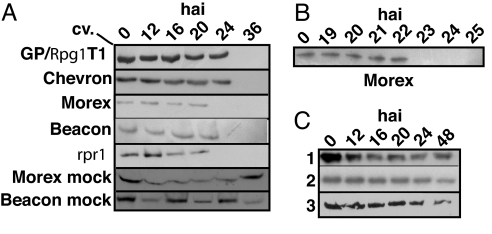
Fig. 1.
Fig. 1.
RPG1 protein disappears between 20 and 24 hai with P. graminis f. sp. tritici avirulent pathotype MCC, whereas it remains stable for at least 36 h in uninoculated samples of Morex and Beacon. (A) Total proteins were extracted and RPG1 visualized on gels as described in Materials and Methods. The lines GP/Rpg1T1 and rpr1 are described in Table 1. Chevron, Q21861, Morex, and Beacon are barley cultivars. Samples were taken at the indicated hai. The RPG1 protein band is 90.2 kDa. (B) Analysis of the RPG1 protein at hourly intervals in Morex showed that it disappears between 22 and 23 h. (C) Degradation of RPG1 is not accompanied by a general proteolysis of cellular proteins after inoculation of Morex with the avirulent pathotype MCC as evidenced from immunoblots showing stability of three enzymes. glutamate-1-semialdehyde aminotransferase (1) glutamyl tRNA synthetase (2), and GST (3).
Fig. 2.
Fig. 2.
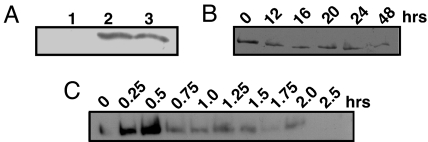
Absence of the RPG1 protein in inoculated leaves is not due to in vitro degradation during processing of the samples or inhibition of mRNA translation. (A) Morex leaves uninoculated and inoculated with Pgt avirulent pathotype MCC were harvested 28 hai and prepared either separately or mixed in equal amounts for immunoblot analysis as described in Materials and Methods. Lane 1: inoculated Morex; lane 2: uninoculated Morex; lane 3: inoculated and uninoculated leaves were mixed together before sample preparation. (B and C) Morex seedling leaves were infiltrated with cycloheximide (100 μg/ml) and incubated with nitrate under continuous light (265 μE/m2s) as described (29). Nitrate reductase has a rapid turnover rate, but it is stably maintained for at least 60 h in nitrate and under lights (29). Samples were taken at indicated time points and analyzed for the presence of either RPG1 or nitrate reductase protein with specific antibodies. (B) Cycloheximide did not affect the RPG1 protein, which was stable for at least 48 h, indicating low turnover rate. (C) Cycloheximide, an inhibitor of translation by cytosolic ribosomes, affected cytosolic nitrate reductase accumulation, which rapidly disappeared to undetectable levels after 2 h, indicating effective cycloheximide treatment. The nitrate reductase protein band is 110 kDa.
Fig. 3.
Fig. 3.
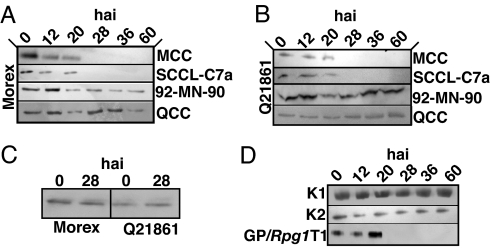
RPG1 disappearance is triggered by avirulent, but not virulent, rust pathotypes and is correlated with resistance to stem rust P. graminis f. sp. tritici. (A and B) The RPG1 protein in Q21861 (carrying resistance genes Rpg1, rpg4, and Rpg5) and Morex (with Rpg1) disappeared upon infection with Pgt pathotypes MCC and SCCL-C7a, avirulent on Rpg1, but not with Pgt pathotype QCC and Pgs isolate 92-MN-90, virulent on Rpg1, but avirulent on rpg4 and Rpg5. (C) RPG1 protein was not degraded upon inoculation of Morex (left lanes) or Q21861 (right lanes) with the virulent stripe rust Puccinia striiformis f. sp. hordei, pathotype, PSH-63. (D) Mutant K1 (KK151, 152NQ) and K2 (KK461, 462NQ) RPG1 protein is not degraded upon infection with the normally avirulent stem rust pathotype MCC, whereas immune transformant GP/Rpg1T1, RPG1 completely disappeared after 20 h. Mutant K1 RPG1 (in the pseudokinase domain) retains kinase activity because of the pK2 domain, whereas mutant K2 RPG1 (in the active kinase domain) is catalytically defunct (24).
Fig. 4.
Fig. 4.
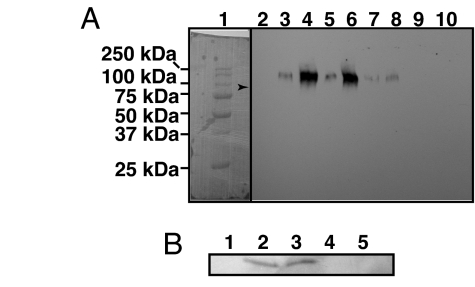
Disappearance of RPG1 is correlated with polyubiquitination. (A) The RPG1 protein is polyubiquitinated in all lines tested except the K2 mutant, and the amount of RPG1 polyubiquitinated is enhanced upon infection with the avirulent pathotype MCC except in mutant K1. The polyubiquitinated protein was prepared from leaves 28 hai and isolated with polyubiquitin affinity resin and separated by SDS/PAGE, and the immunoblots were decorated with RPG1 antibody. Lane 1: molecular weight markers; lane 2: Golden Promise (no RPG1 present); lanes 3, 5, 7, and 9: uninfected Morex, GP/Rpg1T1, K1 mutant, and K2 mutant, respectively; lanes 4, 6, 8, and 10: the same lines but inoculated with the avirulent pathotype MCC. These results indicate that polyubiquitination is completely blocked in the catalytically inactive kinase mutant K2, whereas it occurs at normal levels in the K1 mutant before infection, but it does not respond to the stem rust infection. The polyubiquitinated RPG1 band is of higher molecular mass than the unubiquitinated RPG1 indicated by the arrow. (B) Disappearance of the RPG1 protein is blocked by the proteasome inhibitor MG132 but not by a plant protease inhibitor mixture. Lane 1: Morex infected with P. graminis f. sp. tritici pathotype MCC; lane 2: Morex infiltrated with the proteasome peptide aldehyde inhibitor MG132 in DMSO and infected with pathotype MCC; lane 3: uninfected and untreated Morex; lane 4: Morex infiltrated with plant protease inhibitor mixture, P9599 in DMSO and infected with pathotype MCC; and lane 5: Morex infiltrated with DMSO and infected with pathotype MCC. Immunoblot analysis of extracts 28 hai was carried out with antibody specific for RPG1.

References

    1. Hammond-Kosack KE, Jones JDG. Annu Rev Plant Physiol Plant Mol Biol. 1997;48:575–607. - PubMed
    1. Tang X, Frederick RD, Zhou J, Halterman DA, Yia Y. Science. 1996;274:2060–2063. - PubMed
    1. Ellis JG, Lawrence GJ, Luck JE, Dodds PN. Plant Cell. 1999;11:495–506. - PMC - PubMed
    1. Scofield SR, Tobias CM, Rathjen JP, Chang JH, Lavelle DT, Michelmore RW, Staskawicz BJ. Science. 1996;274:2063–2065. - PubMed
    1. Leister RT, Katagiri F. Plant J. 2000;22:345–354. - PubMed

Publication types

Substances

LinkOut - more resources